


Mechanical Behavior of Materials
Seiten
2005
Cambridge University Press (Verlag)
978-0-521-84670-7 (ISBN)
Cambridge University Press (Verlag)
978-0-521-84670-7 (ISBN)
- Titel erscheint in neuer Auflage
- Artikel merken
Zu diesem Artikel existiert eine Nachauflage
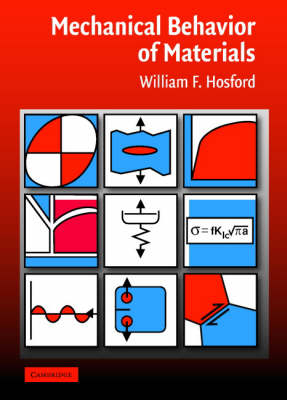
This text for courses on Mechanical Behavior of Materials in Mechanical Engineering and Materials Science, includes numerous examples and problems and emphasizes quantitative problem solving. It considers numerous topics including mechanical testing to determine material properties, plasticity for FEM analyses, means of altering mechanical properties and several modes of failure.
This textbook is for courses on Mechanical Behavior of Materials taught in departments of Mechanical Engineering and Materials Science. The text includes numerous examples and problems for student practice. The book emphasizes quantitative problem solving. End of the chapter notes are included to increase students' interest. This text differs from others because the treatment of plasticity has greater emphasis on the interrelationship of the flow, effective strain and effective stress and their use in conjunction with yield criteria to solve problems. The treatment of defects is new. Schmid's law is generalized for complex stress states. Its use with strains allows for prediction of R-values for textures. Another feature is the treatment of lattice rotations and how they lead to deformation textures. The chapter on fracture mechanics includes coverage of Gurney's approach. Much of the analysis of particulate composites is new. Few texts include anything on metal forming.
This textbook is for courses on Mechanical Behavior of Materials taught in departments of Mechanical Engineering and Materials Science. The text includes numerous examples and problems for student practice. The book emphasizes quantitative problem solving. End of the chapter notes are included to increase students' interest. This text differs from others because the treatment of plasticity has greater emphasis on the interrelationship of the flow, effective strain and effective stress and their use in conjunction with yield criteria to solve problems. The treatment of defects is new. Schmid's law is generalized for complex stress states. Its use with strains allows for prediction of R-values for textures. Another feature is the treatment of lattice rotations and how they lead to deformation textures. The chapter on fracture mechanics includes coverage of Gurney's approach. Much of the analysis of particulate composites is new. Few texts include anything on metal forming.
W. F. Hosford is Professor Emeritus, Materials Science and Engineering, University of Michigan.
1. Stress and strain; 2. Elasticity; 3. Tensile testing; 4. Other tests of plastic behavior; 5. Strain hardening of metals; 6. Plasticity theory; 7. Strain-rate and temperature dependence of flow stress; 8. Slip; 9. Dislocation geometry and energy; 10. Dislocation mechanics; 11. Mechanical twinning; 12. Hardening mechanisms in metals; 13. Ductility and fracture; 14. Fracture mechanics; 15. Viscoelasticity; 16. Creep and stress rupture; 17. Fatigue; 18. Residual stress; 19. Ceramics and glasses; 20. Polymers; 21. Composites; 22. Mechanical working.
| Erscheint lt. Verlag | 2.5.2005 |
|---|---|
| Zusatzinfo | Worked examples or Exercises; 24 Tables, unspecified; 39 Halftones, unspecified; 455 Line drawings, unspecified |
| Verlagsort | Cambridge |
| Sprache | englisch |
| Maße | 182 x 263 mm |
| Gewicht | 950 g |
| Themenwelt | Technik ► Maschinenbau |
| ISBN-10 | 0-521-84670-6 / 0521846706 |
| ISBN-13 | 978-0-521-84670-7 / 9780521846707 |
| Zustand | Neuware |
| Informationen gemäß Produktsicherheitsverordnung (GPSR) | |
| Haben Sie eine Frage zum Produkt? |
Mehr entdecken
aus dem Bereich



aus dem Bereich
Buch | Softcover (2024)
Springer Vieweg (Verlag)
CHF 46,15
Buch | Softcover (2025)
Springer Vieweg (Verlag)
CHF 39,15
Lösungshinweise, Ergebnisse und ausführliche Lösungen
Buch | Softcover (2025)
Springer Fachmedien Wiesbaden GmbH (Verlag)
CHF 41,95


