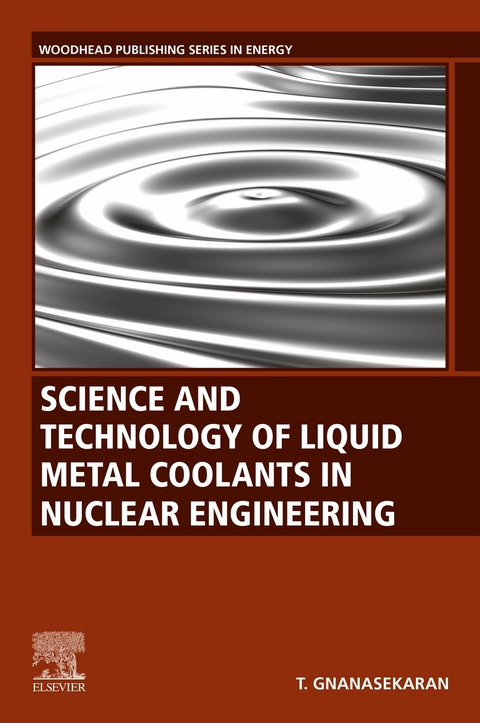
Science and Technology of Liquid Metal Coolants in Nuclear Engineering (eBook)
560 Seiten
Elsevier Science (Verlag)
978-0-323-95867-7 (ISBN)
Dr. T. Gnanasekaran has experience spanning more than 40 years in this field. He has been leading a group of scientists developing facilities for handling sodium, analytical characterisation of sodium and carrying out studies on reactions in liquid metals viz., sodium, lead and lead-bismuth eutectic alloy. He has measured thermochemical properties of various compounds formed in these coolant-structural material systems and established the phase diagrams of relevance for understanding corrosion in these systems. Notable instruments developed by him are sensors for measuring non-metallic impurities in liquid sodium and heavy liquid metals. He has also developed a method to fabricate a high temperature ultrasonic transducer for viewing components immersed in liquid metals. Dr. Gnanasekaran superannuated as Associate Director of the Chemistry Group at IGCAR and was Raja Ramanna Fellow of the centre. He was a Senior Professor at Homi Bhabha National Institute (HBNI) and formulating and conducting chemistry related courses at IGCAR. He is currently one of the editors of Journal of Alloys and Compounds, Elsevier.
Science and Technology of Liquid Metal Coolants in Nuclear Engineering is a comprehensive consolidation of the latest research and knowledge on liquid metal coolants. Over the last decades, various new technologies have been developed for the liquid metal coolants of fast breeder and fusion reactors and accelerator driven systems. Details of pumps and instrumentation used in these coolants and their operating principles are included to provide the reader with a well-rounded understanding of the topic and to guide on the operation of different liquid metal coolant systems. Methods for the safe handling and control of impurity levels in these coolants are clearly discussed, along with alkali metal fires and their management, including methods for safe disposal of sodium waste. - Discusses the thermophysical and chemical properties of liquid metals described with their microscopic origin- Includes methods for the safe handling of liquid metal coolants and their purification and management- Discusses pumps and instrumentation principles and design
| Erscheint lt. Verlag | 17.9.2024 |
|---|---|
| Sprache | englisch |
| Themenwelt | Technik ► Elektrotechnik / Energietechnik |
| ISBN-10 | 0-323-95867-2 / 0323958672 |
| ISBN-13 | 978-0-323-95867-7 / 9780323958677 |
| Informationen gemäß Produktsicherheitsverordnung (GPSR) | |
| Haben Sie eine Frage zum Produkt? |
 EPUB (Adobe DRM)
Kopierschutz: Adobe-DRM
Adobe-DRM ist ein Kopierschutz, der das eBook vor Mißbrauch schützen soll. Dabei wird das eBook bereits beim Download auf Ihre persönliche Adobe-ID autorisiert. Lesen können Sie das eBook dann nur auf den Geräten, welche ebenfalls auf Ihre Adobe-ID registriert sind.
Details zum Adobe-DRM
Dateiformat: EPUB (Electronic Publication)
EPUB ist ein offener Standard für eBooks und eignet sich besonders zur Darstellung von Belletristik und Sachbüchern. Der Fließtext wird dynamisch an die Display- und Schriftgröße angepasst. Auch für mobile Lesegeräte ist EPUB daher gut geeignet.
Systemvoraussetzungen:
PC/Mac: Mit einem PC oder Mac können Sie dieses eBook lesen. Sie benötigen eine
eReader: Dieses eBook kann mit (fast) allen eBook-Readern gelesen werden. Mit dem amazon-Kindle ist es aber nicht kompatibel.
Smartphone/Tablet: Egal ob Apple oder Android, dieses eBook können Sie lesen. Sie benötigen eine
Geräteliste und zusätzliche Hinweise
Buying eBooks from abroad
For tax law reasons we can sell eBooks just within Germany and Switzerland. Regrettably we cannot fulfill eBook-orders from other countries.
aus dem Bereich