


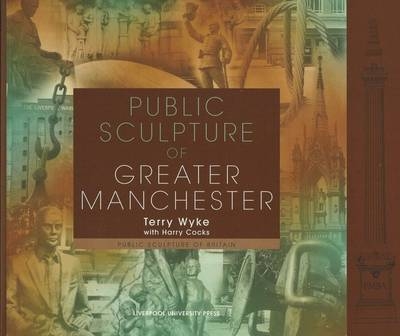
Public Sculpture of Greater Manchester
Seiten
2004
Liverpool University Press (Verlag)
978-0-85323-557-6 (ISBN)
Liverpool University Press (Verlag)
978-0-85323-557-6 (ISBN)
- Titel ist leider vergriffen;
keine Neuauflage - Artikel merken
Covering the area formerly administered by the Greater Manchester Metropolitan Council, this title focuses on the communities at the heart of the industrial revolution in Britain (Manchester, Salford, Bolton, Bury, Oldham, Rochdale, Stockport, Tameside, Trafford and Wigan), exploring both the connections and the differences among them.
Covering the area formerly administered by the Greater Manchester Metropolitan Council, Public Sculpture of Greater Manchester focuses on the communities at the heart of the industrial revolution in Britain (Manchester, Salford, Bolton, Bury, Oldham, Rochdale, Stockport, Tameside, Trafford and Wigan), exploring both the connections and the differences among them. Although Manchester’s first free-standing public statue – Francis Chantrey’s portrait of the scientist John Dalton – dates from 1838, it was the wave of public commemoration following the death of Sir Robert Peel in 1850 that proved the decisive event for public statuary in the region, with statues being raised to Peel in Manchester, Salford and Bury. Salford’s Peel Park, opened in 1846, displayed one of the first groups of public statues in Britain. Politics were never far away, with the placing of statues of three living Liberals – Gladstone, Bright and Villiers – in Manchester town hall (also famous for Ford Madox Brown’s murals) marking the strong association of the area with free trade policies. Harry Bates’s Socrates Teaching the People in the Agora, at Manchester University, is one of the most significant examples of the ‘New Sculpture’; notable twentieth-century works include Eric Gill’s relief St Mary, St Denys, St George and the Christ Child for Manchester Cathedral and Barbara Hepworth’s Two Forms (Divided Circle) in Bolton. The 30-mile Irwell Sculpture Trail, following the River Irwell from Salford Quays through Bury to the Pennines, is one of the most ambitious contemporary public art programmes in Britain and has commissioned sculpture from regional, national and international artists. Winner of the Portico Prize for Literature 2004.
Covering the area formerly administered by the Greater Manchester Metropolitan Council, Public Sculpture of Greater Manchester focuses on the communities at the heart of the industrial revolution in Britain (Manchester, Salford, Bolton, Bury, Oldham, Rochdale, Stockport, Tameside, Trafford and Wigan), exploring both the connections and the differences among them. Although Manchester’s first free-standing public statue – Francis Chantrey’s portrait of the scientist John Dalton – dates from 1838, it was the wave of public commemoration following the death of Sir Robert Peel in 1850 that proved the decisive event for public statuary in the region, with statues being raised to Peel in Manchester, Salford and Bury. Salford’s Peel Park, opened in 1846, displayed one of the first groups of public statues in Britain. Politics were never far away, with the placing of statues of three living Liberals – Gladstone, Bright and Villiers – in Manchester town hall (also famous for Ford Madox Brown’s murals) marking the strong association of the area with free trade policies. Harry Bates’s Socrates Teaching the People in the Agora, at Manchester University, is one of the most significant examples of the ‘New Sculpture’; notable twentieth-century works include Eric Gill’s relief St Mary, St Denys, St George and the Christ Child for Manchester Cathedral and Barbara Hepworth’s Two Forms (Divided Circle) in Bolton. The 30-mile Irwell Sculpture Trail, following the River Irwell from Salford Quays through Bury to the Pennines, is one of the most ambitious contemporary public art programmes in Britain and has commissioned sculpture from regional, national and international artists. Winner of the Portico Prize for Literature 2004.
Terry Wyke is Senior Lecturer in Social & Economic History, Manchester Metropolitan University.
Preface
Introduction
Acknowledgements
Sources of Illustrations
Public Sculpture of Greater Manchester
Manchester
Salford
Bolton
Bury
Oldham
Rochdale
Stockport
Tameside
Trafford
Wigan
Glossary
Selected Biographies
Bibliography
Index
| Reihe/Serie | Public Sculpture of Britain ; 8 |
|---|---|
| Verlagsort | Liverpool |
| Sprache | englisch |
| Maße | 250 x 220 mm |
| Gewicht | 1696 g |
| Themenwelt | Kunst / Musik / Theater ► Malerei / Plastik |
| Technik ► Architektur | |
| ISBN-10 | 0-85323-557-0 / 0853235570 |
| ISBN-13 | 978-0-85323-557-6 / 9780853235576 |
| Zustand | Neuware |
| Informationen gemäß Produktsicherheitsverordnung (GPSR) | |
| Haben Sie eine Frage zum Produkt? |
Mehr entdecken
aus dem Bereich


aus dem Bereich
Katalog, Fondation Louis Vuitton. Deutsche Ausgabe, Paris 2025.
Buch | Hardcover (2025)
Schirmer Mosel (Verlag)
CHF 62,90


