


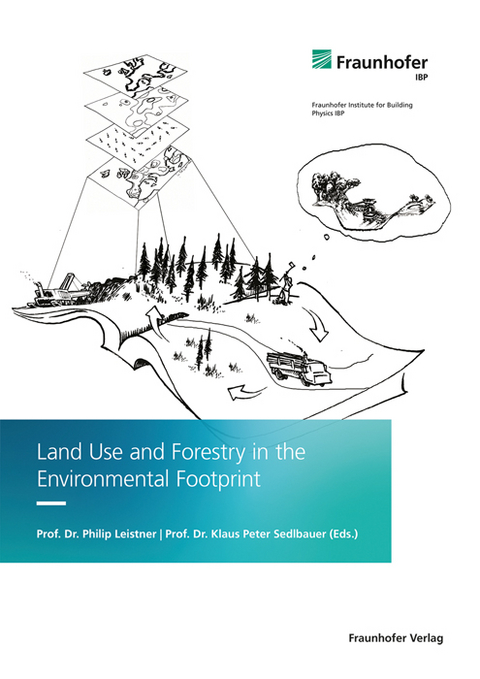
Land Use And Forestry In The Environmental Footprint
Seiten
Land use is a key driver of anthropogenic environmental impact. Its consideration in Life Cycle Assessment is complex and requires expert involvement. This report focuses on land use impact assessment methods applied to forestry. It investigates of the UNEP SETAC land use framework, the Environmental Footprint and the LANCA® framework. Building on these, recommendations for method developers and practitioners are provided and applied exemplarily.
Land using practices are at the core of many human activities with an impact on the environment. Its consideration in methods such as Life Cycle Assessment (LCA) is complex and oftentimes requires experts to perform studies and understand results.
This report focuses on land use impact assessment methods in LCA studies applied to forestry. It presents an in-depth investigation of the state of the art in forestry modelling and LCA, considering the EFISCEN space forest model, the UNEP/SETAC land use framework, the European Commissions' Environmental footprint, and the Fraunhofer LANCA® framework. Building on these, recommendations are provided for the modelling framework, the improvement of existing and the introduction of new indicators. Improvements for LANCA® are presented and Soil Organic Carbon (SOC) as well as Human Appropriated Net Primary Production (HANPP) are introduced as new indicators. The improved framework is applied to an exemplary case study using different modelling approaches based on EFISCEN space. The findings are finally condensed in a recommendation section for developers, practitioners, stakeholders, and policymakers.
Land using practices are at the core of many human activities with an impact on the environment. Its consideration in methods such as Life Cycle Assessment (LCA) is complex and oftentimes requires experts to perform studies and understand results.
This report focuses on land use impact assessment methods in LCA studies applied to forestry. It presents an in-depth investigation of the state of the art in forestry modelling and LCA, considering the EFISCEN space forest model, the UNEP/SETAC land use framework, the European Commissions' Environmental footprint, and the Fraunhofer LANCA® framework. Building on these, recommendations are provided for the modelling framework, the improvement of existing and the introduction of new indicators. Improvements for LANCA® are presented and Soil Organic Carbon (SOC) as well as Human Appropriated Net Primary Production (HANPP) are introduced as new indicators. The improved framework is applied to an exemplary case study using different modelling approaches based on EFISCEN space. The findings are finally condensed in a recommendation section for developers, practitioners, stakeholders, and policymakers.
| Erscheinungsdatum | 04.06.2022 |
|---|---|
| Zusatzinfo | num., col. illus. and tab. |
| Verlagsort | Stuttgart |
| Sprache | englisch |
| Maße | 210 x 297 mm |
| Themenwelt | Naturwissenschaften ► Biologie ► Ökologie / Naturschutz |
| Technik | |
| Weitere Fachgebiete ► Land- / Forstwirtschaft / Fischerei | |
| Schlagworte | A • forestry • Forstwirte • LCA-Anwender • LCA-Experten • Politiker • pollution • sustainability • Threats to the environment |
| ISBN-10 | 3-8396-1771-5 / 3839617715 |
| ISBN-13 | 978-3-8396-1771-7 / 9783839617717 |
| Zustand | Neuware |
| Informationen gemäß Produktsicherheitsverordnung (GPSR) | |
| Haben Sie eine Frage zum Produkt? |
Mehr entdecken
aus dem Bereich

aus dem Bereich
Gewinnung - Aufbereitung - Speicherung - Verteilung
Buch | Softcover (2022)
Springer Vieweg (Verlag)
CHF 55,95
Methoden – Lösungen – Anwendungen
Buch | Hardcover (2025)
Hanser (Verlag)
CHF 69,95


