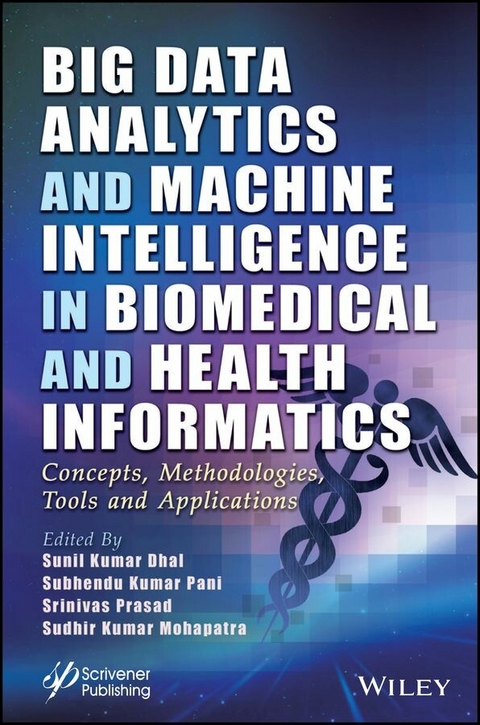
Big Data Analytics and Machine Intelligence in Biomedical and Health Informatics (eBook)
John Wiley & Sons (Verlag)
978-1-119-79235-2 (ISBN)
Provides coverage of developments and state-of-the-art methods in the broad and diversified data analytics field and applicable areas such as big data analytics, data mining, and machine intelligence in biomedical and health informatics.
The novel applications of Big Data Analytics and machine intelligence in the biomedical and healthcare sector is an emerging field comprising computer science, medicine, biology, natural environmental engineering, and pattern recognition. Biomedical and health informatics is a new era that brings tremendous opportunities and challenges due to the plentifully available biomedical data and the aim is to ensure high-quality and efficient healthcare by analyzing the data.
The 12 chapters in??Big Data Analytics and Machine Intelligence in Biomedical and Health Informatics??cover the latest advances and developments in health informatics, data mining, machine learning, and artificial intelligence. They have been organized with respect to the similarity of topics addressed, ranging from issues pertaining to the Internet of Things (IoT) for biomedical engineering and health informatics, computational intelligence for medical data processing, and Internet of Medical Things??(IoMT).
New researchers and practitioners working in the field will benefit from reading the book as they can quickly ascertain the best performing methods and compare the different approaches.
Audience
Researchers and practitioners working in the fields of biomedicine, health informatics, big data analytics, Internet of Things, and machine learning.
Sunil Kumar Dhal, PhD, is a computer scientist and is Head of Department and professor in the Faculty of Management, Sri Sri University, India. He has more than 20 years of teaching experience with more than 60 international publications including eight books and two patents.
Subhendu Kumar Pani, PhD, is a professor in the Department of Computer Science & Engineering, Orissa Engineering College (OEC) Bhubaneswar, India. He has more than 15 years of teaching and research experience and has published more than 50 international journal articles as well as five authored books, 12 edited books, and eight patents.
Srinivas Prasad, PhD, is a professor in the Department of Computer Science and Engineering at GITAM University, Visakhapatnam, India. He has more than 20 years of teaching experience and published more than 60 publications which include journal articles, conference papers, edited volumes, and book chapters.
Sudhir Kumar Mohapatra, PhD, is an associate professor at Addis Ababa Science & Technology University, Addis Ababa, Ethiopia. Besides 10 years of teaching and research, he spent five years in software development in the banking and education domains.
BIG DATA ANALYTICS AND MACHINE INTELLIGENCE IN BIOMEDICAL AND HEALTH INFORMATICS Provides coverage of developments and state-of-the-art methods in the broad and diversified data analytics field and applicable areas such as big data analytics, data mining, and machine intelligence in biomedical and health informatics. The novel applications of Big Data Analytics and machine intelligence in the biomedical and healthcare sector is an emerging field comprising computer science, medicine, biology, natural environmental engineering, and pattern recognition. Biomedical and health informatics is a new era that brings tremendous opportunities and challenges due to the plentifully available biomedical data and the aim is to ensure high-quality and efficient healthcare by analyzing the data. The 12 chapters in??Big Data Analytics and Machine Intelligence in Biomedical and Health Informatics??cover the latest advances and developments in health informatics, data mining, machine learning, and artificial intelligence. They have been organized with respect to the similarity of topics addressed, ranging from issues pertaining to the Internet of Things (IoT) for biomedical engineering and health informatics, computational intelligence for medical data processing, and Internet of Medical Things??(IoMT). New researchers and practitioners working in the field will benefit from reading the book as they can quickly ascertain the best performing methods and compare the different approaches. Audience Researchers and practitioners working in the fields of biomedicine, health informatics, big data analytics, Internet of Things, and machine learning.
Sunil Kumar Dhal, PhD, is a computer scientist and is Head of Department and professor in the Faculty of Management, Sri Sri University, India. He has more than 20 years of teaching experience with more than 60 international publications including eight books and two patents. Subhendu Kumar Pani, PhD, is a professor in the Department of Computer Science & Engineering, Orissa Engineering College (OEC) Bhubaneswar, India. He has more than 15 years of teaching and research experience and has published more than 50 international journal articles as well as five authored books, 12 edited books, and eight patents. Srinivas Prasad, PhD, is a professor in the Department of Computer Science and Engineering at GITAM University, Visakhapatnam, India. He has more than 20 years of teaching experience and published more than 60 publications which include journal articles, conference papers, edited volumes, and book chapters. Sudhir Kumar Mohapatra, PhD, is an associate professor at Addis Ababa Science & Technology University, Addis Ababa, Ethiopia. Besides 10 years of teaching and research, he spent five years in software development in the banking and education domains.
Preface
Introduction
The novel applications of Big Data Analytics and machine intelligence in biomedical and healthcare sector can be regarded as an emerging field in computer science, medicine, biology application, natural environmental engineering, and pattern recognition. The use of various Data Analytics and intelligence techniques are nowadays successfully implemented in many healthcare sectors. Biomedical and Health Informatics is a new era that brings tremendous opportunities and challenges due to easily available plenty of biomedical data. Machine learning presenting tremendous improvement in accuracy, robustness, and cross-language generalizability over conventional approaches. The aim of healthcare informatics is to ensure the high-quality, efficient healthcare, better treatment and quality of life by efficiently analyzing the abundant biomedical, and healthcare data. Earlier, it was common requirements to have a domain expert to develop a model for biomedical or healthcare; but now the patterns are learned automatically for prediction. Due to the rapid advances in intelligent algorithms have established the growing significance in healthcare data analytics. The IoT focuses to the common idea of things that is recognizable, readable, locatable, controllable, and addressable via the Internet. Intelligent Learning aims to provide computational methods for accumulating, updating and changing knowledge in the intelligent systems and particularly learning mechanisms that help us to induce knowledge from the data. It is helpful in cases where direct algorithmic solutions are unavailable, there is lack of formal models, or the knowledge about the application domain is inadequately defined. In Future Big data analytics has the impending capability to change the way we work and live. With the influence and the development of the Big Data, IoT concept, the need for AI (Artificial Intelligence) techniques has become more significant than ever. The aim of these techniques is to accept imprecision, uncertainties and approximations to get a rapid solution. However, recent advancements in representation of intelligent system generate a more intelligent and robust system providing a human interpretable, low-cost, approximate solution. Intelligent systems have demonstrated great performance to a variety of areas including big data analytics, time series, biomedical and health informatics etc.
This book covers the latest advances and developments in health informatics, data mining, machine learning and artificial intelligence, fields which to a great extent will play a vital role in improving human life. All the researchers and practitioners will be highly benefited those are working in field of biomedical, health informatics, Big Data Analytics, IoT and Machine Learning. This book would be a good collection of state-of-the-art approaches for Big Data and Intelligent based biomedical and health related applications. It will be very beneficial for the new researchers and practitioners working in the field to quickly know the best performing methods. They would be able to compare different approaches and can carry forward their research in the most important area of research which has direct impact on betterment of the human life and health. This book would be very useful because there is no book in the market which provides a good collection of state-of-the-art methods of Big Data, machine learning and IoT in Biomedical and Health Informatics. Various models for biomedical and health informatics is recently emerged and very unmatured field of research in biomedical and healthcare. This book would be very useful because there is no book in the market which provides a good collection of state-of-the-art methods of for Big data analytics based models for healthcare.
Organization of the Book
The 12 chapters of this book present scientific concepts, frameworks and ideas on biomedical data analytics from the different biomedical domains. The Editorial Advisory Board and expert reviewers have ensured the high caliber of the chapters through careful refereeing of the submitted papers. For the purpose of coherence, we have organized the chapters with respect to similarity of topics addressed, ranging from issues pertaining to the internet of things for biomedical engineering and health informatics, computational intelligence for medical data processing and Internet of medical things.
In Chapter 1, “An Introduction to Big Data Analytics Techniques in Healthcare”. Anil Audumbar Pise presents the use of big data analytics in medicine and healthcare which is incredibly powerful, productive, interesting, and diverse. It integrates heterogeneous data like medical records, experimental, electronic health, and social data in order to explore the relations among the different characteristics and traces of data points like diagnoses and medication dosages, along with information such as public chatter to derive conclusions about outcomes. More diverse data needs to be combined into big data analysis, such as bio-sciences, sensor informatics, medical informatics, bioinformatics, and health computational biomedicine to get the truth out of its information.
In Chapter 2, “Identify Determinants of Infant and Child Mortality Based Using Machine Learning: Case Study on Ethiopia” Sudhir Kumar Mohapatra, Srinivas Prasad, Getachew Mekuria Habtemariam, Mohammed Siddique developed predictive models using four supervised machine learning techniques namely C5.0 Decision tree, Random Forest, Support Vector Machine and Naïve Bayes algorithms using the 2016 EDHS dataset of 10,641 records. The Ethiopian government doing for the past two decades for attaining millennium development goals agenda for preventing childhood mortality by improving the child health’s to change the country image to the rest of the world in reduction of childhood mortality. This study contributes some values in the improvement of childhood health by analyzing the determinants infant and child mortality by using machine learning techniques. Different reports indicate that the distribution of childhood mortality differs in the world.
In Chapter 3, “Pre-Trained CNN Models in Early Alzheimer’s Prediction Using Post-Processed MRI” Kalyani Gunda and Pradeepini Gera test MRI Scan with Dementia or Not by Non-image MRI Evidence using Random Forest Classifier which obtained 87% accuracy without false prediction and also by predicting Alzheimer’s Progression using advanced CNN models. Gentle Dementia is more focused to train the Early Detection by omitting converted MRI Sessions. Various Transfer Learning Deep Neural Networks like Residual Network (ResNet50), GoogleNet, VGG19 (Visual Geometric Group), MobileNet, AlexNet is compared to classify Alzheimer’s. Model comparison evaluated to explicate model efficacy.
In Chapter 4, “Robust Segmentation Algorithms for Retinal Blood Vessels, Optic Disc, and Optic Cup of Retinal Images in Medical Imaging” Birendra Biswal, Raveendra T., Dwiti Krishna Bebarta, Geetha Pavani P. and P.K. Biswal discussed the several robust segmentation algorithms such as a new statistical-based Kurtosis test, a novel hybrid active contour method with a new pre-processing technique is applied to fundus images of human eyes for observing the changes in Retinal Blood Vessels and Optic Disc & Optic Cup to classify as healthy or diseased eyes. For validating all these robust segmentation algorithms standard metrics are used in evaluating the performance of segmentation models. Consequently, the experimental result and comparison analysis are presented to estimate the efficacy of the proposed algorithm. As a result, standard metrics of the proposed algorithm were compared with many other previous methods suggested by various researchers and it is confirmed as to attain better efficacy values.
In Chapter 5, “Analysis of Healthcare Systems Using Computational Approaches” Hemanta Kumar Bhuyan and Subhendu Kumar Pani highlight recent contributions and efficiency of AI and ML in computer systems development for better healthcare and precision medicine. Despite various traditional and AI-based solutions, current healthcare constraints and challenges include uneven distribution of resources towards the future of digital healthcare. Unmet clinical research and data analytics requires the development of intelligent and secure systems to support the transformation of practices for the worldwide application of precision medicine. Overarching goals include new multifunctional platforms that incorporate heterogeneous clinical data from multiple platforms based on clinical, AI, and technical premises. It must address possible challenges that continue to slow the progress of this breakthrough approach.
In Chapter 6, “Expert Systems in Behavioral and Mental Healthcare: Applications of AI in Decision-Making and Consultancy” Shrikaant Kulkarni Present the latest technological advancements so as to showcase futuristic challenges and a glance at potential innovations on the horizon. The treatise enumerates the expert systems in behavioral and mental healthcare areas. It also further discusses the benefits AI can offer to behavioral and mental healthcare.
In Chapter 7, “A Mathematical-Based Epidemic Model to Prevent and Control Outbreak of Corona Virus 2019 (COVID-19)” Shanmuk Srinivas Amiripalli, Vishnu Vardhan Reddy Kollu, Ritika Prasad, Mukkamala S.N.V. Jitendra provide a preliminary evolutionary graph theory based mathematical model was designed for control and prevention of COVID-19. In the proposed model, well known technique of social distancing with different...
| Erscheint lt. Verlag | 20.5.2022 |
|---|---|
| Reihe/Serie | Advances in Intelligent and Scientific Computing | Advances in Intelligent and Scientific Computing |
| Sprache | englisch |
| Themenwelt | Informatik ► Theorie / Studium ► Künstliche Intelligenz / Robotik |
| Technik ► Umwelttechnik / Biotechnologie | |
| Schlagworte | AI • Alzheimer's 4-Class-Image-Dataset • Alzheimer's disease • and Optic Cup of Retinal Images in Medical Imaging • Artificial Intelligence • Big Data • biomedical engineering • Biomedical engineering and health informatics • Biomedizinische Informatik • Biomedizintechnik • Classification Reports • computational intelligence for medical data processing • Computer Science • data analytics • data model • Deep learning • early Alzheimer's prediction • graph machine learning • Informatics • Informatik • Informatik in der Radiologie • Internet of Medical Things • KI • Künstliche Intelligenz • Machine Learning and Transfer Learning • Medical Informatics & Biomedical Information Technology • Medical Science • Medizin • Medizininformatik u. biomedizinische Informationstechnologie • Medizinische Informatik • OASIS Dataset • Optic disc • patiotemporal data mining • Random Forest Classifier MobileNetV2 • Retinal Blood Vessels |
| ISBN-10 | 1-119-79235-5 / 1119792355 |
| ISBN-13 | 978-1-119-79235-2 / 9781119792352 |
| Informationen gemäß Produktsicherheitsverordnung (GPSR) | |
| Haben Sie eine Frage zum Produkt? |
 EPUB (Adobe DRM)
Kopierschutz: Adobe-DRM
Adobe-DRM ist ein Kopierschutz, der das eBook vor Mißbrauch schützen soll. Dabei wird das eBook bereits beim Download auf Ihre persönliche Adobe-ID autorisiert. Lesen können Sie das eBook dann nur auf den Geräten, welche ebenfalls auf Ihre Adobe-ID registriert sind.
Details zum Adobe-DRM
Dateiformat: EPUB (Electronic Publication)
EPUB ist ein offener Standard für eBooks und eignet sich besonders zur Darstellung von Belletristik und Sachbüchern. Der Fließtext wird dynamisch an die Display- und Schriftgröße angepasst. Auch für mobile Lesegeräte ist EPUB daher gut geeignet.
Systemvoraussetzungen:
PC/Mac: Mit einem PC oder Mac können Sie dieses eBook lesen. Sie benötigen eine
eReader: Dieses eBook kann mit (fast) allen eBook-Readern gelesen werden. Mit dem amazon-Kindle ist es aber nicht kompatibel.
Smartphone/Tablet: Egal ob Apple oder Android, dieses eBook können Sie lesen. Sie benötigen eine
Geräteliste und zusätzliche Hinweise
Buying eBooks from abroad
For tax law reasons we can sell eBooks just within Germany and Switzerland. Regrettably we cannot fulfill eBook-orders from other countries.
aus dem Bereich