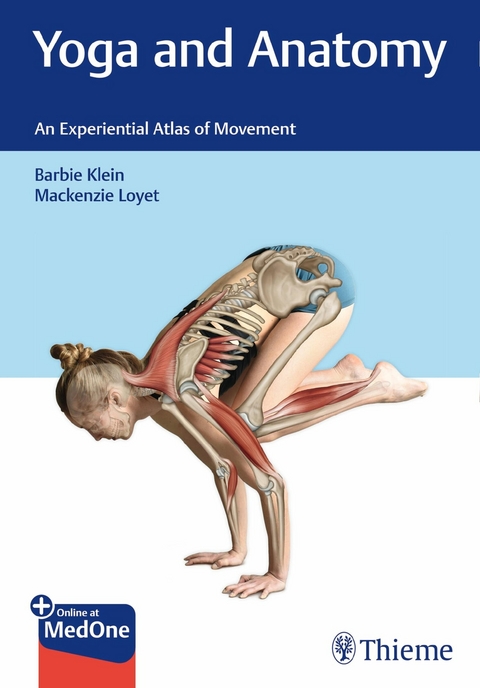
Yoga and Anatomy (eBook)
206 Seiten
Georg Thieme Verlag KG
978-1-63853-540-9 (ISBN)
1 Standing Poses
Chair (Utkatasana)
Summary of the Pose
Translated as “Awkward or Ferocious Pose”, this standing posture resembles sitting toward the back of a chair and strengthens the muscles of the core, hip flexors, and hamstrings.
Modifications: Bring your palms to touch overhead and look up for an additional neck stretch. Place a block between your thighs to promote internal rotation of both femurs. If you experience shoulder pain, practice this pose with both hands at your sternum.
Guided Narrative
Transition 1: Mountain
• Begin in anatomical position by standing with feet hips-width distance apart, aligned directly under your pelvic bones.
• Press evenly through both calcanei and the heads of all five metatarsals.
• Use supinator (Fig. 10.13) in both forearms to rotate your palms anteriorly.
• Your ascending fibers of trapezius (Fig. 10.7) work to depress the scapulae and draw your scapulae down your back.
• Engage your quadriceps femoris (Fig. 11.1) to lift your patellae proximally.
• Tighten your core and use your abdominal muscles (Fig. 9.5) to draw in your umbilicus and stabilize your trunk.
.....................................................
Transition 2: Upward Hand
• Inhale and abduct your arms overhead, using supraspinatus and deltoid (Fig. 10.2).
• Engage the transverse part of your trapezius to draw your scapulae medially retracting your scapulae. Your rhomboid major and rhomboid minor (Fig. 10.8) will also contribute to this medial movement of your scapulae.
• Rotate your palms to face each other, using your infraspinatus and teres minor muscles of the rotator cuff (Fig. 10.4) to laterally rotate the humerus.
• Note that your radial nerve assists with extension through your elbows, wrists, and fingers by innervating the muscles of the posterior compartments of your arm and forearm.
Transition 1: Mountain
Transition 2: Upward Hand
Final Pose: Chair
• While maintaining the extension of the upper body using triceps brachii (Fig. 10.11) and the muscles of the posterior compartment of your forearm, begin to flex both hip and knee joints and sit back. Feel rectus femoris, sartorius, and tensor fasciae latae (Fig. 11.1) flexing at the hip joints while your hamstrings (Fig. 11.4) flex both knees.
• Engage your adductor muscles to draw your knees together while gluteus medius (Fig. 11.4) helps to internally rotate the hips.
• Rock weight into the calcanei of both feet. Option to extend all ten toes offthe mat to challenge your balance and feel the dorsiflexors of the anterior compartment of the leg contracting, and then release your toes back to the mat.
• On both arms lifted, the inferior part of serratus anterior (Fig. 10.6) is working to upwardly rotate your scapulae.
• On every inhalation, work on reaching your fingers higher toward the ceiling while continuing to depress your scapulae. Sit back further with every exhalation, flexing more at the knees (as is comfortable).
• Extend your knees and hips, then lower your arms back into anatomical position to release from this pose.
______________________________________________________________
Final Pose: Chair
Warrior I (Virabhadrasana I)
Summary of the Pose
Named after the Sanskrit word vira, meaning hero, this is a foundational pose in yoga that strengthens the ankles, calves, hips, abdominals, and low back.
Modifications: If you experience shoulder pain, press your palms together anterior to your sternum. You may also shorten the distance between your front and back foot to decrease the intensity of the hip stretch.
Guided Narrative
Transition 1: Forward Fold
• From anatomical position, with your feet together or hips-width distance apart, contract your abdominals (Fig. 9.7) to flex your vertebral column and fold at your hips bringing your chest toward your thighs.
• Place your hands on the mat; if the ground seems far away, flex your knees or place your palms on blocks.
• Lift your patellae proximally by contracting quadriceps femoris (Fig. 11.1) to feel a deep stretch across your hamstrings (Fig. 11.1).
• Relax your head and neck and gaze between your legs. Only go as a deep in this fold as you are comfortable.
• As you press into the mat or blocks, notice triceps brachii (Fig. 10.10) working to extend your elbows.
..........................................
Transition 2: Low Lunge
• Use your left hamstrings and gluteus maximus (Fig. 11.8) to extend your thigh placing your left foot near the back of your mat.
• Ensure that the patella of your right knee is aligned superior to your right ankle.
• Contract your abdominals to flex your vertebral column and draw your umbilicus up and in, away from your right thigh.
• Bilaterally contract trapezius supplied by the spinal accessory nerve (cranial nerve XI), splenius capitis, and longissimus capitis (Fig. 8.2) to slightly extend your head and neck to gaze a few inches in front of your mat.
• As you push into the ground, feel serratus anterior (Fig. 10.6) protract your scapulae and notice that deltoid and the muscles of the rotator cuff (Fig. 10.4) help to stabilize the shoulder joint.
Transition 1: Forward Fold
Transition 2: Low Lunge
Final Pose: Warrior I
• On an inhalation, rotate your back foot to about a 45-degree angle and bring yourself up by ipsilaterally contracting your left abdominal obliques (Fig. 9.7) and erector spinae to laterally flex your torso.
• Engage quadriceps femoris in your back left leg to extend your left knee. Maintain the flexion in your right knee and knee above ankle alignment from Low Lunge.
• Use your adductors, including gracilis (Fig. 11.3), to adduct both thighs toward the midline.
• Inhale and flex both arms overhead, utilizing the clavicular part of deltoid (innervated by the axillary nerve) and biceps brahii (innervated by the musculocutaneous nerve). Feel a stretch in your abdominal obliques.
• The middle and ascending fibers of trapezius work to draw both scapulae medially and downward (Fig. 10.7) while triceps brachii extends your forearms. Point your fingers toward the ceiling by contracting extensor digitorum.
• On an exhalation, step your left foot to meet your right at the top of the mat and repeat this sequence on the other side.
______________________________________________________________
Final Pose: Warrior I
Warrior II (Virabhadrasana II)
Summary of the Pose
Named after a warrior scouting out their prey, this standing pose stretches the muscles and ligaments around the hip joints as well as the muscles across the chest and shoulders.
Modifications: Individuals with neck pain should avoid rotating their head in this pose. If maintaining your balance while standing in this pose is challenging, try Warrior II while seated at the edge of a chair for support.
Guided Narrative
Transition 1: Three-legged Down Dog
• From Downward Facing Dog, use gluteus maximus and the hamstrings (Fig. 11.4) to extend your right thigh at the hip, lifting your right leg into the air.
• Push your palms into the mat and feel serratus anterior protracting your scapulae and trapezius (Fig. 10.7) depressing your scapulae, creating space between the ears and shoulders.
• Feel both quadriceps femoris (Fig. 11.1) extend your knees and a stretch across the muscles of the posterior compartment of your grounded left leg.
• Use tibialis anterior (Fig. 11.14) to dorsiflex your right foot...
| Erscheint lt. Verlag | 5.8.2020 |
|---|---|
| Verlagsort | Stuttgart |
| Sprache | englisch |
| Themenwelt | Medizin / Pharmazie ► Medizinische Fachgebiete ► Chirurgie |
| Medizin / Pharmazie ► Physiotherapie / Ergotherapie ► Rehabilitation | |
| Studium ► 1. Studienabschnitt (Vorklinik) ► Anatomie / Neuroanatomie | |
| Technik | |
| Schlagworte | anatomy • Asanas • Atlas • Head and Neck • Lower Limb • muscle action • muscle innervation • muscle insertion • muscle origin • Trunk • Upper Limb • Yoga • yoga anatomy • yoga poses |
| ISBN-10 | 1-63853-540-X / 163853540X |
| ISBN-13 | 978-1-63853-540-9 / 9781638535409 |
| Informationen gemäß Produktsicherheitsverordnung (GPSR) | |
| Haben Sie eine Frage zum Produkt? |
 EPUB (Wasserzeichen)
DRM: Digitales Wasserzeichen
Dieses eBook enthält ein digitales Wasserzeichen und ist damit für Sie personalisiert. Bei einer missbräuchlichen Weitergabe des eBooks an Dritte ist eine Rückverfolgung an die Quelle möglich.
Dateiformat: EPUB (Electronic Publication)
EPUB ist ein offener Standard für eBooks und eignet sich besonders zur Darstellung von Belletristik und Sachbüchern. Der Fließtext wird dynamisch an die Display- und Schriftgröße angepasst. Auch für mobile Lesegeräte ist EPUB daher gut geeignet.
Systemvoraussetzungen:
PC/Mac: Mit einem PC oder Mac können Sie dieses eBook lesen. Sie benötigen dafür die kostenlose Software Adobe Digital Editions.
eReader: Dieses eBook kann mit (fast) allen eBook-Readern gelesen werden. Mit dem amazon-Kindle ist es aber nicht kompatibel.
Smartphone/Tablet: Egal ob Apple oder Android, dieses eBook können Sie lesen. Sie benötigen dafür eine kostenlose App.
Geräteliste und zusätzliche Hinweise
Buying eBooks from abroad
For tax law reasons we can sell eBooks just within Germany and Switzerland. Regrettably we cannot fulfill eBook-orders from other countries.
aus dem Bereich