


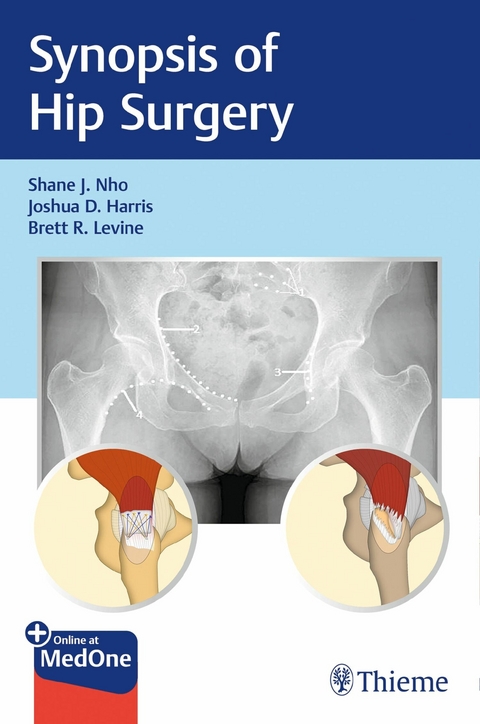
Synopsis of Hip Surgery (eBook)
Thieme Medical Publishers (Verlag)
9781638534730 (ISBN)
1 | Anatomy of the Hip and Surgical ApproachesBrian R. Waterman, Edward C. Beck, Gift Echefu, Ian Clapp, William H. Neal, Shane J. Nho |
Basic Anatomy of the Hip and Pelvis
Femur
I. The femur bone is a near-cylindrical long bone with high cortical bone density, separated from each other by the breadth of the pelvis. The anterior femoral bow is angled medially for relative valgus alignment. There is a gender difference in pelvic breadth, with it being wider in females.
II. It is divided into the body and two extremities, upper and lower (Fig. 1.1).
A. The upper extremity consists of the head, neck, and greater and lesser trochanter:
1. The head:
a. It is globular, convex, and hemispheric. It is superiorly, medially, and slightly anterior directed.
b. It has a smooth, articular surface covered in hyaline cartilage normally.
c. The fovea capitis is a small, concave, depression within the medial side of the head, directed superior to posteroinferiorly. It is deficient in articular cartilage and provides attachment for the ligamentum teres: the acetabular branch of the obturator artery runs within and disruption results in avascular necrosis of the head.
2. Neck:
a. The neck is relatively flat and pyramidal. It connects the head to the shaft of the femur.
b. It is flattened anterior to posterior, constricted in the middle, and broadens from medial to lateral.
c. The anterior surface is perforated by numerous vascular foramina. Along the junction of the anterior surface with the head is a shallow groove. It is prominent in the elderly and provides attachment to orbicular fibers of the hip joint capsule.
d. The inferior border, long and narrow, curves slightly posteriorly and ends at the lesser trochanter.
e. The angle of inclination is formed by intersection of a line drawn along the shaft of the femur and a line drawn down the neck of the femur. It is widest in infancy and decreases with age. The normal angle is between 120 degrees and 125 degrees. It shows height and gender variability: less in shorter individuals and right angle in females than in males. Angle greater than 125 degrees results in coxa valga, and decreased angle results in coxa vara.
Fig. 1.1 The right femur: anterior (a) and posterior (b) views. (Source: Schuenke M, Schulte E, Schumacher U. Thieme Atlas of Anatomy. General Anatomy and Musculoskeletal System. 2nd edition, ©2014, Thieme Publishers, New York. Illustrations by Voll M and Wesker K.)
3. The trochanter is divided into lesser and greater trochanters; they are connected by the intertrochanteric line.
a. The lesser trochanter is a conical eminence. From its apex, three borders extend: medial, lateral, and inferior. The inferior border is continuous with the middle division of the linea aspera. The apex provides attachment to the psoas major muscle.
b. The greater trochanter is a large, irregular, quadrilateral eminence. It is located at the junction of the neck with the upper part of the body. It has two surfaces (medial and lateral surfaces) and four borders (superior, inferior, anterior, and posterior borders).
B. Lower extremity:
1. The distal end of the femur is cuboid and has a greater transverse diameter than the anteroposterior diameter. It is prominent on both sides as the medial and lateral condyles, separated by the intercondylar fossa.
2. Inferior to the lateral condyle is an oblique groove that provides attachment to the popliteus muscles.
C. Body:
1. The body of the femur is cylindrical, broader superiorly, flattens, and narrows downward. It is convex anteriorly and concave posteriorly. The prominent longitudinal ridge, linea aspera, lies posteriorly.
2. It has three borders (posterior, lateral, and medial) and three surfaces, separated by the borders.
3. The linea aspera is a crest on the posterior aspect of the femur. It is composed of the medial and lateral lips, and an intermediate line. The lateral ridge extends upward from the lateral lip to the base of the greater trochanter, forming the gluteal tuberosity and providing attachment to the gluteus maximus. The intermediate ridge extends upward as the pectineal line toward the base of the lesser trochanter, providing attachment to the pectineus muscle.
4. The lateral border runs from the greater trochanter to the anterior extremity of the lateral condyle. The medial border runs from the intertrochanteric line to the anterior extremity of the medial condyle.
5. The anterior surface is situated between the lateral and medial borders. it is smooth, convex, broader superiorly and inferiorly with a narrow center. It provides attachment for the vastus intermedius.
6. The lateral surface is the portion between the lateral border and the linea aspera. The superior three-fourths provide attachment for the vastus intermedius.
7. The medial surface includes the area between the medial border and the linea aspera; it provides attachment for the vastus medialis.
Pelvis and Acetabulum
Fig. 1.2 shows a three-dimensional reconstruction of the hip.
I. The pelvis is formed by the bones of the ilium, ischium, and pubis. It is a large and flat bone.
II. Ossification is from three primary centers for the ilium, ischium, and pubis.
III. The primary centers fuse by age 13 to 14 at a Y-shaped triradiate cartilage at the center of the acetabulum.1
IV. The right and left hemipelvis articulate with each other anteriorly at the pubic symphysis and posteriorly at the sacral ala to form the sacroiliac joint.
V. The pelvis offers the primary connection between the axial skeleton and the bones of the lower limb, forming a bridge for structures passing from the axial skeleton to the lower limb.
VI. Bones of the hip offer stability and attachment for soft tissues.
Fig. 1.2 (a–c) 1. The pelvis (example shown here is male). (Source: Schuenke M, Schulte E, Schumacher U. Thieme Atlas of Anatomy. General Anatomy and Musculoskeletal system. 2nd edition, ©2014, Thieme Publishers, New York. Illustrations by Voll M and Wesker K.)
Ilium
I. The ilium is the widest and the largest of the three parts of the hemipelvis.
II. It is divided into the ala and the body, which are separated by the arcuate line anteriorly and the acetabular margin externally.
III. Ala:
A. The ilium expands superiorly to form the ala:
1. The concave inner surface of the ala forms the iliac fossa, giving attachment to the iliacus.
2. The convex external surface forms the gluteal fossa from which originates the gluteal muscles.
B. The superior margin thickens to form the iliac crest. The crest projects forward and backward, forming the anterior and posterior iliac spines.
1. The superior margin provides an inferior attachment for the abdominal wall muscles.
2. The anterior and posterior iliac spines further subdivide into the superior and inferior spines.
3. The anterosuperior iliac spine (ASIS) is an important landmark; it provides attachment for the inguinal ligament and the sartorius muscle.
4. The anteroinferior iliac spine (AIIS) projects outward from the wing of the ilium. The superior portion of the AIIS provides attachment to the direct head of the rectus femoris. Avulsion fracture may occur at this site of attachment. The inferior portion provides attachment to the iliofemoral ligament of the hip joint, slightly superior to the acetabular rim. In some individuals, the AIIS may project distally to impinge on the femoral neck during motion. Subspine impingement may limit hip motion and cause labral injuries.2
IV. Body:
A. The body of the ilium forms a part of the acetabulum and provides attachment to the obturator internus.
Ischium
I. It is inferior to the ileum and posterior to the pubis. The superior portion forms one-third of the acetabulum.
II. Parts: superior, inferior rami, and the body:
A. Superior ramus:
1. It extends inferiorly and posteriorly from the body.
2. Its three surfaces are the posterior, inner, and external surfaces.
3. It extends anteriorly to form the posteroinferior margin of the obturator foramen.
4. It expands posteriorly to form the ischial tuberosity.
B. Inferior ramus:
1. It is flat and thin and ascends from the superior ramus to join the pubis anteriorly.
2. It has two surfaces, inner and external, and two borders, medial and lateral.
C. Body of the ischium:
1. It contributes to the formation of the acetabulum.
2. It has two surfaces, external and...
| Erscheint lt. Verlag | 10.2.2021 |
|---|---|
| Sprache | englisch |
| Themenwelt | Medizinische Fachgebiete ► Chirurgie ► Unfallchirurgie / Orthopädie |
| Medizin / Pharmazie ► Medizinische Fachgebiete ► Orthopädie | |
| Medizin / Pharmazie ► Medizinische Fachgebiete ► Sportmedizin | |
| Technik | |
| Schlagworte | Acetabulum • Arthroplasty • Fractures • hip replacement • Hip surgery • orthopaedic surgery • Pelvis • Sports injuries |
| ISBN-13 | 9781638534730 / 9781638534730 |
| Informationen gemäß Produktsicherheitsverordnung (GPSR) | |
| Haben Sie eine Frage zum Produkt? |
 EPUB (Wasserzeichen)
DRM: Digitales Wasserzeichen
Dieses eBook enthält ein digitales Wasserzeichen und ist damit für Sie personalisiert. Bei einer missbräuchlichen Weitergabe des eBooks an Dritte ist eine Rückverfolgung an die Quelle möglich.
Dateiformat: EPUB (Electronic Publication)
EPUB ist ein offener Standard für eBooks und eignet sich besonders zur Darstellung von Belletristik und Sachbüchern. Der Fließtext wird dynamisch an die Display- und Schriftgröße angepasst. Auch für mobile Lesegeräte ist EPUB daher gut geeignet.
Systemvoraussetzungen:
PC/Mac: Mit einem PC oder Mac können Sie dieses eBook lesen. Sie benötigen dafür die kostenlose Software Adobe Digital Editions.
eReader: Dieses eBook kann mit (fast) allen eBook-Readern gelesen werden. Mit dem amazon-Kindle ist es aber nicht kompatibel.
Smartphone/Tablet: Egal ob Apple oder Android, dieses eBook können Sie lesen. Sie benötigen dafür eine kostenlose App.
Geräteliste und zusätzliche Hinweise
Buying eBooks from abroad
For tax law reasons we can sell eBooks just within Germany and Switzerland. Regrettably we cannot fulfill eBook-orders from other countries.
aus dem Bereich


