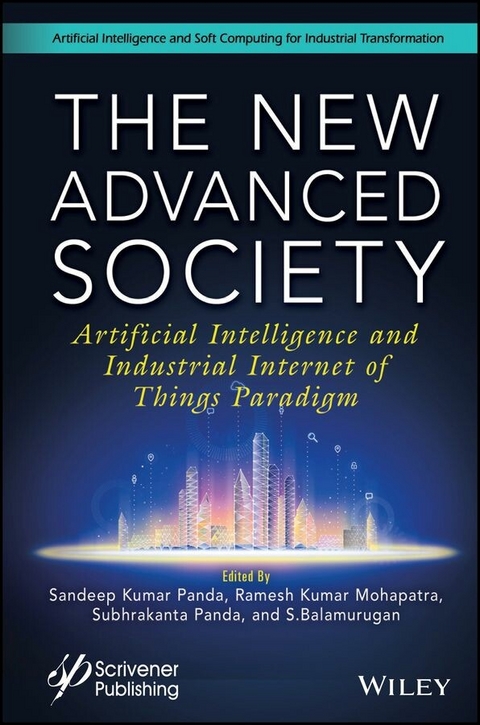
The New Advanced Society (eBook)

Included in this book are the fundamentals of Society 5.0, artificial intelligence, and the industrial Internet of Things, featuring their working principles and application in different sectors.
A 360-degree view of the different dimensions of the digital revolution is presented in this book, including the various industries transforming industrial manufacturing, the security and challenges ahead, and the far-reaching implications for society and the economy. The main objective of this edited book is to cover the impact that the new advanced society has on several platforms such as smart manufacturing systems, where artificial intelligence can be integrated with existing systems to make them smart, new business models and strategies, where anything and everything is possible through the internet and cloud, smart food chain systems, where food products can be delivered to any corner of the world at any time and in any situation, smart transport systems in which robots and self-driven cars are taking the lead, advances in security systems to assure people of their privacy and safety, and smart healthcare systems, where biochips can be incorporated into the human body to predict deadly diseases at early stages. Finally, it can be understood that the social reformation of Society 5.0 will lead to a society where every person leads an active and healthy life.
Audience
The targeted audience for this book includes research scholars and industry engineers in artificial intelligence and information technology, engineering students, cybersecurity experts, government research agencies and policymakers, business leaders, and entrepreneurs.
Sandeep Kumar Panda, PhD is an associate professor in the Department of Data Science and Artificial Intelligence at IcfaiTech (Faculty of Science and Technology), ICFAI Foundation for Higher Education, Hyderabad. His research areas include artificial intelligence, IoT, blockchain technology, cloud computing, cryptography, computational intelligence, and software engineering.
Ramesh Kumar Mohapatra, PhD is an assistant professor in the Department of Computer Science and Engineering, National Institute of Technology, Rourkela, Odisha, India. His research interests include optical character recognition, document image analysis, video processing, secure computing, and machine learning.
Subhrakanta Panda, PhD is an assistant professor in the Department of Computer Science and Information Systems, BITS-PILANI, Hyderabad Campus, Jawahar Nagar, Hyderabad, India. His research interests include social network analysis, cloud computing, security testing, and blockchain.
S. Balamurugan, PhD is the Director of Research and Development, Intelligent Research Consultancy Services (iRCS), Coimbatore, Tamilnadu, India. He is also Director of the Albert Einstein Engineering and Research Labs (AEER Labs), as well as Vice-Chairman, Renewable Energy Society of India (RESI), India. He has published 45 books, 200+ international journals/ conferences, and 35 patents.
Sandeep Kumar Panda, PhD is an associate professor in the Department of Data Science and Artificial Intelligence at IcfaiTech (Faculty of Science and Technology), ICFAI Foundation for Higher Education, Hyderabad. His research areas include Artificial Intelligence, IoT, Blockchain Technology, Cloud Computing, Cryptography, Computational Intelligence, and Software Engineering.
Ramesh Kumar Mohapatra, PhD is an assistant professor in the Department of Computer Science and Engineering, National Institute of Technology, Rourkela, Odisha, India. His research interests include Optical Character Recognition, Document Image Analysis, Video Processing, Secure Computing, Machine Learning.
Subhrakanta Panda, PhD is an assistant professor in the department of Computer Science and Information Systems, BITS-PILANI, Hyderabad Campus, Jawahar Nagar, Shameerpet Mandal, Hyderabad, INDIA. His research interests include Social Network Analysis, Cloud Computing, Security Testing, Blockchain.
S. Balamurugan, PhD is the Director of Research and Development, Intelligent Research Consultancy Services (iRCS), Coimbatore, Tamilnadu, India. He is also Director of the Albert Einstein Engineering and Research Labs (AEER Labs), as well as Vice-Chairman, Renewable Energy Society of India (RESI), India. He has published 45 books, 200+ international journals/ conferences, and 35 patents.
THE NEW ADVANCED SOCIETY Included in this book are the fundamentals of Society 5.0, artificial intelligence, and the industrial Internet of Things, featuring their working principles and application in different sectors. A 360-degree view of the different dimensions of the digital revolution is presented in this book, including the various industries transforming industrial manufacturing, the security and challenges ahead, and the far-reaching implications for society and the economy. The main objective of this edited book is to cover the impact that the new advanced society has on several platforms such as smart manufacturing systems, where artificial intelligence can be integrated with existing systems to make them smart, new business models and strategies, where anything and everything is possible through the internet and cloud, smart food chain systems, where food products can be delivered to any corner of the world at any time and in any situation, smart transport systems in which robots and self-driven cars are taking the lead, advances in security systems to assure people of their privacy and safety, and smart healthcare systems, where biochips can be incorporated into the human body to predict deadly diseases at early stages. Finally, it can be understood that the social reformation of Society 5.0 will lead to a society where every person leads an active and healthy life. Audience The targeted audience for this book includes research scholars and industry engineers in artificial intelligence and information technology, engineering students, cybersecurity experts, government research agencies and policymakers, business leaders, and entrepreneurs. Sandeep Kumar Panda, PhD is an associate professor in the Department of Data Science and Artificial Intelligence at IcfaiTech (Faculty of Science and Technology), ICFAI Foundation for Higher Education, Hyderabad. His research areas include artificial intelligence, IoT, blockchain technology, cloud computing, cryptography, computational intelligence, and software engineering. Ramesh Kumar Mohapatra, PhD is an assistant professor in the Department of Computer Science and Engineering, National Institute of Technology, Rourkela, Odisha, India. His research interests include optical character recognition, document image analysis, video processing, secure computing, and machine learning. Subhrakanta Panda, PhD is an assistant professor in the Department of Computer Science and Information Systems, BITS-PILANI, Hyderabad Campus, Jawahar Nagar, Hyderabad, India. His research interests include social network analysis, cloud computing, security testing, and blockchain. S. Balamurugan, PhD is the Director of Research and Development, Intelligent Research Consultancy Services (iRCS), Coimbatore, Tamilnadu, India. He is also Director of the Albert Einstein Engineering and Research Labs (AEER Labs), as well as Vice-Chairman, Renewable Energy Society of India (RESI), India. He has published 45 books, 200+ international journals/ conferences, and 35 patents.
Sandeep Kumar Panda, PhD is an associate professor in the Department of Data Science and Artificial Intelligence at IcfaiTech (Faculty of Science and Technology), ICFAI Foundation for Higher Education, Hyderabad. His research areas include Artificial Intelligence, IoT, Blockchain Technology, Cloud Computing, Cryptography, Computational Intelligence, and Software Engineering. Ramesh Kumar Mohapatra, PhD is an assistant professor in the Department of Computer Science and Engineering, National Institute of Technology, Rourkela, Odisha, India. His research interests include Optical Character Recognition, Document Image Analysis, Video Processing, Secure Computing, Machine Learning. Subhrakanta Panda, PhD is an assistant professor in the department of Computer Science and Information Systems, BITS-PILANI, Hyderabad Campus, Jawahar Nagar, Shameerpet Mandal, Hyderabad, INDIA. His research interests include Social Network Analysis, Cloud Computing, Security Testing, Blockchain. S. Balamurugan, PhD is the Director of Research and Development, Intelligent Research Consultancy Services (iRCS), Coimbatore, Tamilnadu, India. He is also Director of the Albert Einstein Engineering and Research Labs (AEER Labs), as well as Vice-Chairman, Renewable Energy Society of India (RESI), India. He has published 45 books, 200+ international journals/ conferences, and 35 patents.
Preface
The primary goal of an advanced society, also known as Society 5.0, is to create a human-centric society in which economic progress and social problems are balanced by implementing a system that integrates cyberspace and physical space. That is, a society which aims to create a better social and economic model by adapting the technological innovations of Industry 4.0. Society 5.0 is a huge societal transformation plan that visualizes a “super-smart society.” It is a follow-up to Industry 4.0, where “information” was the predominant factor but cross-sectional knowledge sharing was not adequate, making cooperation among different sectors difficult. Also, finding the information needed from among information overflow is a tedious task, thereby limiting the scope of actions due to various factors like lack of skills, different abilities of those doing the work, etc. In Industry 4.0, data is accessed from the cloud and operations like searching, retrieving and analyzing data happen over the internet, with the burden of analysis being carried by humans. Whereas, in Society 5.0, people, systems and things will all be connected and the vast amounts of data from sensors will be collected in real time, accumulated and analyzed using artificial intelligence (AI), and the resultant analyses fed back to humans in different forms. Society 5.0 balances economic advancements with the resolution of social problems by incorporating the latest technological advancements like big data, AI, the internet of things (IoT) and robotics in all industrial and societal activities. Of course, Industry 4.0 will be a major component of Society 5.0, but is not the only component—it is also about citizens, organizations, stakeholders, academia and so on. In short, using the technological advancements to provide solutions to better the lives of humans is what an advanced society all about. Some salient features of an advanced society are problem-solving and value-adding, bringing out divergent abilities, decentralization, resilience, sustainability and environmental harmony.
A 360-degree view of the different dimensions of this revolution is presented in this book, including the various industries transforming industrial manufacturing, the security and challenges ahead and the far-reaching implications for society and the economy. The main objective of this edited book is to cover the impact that the new advanced society has on several platforms such as smart manufacturing systems, where artificial intelligence can be integrated with existing systems to make them smart, new business models and strategies, where anything and everything is possible through the internet and cloud, smart food chain systems, where food products can be delivered to any corner of the world at any time and in any situation, smart transport systems in which robots and self-driven cars are taking the lead, advances in security systems to assure people of their privacy and safety, and smart healthcare systems, where biochips can be incorporated into the human body to predict deadly diseases at early stages. Finally, it can be understood that the social reformation of Society 5.0 will lead to a society where every person leads an active and healthy life.
Included in this book are the fundamentals of Society 5.0, artificial intelligence, and the industrial internet of things, featuring their working principles and application in different sectors. In order to meet these objectives, accomplished writers in the field have contributed the 19 chapters summarized below.
- – Chapter 1 discusses areas of management, cybercrime in the financial sector, human depression, and school/college closures. Moreover, the constraints posed by returning migrant workers and the remedial measures devised to overcome them, and how to build a new advanced society in a post-COVID-19 era are also discussed.
- – Chapter 2 elaborates on the clients, architects, contractors, material suppliers, etc., in the construction industry. The complex supply chain of globally manufactured construction products has to be managed for the sake of meeting quality requirements and customer satisfaction. But, the lack of accountability in the construction industry sometimes leads to various types of errors, delays, and even accidents at some stages. This chapter introduces the key to ending these disputes with the help of Corda, a distributed ledger platform for permissioned networks inspired by blockchain technology. This helps in maintaining transparency among the actors involved in this industry, thus avoiding any miscommunication.
- – Chapter 3 analyzes the identity and access management challenges in the IoT, followed by a proposal of a cloud identity management model for the IoT using distributed ledger technology.
- – Chapter 4 elucidates the development of an efficient deep neural network (DNN) with a reduced number of parameters to make it real-time implementable. The architecture was implemented on German traffic sign recognition benchmark (GTSRB) dataset. Four variations of neural network architectures—feedforward neural network (FFNN), radial basis function neural network (RBNN), convolutional neural network (CNN), and recurrent neural network (RNN)—are designed. The various hyperparameters of the architectures—batch size, number of epochs, momentum, initial learning rate—are tuned to achieve the best results.
- – Chapter 5 deals with the basic aspects of honeypots, their importance in modern networks, types of honeypots, their level of interaction, and their advantages and disadvantages. Furthermore, this chapter also discusses how honeypots enhance the security architecture of a network.
- – Chapter 6 provides an in depth review of the necessity for security in IoT platforms and applications of the industrial internet of things (IIoT). Over the past decade, cyberattacks have mostly occurred on IoT devices; therefore, cybersecurity is introduced to deal with these cyberattacks. Furthermore, one of the chief attack modes in the IIoT are botnets and denial-of-service attacks. These attacks happen in several ways, and once they have occurred it is hard to predict and stop them. This chapter highlights many suggestions from diverse authors, which are detailed in tabular form.
- – Chapter 7 proposes an efficient navigation controller embedding hybrid Jaya-DE algorithm to obtain the optimum path of an individual robot. The efficiency of the proposed navigation controller was evaluated through simulation. The outcomes of the simulation revealed the efficacy of the suggested controller in monitoring the robots towards achieving a safe and optimal path. The strength of the suggested controller was further verified with a similar problem framework. The potency of the proposed controller can be seen from the outcome in resolving the navigation of mobile robots as compared to its competitor.
- – Chapter 8 discusses a study conducted for diagnosing Parkinson’s disease using different machine learning (ML) algorithms for categorization and severity prediction through the measure of 16 voice and eight kinematic features accomplished with various archives. The dataset included 40 people with Parkinson’s disease and healthy patients generated with the help of spiral drawings and voice readings. Of the various ML algorithms used for estimating, the highest accuracy (94.87%) was demonstrated by ANN, while Naïve Bayes was the least precise (71.79%). The work also predicted a severity score by suggesting some scientific measures with a prototype dataset.
- – Chapter 9 discusses the challenges faced in the development of a multi-sensor classification system and their possible solutions. Smart agriculture in rural areas can largely benefit from the low-power, low-cost sensors and aerial devices to sense (soil, temperature, salinity, water, light, insects, pests) and exchange data/images for monitoring and controlling crops.
- – Chapter 10 builds a classification model that classifies whether a customer is going to buy a car with specific features. This research work consisted of four ML models and an analysis of their results. These classifying models were Gaussian Naïve Bayes, decision tree, Karnough Nearest Neighbors and neural networks. The author also attempted to find the best hyperparameter value to obtain the best result from these models. These results are used to compare the accuracies of every model and decide the best model for use in real-time prediction. Here, the author was predicting whether a customer was going to buy a car or not buy a car with particular features available in it. Hence, for this prediction the best accuracy we got was 97.4%, which was given by the decision tree classifier. Also, the neural network had about the same prediction accuracy. Therefore, this ML model can be used by a firm to determine whether or not a new car with specific features will sell well or by a customer wanting to know whether a particular car will be bought by other customers as well.
- – Chapter 11 examines the use of AI and ML in political campaigns. It is divided into three sections—the first section explores internet penetration and the influence of social media on the Indian Lok Sabha election; the second section explores the forms of deepfake and automated social media bots and their use during the election campaign; and the final section explores the future of AI and ML in the election campaign in India.
- – Chapter 12 attempts to explain the impact of segment routing (SR) in...
| Erscheint lt. Verlag | 18.3.2022 |
|---|---|
| Reihe/Serie | Wiley-Scrivener |
| Wiley-Scrivener | Wiley-Scrivener |
| Sprache | englisch |
| Themenwelt | Informatik ► Theorie / Studium ► Künstliche Intelligenz / Robotik |
| Technik ► Elektrotechnik / Energietechnik | |
| Schlagworte | AI • Artificial Intelligence • Computer Science • Electrical & Electronics Engineering • Elektrotechnik u. Elektronik • Engineering Technology Management • Industrial Engineering • Industrielle Verfahrenstechnik • Informatik • Intelligente Systeme u. Agenten • Intelligent Systems & Agents • KI • Künstliche Intelligenz • Technologiemanagement |
| ISBN-13 | 9781119884378 / 9781119884378 |
| Informationen gemäß Produktsicherheitsverordnung (GPSR) | |
| Haben Sie eine Frage zum Produkt? |
 EPUB (Adobe DRM)
Kopierschutz: Adobe-DRM
Adobe-DRM ist ein Kopierschutz, der das eBook vor Mißbrauch schützen soll. Dabei wird das eBook bereits beim Download auf Ihre persönliche Adobe-ID autorisiert. Lesen können Sie das eBook dann nur auf den Geräten, welche ebenfalls auf Ihre Adobe-ID registriert sind.
Details zum Adobe-DRM
Dateiformat: EPUB (Electronic Publication)
EPUB ist ein offener Standard für eBooks und eignet sich besonders zur Darstellung von Belletristik und Sachbüchern. Der Fließtext wird dynamisch an die Display- und Schriftgröße angepasst. Auch für mobile Lesegeräte ist EPUB daher gut geeignet.
Systemvoraussetzungen:
PC/Mac: Mit einem PC oder Mac können Sie dieses eBook lesen. Sie benötigen eine
eReader: Dieses eBook kann mit (fast) allen eBook-Readern gelesen werden. Mit dem amazon-Kindle ist es aber nicht kompatibel.
Smartphone/Tablet: Egal ob Apple oder Android, dieses eBook können Sie lesen. Sie benötigen eine
Geräteliste und zusätzliche Hinweise
Buying eBooks from abroad
For tax law reasons we can sell eBooks just within Germany and Switzerland. Regrettably we cannot fulfill eBook-orders from other countries.
aus dem Bereich