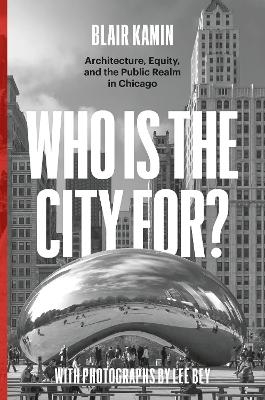
Who Is the City For?
University of Chicago Press (Verlag)
978-0-226-82273-0 (ISBN)
From his high-profile battles with Donald Trump to his insightful celebrations of Frank Lloyd Wright and front-page takedowns of Chicago mega-projects like Lincoln Yards, Pulitzer Prize–winning architecture critic Blair Kamin has long informed and delighted readers with his illuminating commentary. Kamin’s newest collection, Who Is the City For?, does more than gather fifty-five of his most notable Chicago Tribune columns from the past decade: it pairs his words with striking new images by photographer and architecture critic Lee Bey, Kamin’s former rival at the Chicago Sun-Times. Together, they paint a revealing portrait of Chicago that reaches beyond its glamorous downtown and dramatic buildings by renowned architects like Jeanne Gang to its culturally diverse neighborhoods, including modest structures associated with storied figures from the city’s Black history, such as Emmett Till.
At the book’s heart is its expansive approach to a central concept in contemporary political and architectural discourse: equity. Kamin argues for a broad understanding of the term, one that prioritizes both the shared spaces of the public realm and the urgent need to rebuild Black and brown neighborhoods devastated by decades of discrimination and disinvestment. “At best,” he writes in the book’s introduction, “the public realm can serve as an equalizing force, a democratizing force. It can spread life’s pleasures and confer dignity, irrespective of a person’s race, income, creed, or gender. In doing so, the public realm can promote the social contract — the notion that we are more than our individual selves, that our common humanity is made manifest in common ground.” Yet the reality in Chicago, as Who Is the City For? powerfully demonstrates, often falls painfully short of that ideal.
Blair Kamin is the author or editor of several books, including Why Architecture Matters: Lessons from Chicago and Terror and Wonder: Architecture in a Tumultuous Age, also published by the University of Chicago Press. The Chicago Tribune’s architecture critic for 28 years, Kamin was awarded the Pulitzer Prize for Criticism in 1999. Lee Bey is an editorial writer and architecture critic for the ChicagoSun-Times and the author of Southern Exposure: The Overlooked Architecture of Chicago’s South Side. Previously former Chicago mayor Richard M. Daley’s deputy chief of staff for architecture and urban planning, Bey has had photographs published in the New York Times and Architectural Digest.
Introduction
Part One: Presidents and Their Legacy Projects: Self-Aggrandizing or Civic-Minded?
Trump Takes Aim at Design and the Design Press
The Trump Sign, a Poke in the Eye, Mars the Riverfront
Trump’s Sycophantic, Vitriolic Treatment of Architecture Critics
How Should Trump Make Federal Architecture Great? By Ignoring the Ideologues Who Speak for Modernism and Classicism
The Obama Presidential Center: No Walk in the Park
Obama Center Design: Promising, Populist, not Yet Persuasive
Obama Center’s Plans Won’t Destroy Olmsted’s Park—They Should Be Improved, not Rejected
Part Two: Urban Design: Boom Times for Cities, but Who Benefits?
Urbanization on the March—and on Hold Because of the Pandemic
China’s Skyscrapers Are Trophies for the Nation and a Lifeline for Chicago Architects—but Growth Has Its Price
Attacking “Plop Architecture”: There’s a Better, Transit-Oriented Way to Design Our Cities
The Rise of Chicago’s Super Loop: So Much Building, So Little Architecture
The Things We Love about City Life—Public Transit, Urban Hustle—Are the Very Things That Put Us at Risk for COVID-19
Public Spaces: A Burst of Innovation, with Mixed Results on Equity
Maggie Daley Park Is a Seed with Potential to Blossom
Chicago’s Downtown Riverwalk: A New Phase of the City’s “Second Lakefront” Takes Shape, a Model of Waterfront Urbanity
The 606, Two Years Later: As Its Landscape Grows, So Do Concerns about Displacement
Rating Chicago’s Latest wave of Parks and Public Spaces by the Three “E”s: They’re Better on Entertainment and Ecology Than Equity
Transit and Infrastructure: After a Bumpy Start, Solid Advances
Signs Uglify Our Beautiful Bridges
First New Loop “L” Station in Twenty Years Creates Curvy Gateway to Millennium Park
Along the Dan Ryan, an Eye-Grabbing CTA Terminal Reaches beyond the Ordinary
On Chicago’s South Lakefront, a Curving Pedestrian Bridge over Lake Shore Drive Also Bends Toward Justice
Chicago’s New “Shared Street” Tilts the Balance in Favor of Pedestrians, Cyclists, and Social Distancing, but It’s Tinkering, not Structural Change
Part Three: Architecture: Are Buildings Good Citizens?
Tall Buildings: Highs and Lows
150 North Riverside May Look Like It’s Teetering, but There’s a Method to Its Madness
When Bad Things Happen to a Good Architect: The Saga of 151 North Franklin
A Celebrated New Yorker’s New Chicago Tower: The Peak of Urban Luxury, not the Height of Skyscraper Style
The Vista Tower, Now Chicago’s Third-Tallest Building, Brings Stirring Curves and More to a Squared-Off Skyline
Fifty Years Later, Lake Point Tower Is a Singular Achievement—Let’s Hope It Stays That Way
Flagship Stores: From Fine-Grained to Flashy
Apple’s New Flagship Store an Understated Gem on the Chicago River
McDonald’s New Flagship in River North: Not Ketchup Red or Mustard Yellow, but Green
In Skokie, an Architecturally Arresting Pot Shop Reveals How Marijuana Has Gone Mainstream
Museums: Reacting against, and Reaching beyond, “Starchitecture”
George Lucas’s Museum Proposal Is Needlessly Massive
MCA’s Renovation Is No Hostile Takeover. It Reflects How Audiences Interact with Art and Each Other
The National African American Museum Still Stirs the Soul—and Drops Hints of What to Expect at the Obama Presidential Center
Public Buildings: The Benefits—and Limits—of Good Design
Chinatown Library Breaks the Cookie-Cutter Mold and Builds Bonds of Community
A New Boathouse along the Chicago River Transforms the Motion of Rowing into an Instant Landmark
Chicago Shows How Public Housing and Libraries Can Coexist and Be Visually Striking. Now We Need More of These Creative Combinations
A Former North Side Public-Housing Project Is Beautifully Remade, but at What Cost?
Part Four: Historic Preservation: What Gets Saved and Why?
Who Should Determine a Building’s Fate—the Experts, the Community, or the Clout-Heavy?
Changes Will Erode Foundation of Landmarks Commission
Evanston Plan to Demolish Harley Clarke Mansion: Public Vision or Hidden Agenda?
A Plaque on Emmett Till’s House Is Just a First Step. Chicago Can Do a Better Job of Preserving Black History Sites
The Despised Pilsen Landmark District Is about to Get a Hearing. Here’s How to Save the Treasured Neighborhood
The Struggle to Save—and Better Understand—Buildings of the Recent Past
As Prentice Comes Down, Stakes Rise on Its Replacement
Spare Jahn’s Thompson Center from Rauner’s Death Sentence
The U of C’s Architectural Oddball, by the Designer of the Aon Center, Gets a Vibrant, Energy-Saving Remake
A Different View of the Masterful Farnsworth House—Hers
Preserving Buildings of the Distant Past: Yesterday’s Designs, Some Viewed as Radical, Are Today’s Classics
Delayed Restoration of Unity Temple Was Well Worth the Wait
The Robie House Is Again a Full-Fledged Architectural Symphony
Union Station Plan on the Wrong Track: All the Grandeur of a Holiday Inn
With Cubs’ Commercial Excess Mostly in Check, Wrigley Field’s Nearly Complete Multiyear Renovation Is a Hit
Chicago’s Old Post Office, the Nation’s Largest Reuse Project, Delivers the Goods
Once Facing the Wrecking Ball, Old Cook County Hospital Reemerges, Handsomely Remade
Part Five: Two Mayors, Two Directions: Who Can Make the City Work for All?
Rahm Emanuel: Retrospective and Climactic Battle
Emanuel Thought and Built Big, but Progress was Painfully Uneven
An Incredible Transformation? Not Really. The “Meh” Blocks West of Navy Pier Are a Cautionary Tale for Chicago’s Next Round of Megaprojects
Improvement or Invasion? Lincoln Yards Plan Is Too Tall and Out of Place. The Mayor and City Council Should Slow It Down, and Press Architects and Developers to Rethink and Redesign
Lori Lightfoot and Maurice Cox: Detroit Prelude, Chicago Blueprint
Detroit’s Downtown Revival Is Real, but the Road to Recovery Remains Long
Changing Course: Lightfoot’s Top Planner Will Focus on the City’s “Soul”—Its Neighborhoods, not Just Its Downtown “Heart”
Time to Stop Planning and Start Building: It’s Crunch Time for Lightfoot’s Drive to Revive South, West Sides
Epilogue: The End of a Journalistic Era—and What Comes Next?
A Farewell to Tribune Tower and a Shout-out to Its Architects
Reflecting on Twenty-Eight Years of Reviewing Chicago’s Architectural Wonders and Blunders—and Why Such Coverage Should Continue
Acknowledgments
Index
| Erscheinungsdatum | 24.10.2022 |
|---|---|
| Zusatzinfo | 69 halftones |
| Sprache | englisch |
| Maße | 152 x 229 mm |
| Gewicht | 708 g |
| Themenwelt | Geisteswissenschaften ► Geschichte |
| Technik ► Architektur | |
| ISBN-10 | 0-226-82273-7 / 0226822737 |
| ISBN-13 | 978-0-226-82273-0 / 9780226822730 |
| Zustand | Neuware |
| Informationen gemäß Produktsicherheitsverordnung (GPSR) | |
| Haben Sie eine Frage zum Produkt? |
aus dem Bereich