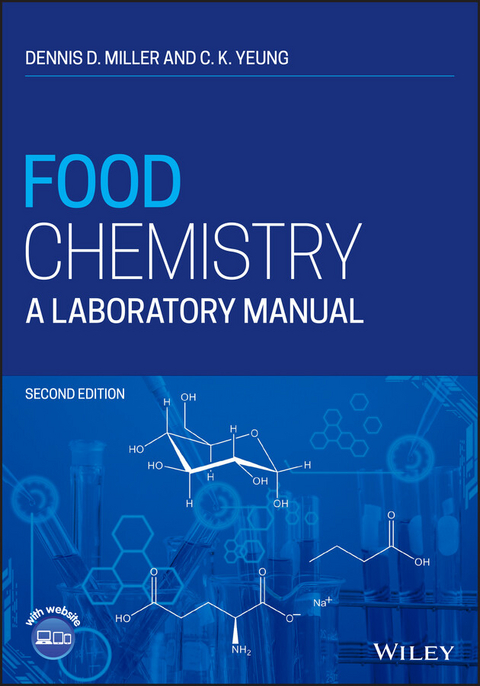
Food Chemistry (eBook)
John Wiley & Sons (Verlag)
978-1-119-71460-6 (ISBN)
A manual designed for Food Chemistry Laboratory courses that meet Institute of Food Technologists undergraduate education standards for degrees in Food Science
In the newly revised second edition of Food Chemistry: A Laboratory Manual, two professors with a combined 50 years of experience teaching food chemistry and dairy chemistry laboratory courses deliver an in-depth exploration of the fundamental chemical principles that govern the relationships between the composition of foods and food ingredients and their functional, nutritional, and sensory properties. Readers will discover practical laboratory exercises, methods, and techniques that are commonly employed in food chemistry research and food product development.
Every chapter offers introductory summaries of key methodological concepts and interpretations of the results obtained from food experiments. The book provides a supplementary online Instructor's Guide useful for adopting professors that includes a Solutions Manual and Preparation Manual for laboratory sessions.
The latest edition presents additional experiments, updated background material and references, expanded end-of-chapter problem sets, expanded use of chemical structures, and:
- A thorough emphasis on practical food chemistry problems encountered in food processing, storage, transportation, and preparation
- Comprehensive explorations of complex interactions between food components beyond simply measuring concentrations
- Additional experiments, references, and chemical structures
- Numerous laboratory exercises sufficient for a one-semester course
Perfect for students of food science and technology, Food Chemistry: A Laboratory Manual will also earn a place in the libraries of food chemists, food product developers, analytical chemists, lab technicians, food safety and processing professionals, and food engineers.
Dennis D. Miller is Professor Emeritus in the Department of Food Science at Cornell University. He is a Fellow of the Institute of Food Technologists and of the International Academy of Food Science and Technology.
C.K. Yeung is Associate Professor in the Animal Science Department at California Polytechnic State University.
FOOD CHEMISTRY A manual designed for Food Chemistry Laboratory courses that meet Institute of Food Technologists undergraduate education standards for degrees in Food Science In the newly revised second edition of Food Chemistry: A Laboratory Manual, two professors with a combined 50 years of experience teaching food chemistry and dairy chemistry laboratory courses deliver an in-depth exploration of the fundamental chemical principles that govern the relationships between the composition of foods and food ingredients and their functional, nutritional, and sensory properties. Readers will discover practical laboratory exercises, methods, and techniques that are commonly employed in food chemistry research and food product development. Every chapter offers introductory summaries of key methodological concepts and interpretations of the results obtained from food experiments. The book provides a supplementary online Instructor s Guide useful for adopting professors that includes a Solutions Manual and Preparation Manual for laboratory sessions. The latest edition presents additional experiments, updated background material and references, expanded end-of-chapter problem sets, expanded use of chemical structures, and: A thorough emphasis on practical food chemistry problems encountered in food processing, storage, transportation, and preparation Comprehensive explorations of complex interactions between food components beyond simply measuring concentrations Additional experiments, references, and chemical structures Numerous laboratory exercises sufficient for a one-semester course Perfect for students of food science and technology, Food Chemistry: A Laboratory Manual will also earn a place in the libraries of food chemists, food product developers, analytical chemists, lab technicians, food safety and processing professionals, and food engineers.
Dennis D. Miller is Professor Emeritus in the Department of Food Science at Cornell University. He is a Fellow of the Institute of Food Technologists and of the International Academy of Food Science and Technology. C.K. Yeung is Associate Professor in the Animal Science Department at California Polytechnic State University.
Preface to the First Edition
Preface to the Second Edition
Acknowledgements
About the Companion Website
1 ACIDS, BASES, AND BUFFERS
2 CHEMICAL LEAVENING AGENTS
3 PROPERTIES OF SUGARS
4 NONENZYMATIC BROWNING
5 FOOD HYDROCOLLOIDS
6 FUNCTIONAL PROPERTIES OF PROTEINS
7 LACTOSE
8 ENZYMATIC BROWNING: KINETICS OF POLYPHENOLOXIDASE
9 BLANCHING EFFECTIVENESS
10 LIPID OXIDATION
11 ASCORBIC ACID: STABILITY AND LEACHABILITY
12 HYDROLYTIC RANCIDITY IN MILK
13 Caffeine in Beverages
14 COLOR ADDITIVES
15 PLANT PIGMENTS
16 MEAT PIGMENTS
17 MEAT TENDERIZERS
18 Detection of Genetically Engineered Maize Varieties
19 Food Emulsions and Surfactants
Appendix I - CONVERSION FACTORS
Appendix II - CONCENTRATION
Appendix III - ACIDS, BASES, BUFFERS AND pH MEASUREMENT
Appendix IV - SPECTROPHOTOMETRY
Appendix V - CHROMATOGRAPHY
Appendix VI - ELECTROPHORESIS
Appendix VII - GLOSSARY
Index
"This is the second edition of this well-known and trusted food chemistry handbook. ... a must-have book for any food chemistry course or analytical chemistry laboratory in the food industry." -- FST Magazine, November 2022
1
Acids, Bases, and Buffers
1.1 Learning Outcomes
After completing this exercise, students will be able to:
- Explain the roles of acids and bases in food products.
- Measure the pH of selected food products.
- Prepare and evaluate a buffer system.
- Measure the buffering capacity of a common beverage.
1.2 Introduction
Many food components may be classified as acids or bases due to their capacity to donate or accept protons (hydrogen ions). These components perform numerous important functions including flavor enhancement, control of microbial growth, inhibition of browning, alteration of texture, prevention of lipid oxidation, and pH control.
Acids and bases are key metabolites in living plant and animal organisms, for example as intermediates in the TCA cycle, and are mostly retained when the plant is harvested or the animal is slaughtered so they are naturally present in foods. They may also be added during processing or synthesized during fermentation to produce desired characteristics in the final food product.
The concentration and relative proportion of acids and bases determine the pH of a food, an extremely important characteristic. pH can affect the flavor, color, texture, stability, and behavior in food processing situations. For example, commercial sterilization of acid foods (pH less than 4.6) [1] can be achieved under milder processing conditions than in foods with a higher pH.
1.2.1 Acids
Acids serve a variety of functions in foods including flavor enhancement, control of microbial growth, protein coagulation, emulsification, control of browning, buffering action, and metal chelation (to control lipid oxidation). All acids have a sour taste but different acids produce distinctively different sour flavors. Thus, it is not enough to simply add any acid when attempting to produce a characteristic sour flavor in a food. Table 1.1 gives structures and pK values of some common food acids.
Table 1.1 Acids common in foods: structures and pKa values.
| Substance | Structure | pKa | Food found in |
|---|
| Acetic acid | pK = 4.75 | Vinegar, figs |
| Adipic acid | pK1 = 4.43 pK2 = 5.62 | Beets |
| Butyric acid | pK = 4.82 | Cheese, butter |
| Citric acid | pK1 = 3.06 pK2 = 4.74 pK3 = 5.40 | Oranges, lemons, apricots, tomatoes |
| Lactic acid | pK = 3.83 | Yogurt, buttermilk, cheese, beer |
| Malic acid | pK1 = 3.40 pK2 = 5.05 | Apples, apricots, grapes, oranges, tomatoes |
| Oxalic acid | pK1 = 1.27 pK2 = 4.27 | Spinach, potatoes, tomatoes |
| Phosphoric acid | pK1 = 2.12 pK2 = 7.21 pK3 = 12.32 | Tomatoes, acidulant used in soft drinks |
| Tartaric acid | pK1 = 2.98 pK2 = 4.34 | Grapes |
| Sodium hydrogen sulfate or sodium acid sulfate | pK = 1.99 | Acidulant. Lowers pH without imparting acid taste. May be added to process water to enhance chlorine activity |
1.2.1.1 Food Acidulants
In the food industry, food additives that have acidic properties are commonly known as food acidulants. There are many approved food acidulants, but only a few are in wide use. They include organic acids like acetic acid, citric acid, fumaric acid, lactic acid, malic acid, and tartaric acid as well as the mineral acids phosphoric acid and sodium hydrogen sulfate. (See [2] for guidance in selecting food acidulants.)
1.2.1.2 Reactions of Food Acids
Most naturally occurring food acids are carboxylic acids. Carboxylic acids are weak acids compared with mineral acids such as HCl and H2SO4. Important reactions of carboxylic acids include the following:
Ionization:
Reaction with alcohols to form esters:
1.2.2 Bases
Bases are also common food additives and are added for a variety of purposes. They may be added to modify the flavor, color, and texture, enhance browning, induce chemical peeling, and produce CO2. Examples of bases used as food additives include dilute NaOH (to induce chemical peeling in fruits and vegetables, enhance browning, de‐bitter olives, solubilize proteins), phosphate salts (to prevent protein coagulation in evaporated and condensed milks, produce a smooth texture in processed cheese), and NaHCO3 (to give chocolate a darker color, produce CO2 in leavening systems).
1.2.3 Buffers
Buffers stabilize the pH in foods. They are also used to neutralize foods which are too acidic. By using the salt of the acid already present, acidity is reduced without adding neutralization flavors. Many buffers are present naturally in foods. Animal products are usually buffered by amino acids, proteins, and phosphate salts. In plants, organic acids (such as citric, malic, oxalic, and tartaric) in conjunction with phosphate salts are the primary buffers. Table 1.2 shows the pHs of some common foods. Notice that most foods are buffered in the acidic range (pH < 7).
Table 1.2 Approximate pH values for some common foodsa.
| Food | pH | Food | pH |
|---|
| Lime juice | 2.0 | Yogurt | 4.0–4.5 |
| Lemon juice | 2.2 | Cheddar cheese | 5.1–5.5 |
| Vinegar | 2.6 | Beef, fresh | 5.5–5.0 |
| Rhubarb | 3.0 | Pork, fresh | 5.6–6.9 |
| Grape juice | 3.1–3.2 | Turkey, fresh | 5.7–6.1 |
| Wines | 2.9–3.9 | Tuna | 6.0 |
| Apple juice | 3.5–3.9 | Carrots, fresh | 5.7–6.1 |
| Strawberries | 3.2–3.4 | Potatoes, fresh | 6.1 |
| Peaches | 3.8 | Green beans, fresh | 6.5–6.7 |
| Pears | 3.9 | Milk, fresh | 6.6 |
| Grapefruit juice | 4.0 | Sweet corn, fresh | 6.7 |
| Orange juice | 4.2 | Egg yolk | 6.0–6.9 |
| Tomato juice | 3.8–4.7 | Egg white (pH increases as egg ages) | 7.6–9.2 |
See Appendix III or your chemistry and biochemistry textbooks for a review of acid and base chemistry.
1.3 Apparatus and Instruments
- pH meter equipped with a pH electrode
- Analytical balance
- Household blender
- Centrifuge
- Centrifuge tubes
- Pipette and pipette bulb, 10 ml
- Volumetric flask, 200 ml
- Beakers, 150 ml
- Burette, 25 or 50 ml
- Burette holder and stand
- Thermometer
- Funnel
- Graduated cylinder, 100 ml
- Squeeze bottle for deionized water
- Tissue
- Weighing paper
- Spatula
- Stirring hot plate with stirring bars
1.4 Reagents and Materials
- Citric acid, monohydrate. MW = 210 g mole−1
- KOH, 0.5 N
- HCl, 0.5 N
- HCl, 0.001 N
- Sprite® (Coca Cola Company) or comparable lemon‐flavored soda
- Selected vegetables, e.g. fresh and canned tomatoes
- Calibration buffers, pH 2 and 4
1.5 Procedures
1.5.1 Determining the pH of a Solid Food [5]
- Cut a fresh tomato into small cubes and blend in a blender until a uniform slurry is formed, measure the temperature of the slurry.
- Calibrate your pH meter.
- Measure the pH of the slurry.
- Centrifuge an aliquot of the slurry for 10 minutes at maximum speed.
- Measure the pH of the supernatant.
- Repeat Steps 1 through 5 using canned tomatoes.
1.5.2 Preparation of a Buffer and Determination of Buffer Capacity
- Calculate the amounts of citric acid monohydrate and 0.5 N KOH required to prepare 200 ml of 0.05 M citrate buffer, pH 3....
| Erscheint lt. Verlag | 18.2.2022 |
|---|---|
| Sprache | englisch |
| Themenwelt | Naturwissenschaften ► Biologie |
| Naturwissenschaften ► Chemie | |
| Technik ► Lebensmitteltechnologie | |
| Weitere Fachgebiete ► Land- / Forstwirtschaft / Fischerei | |
| Schlagworte | Analytical Chemistry • Analytische Chemie • Chemie • Chemistry • Food Biochemistry • Food chemistry • food chemistry experiments • food chemistry laboratory • food chemistry laboratory exercises • food science • Food Science & Technology • Food Technology • Industrial Chemistry • Laboratory manual • Lebensmittelchemie • Lebensmittelforschung u. -technologie • Technik / Chemische Technik • Technische u. Industrielle Chemie |
| ISBN-10 | 1-119-71460-5 / 1119714605 |
| ISBN-13 | 978-1-119-71460-6 / 9781119714606 |
| Informationen gemäß Produktsicherheitsverordnung (GPSR) | |
| Haben Sie eine Frage zum Produkt? |
 EPUB (Adobe DRM)
Kopierschutz: Adobe-DRM
Adobe-DRM ist ein Kopierschutz, der das eBook vor Mißbrauch schützen soll. Dabei wird das eBook bereits beim Download auf Ihre persönliche Adobe-ID autorisiert. Lesen können Sie das eBook dann nur auf den Geräten, welche ebenfalls auf Ihre Adobe-ID registriert sind.
Details zum Adobe-DRM
Dateiformat: EPUB (Electronic Publication)
EPUB ist ein offener Standard für eBooks und eignet sich besonders zur Darstellung von Belletristik und Sachbüchern. Der Fließtext wird dynamisch an die Display- und Schriftgröße angepasst. Auch für mobile Lesegeräte ist EPUB daher gut geeignet.
Systemvoraussetzungen:
PC/Mac: Mit einem PC oder Mac können Sie dieses eBook lesen. Sie benötigen eine
eReader: Dieses eBook kann mit (fast) allen eBook-Readern gelesen werden. Mit dem amazon-Kindle ist es aber nicht kompatibel.
Smartphone/Tablet: Egal ob Apple oder Android, dieses eBook können Sie lesen. Sie benötigen eine
Geräteliste und zusätzliche Hinweise
Buying eBooks from abroad
For tax law reasons we can sell eBooks just within Germany and Switzerland. Regrettably we cannot fulfill eBook-orders from other countries.
aus dem Bereich