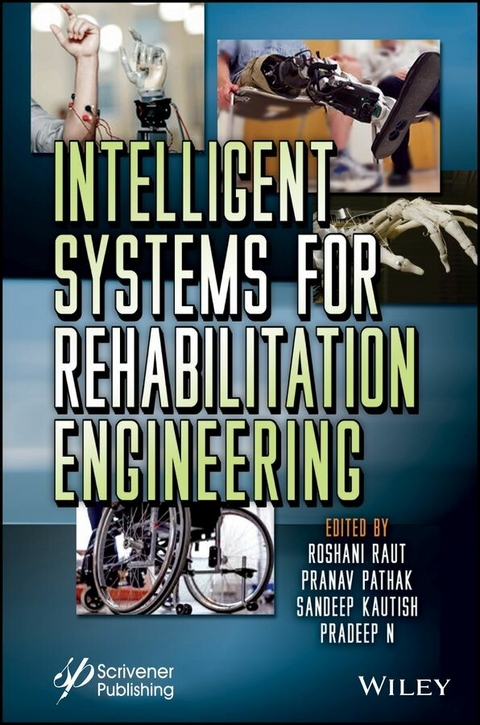
Intelligent Systems for Rehabilitation Engineering (eBook)
John Wiley & Sons (Verlag)
978-1-119-78563-7 (ISBN)
Encapsulates different case studies where technology can be used as assistive technology for the physically challenged, visually and hearing impaired.
Rehabilitation engineering includes the development of technological solutions and devices to assist individuals with disabilities, while also supporting the recovery of the disabled who have lost their physical and cognitive functions. These systems can be designed and built to meet a wide range of needs that can help individuals with mobility, communication, vision, hearing, and cognition. The growing technological developments in machine learning, deep learning, robotics, virtual intelligence, etc., play an important role in rehabilitation engineering.
Intelligent Systems for Rehabilitation Engineering focuses on trending research of intelligent systems in rehabilitation engineering which involves the design and development of innovative technologies and techniques including rehabilitation robotics, visual rehabilitation, physical prosthetics, brain computer interfaces, sensory rehabilitation, motion rehabilitation, etc.
This groundbreaking book
- Provides a comprehensive reference covering different computer assistive techniques for the physically disabled, visually and hearing impaired.
- Focuses on trending research of intelligent systems in rehabilitation engineering which involves the design and development of innovative technologies and techniques.
- Provides insights into the role of intelligent systems in rehabilitation engineering.
Audience
Engineers and device manufacturers working in rehabilitation engineering as well as researchers in computer science, artificial intelligence, electronic engineering, who are working on intelligent systems.
Roshani Raut, PhD is an associate professor in the Department of Information Technology at Pimpri Chinchwad College of Engineering, Pune University, India. She has presented and published more than 70 research communications in national/ international conferences and journals and has published 13 patents.
Pranav D. Pathak, PhD from Visveswaraya National Institute of Technology, Nagpur, India. He is currently an assistant professor at MIT School of Bioengineering Sciences & Research, Pune.
Sandeep Kautish, PhD in Computer Science on Intelligent Systems in Social Networks is Professor & Dean of Academics with LBEF Campus, Kathmandu Nepal. He has published more than 40 papers in international journals.
Pradeep N., PhD is an associate professor in Computer Science and Engineering, Bapuji Institute of Engineering and Technology, Karnataka, India. He has a number of edited books and journal research articles to his credit.
INTELLIGENT SYSTEMS FOR REHABILITATION ENGINEERING Encapsulates different case studies where technology can be used as assistive technology for the physically challenged, visually and hearing impaired. Rehabilitation engineering includes the development of technological solutions and devices to assist individuals with disabilities, while also supporting the recovery of the disabled who have lost their physical and cognitive functions. These systems can be designed and built to meet a wide range of needs that can help individuals with mobility, communication, vision, hearing, and cognition. The growing technological developments in machine learning, deep learning, robotics, virtual intelligence, etc., play an important role in rehabilitation engineering. Intelligent Systems for Rehabilitation Engineering focuses on trending research of intelligent systems in rehabilitation engineering which involves the design and development of innovative technologies and techniques including rehabilitation robotics, visual rehabilitation, physical prosthetics, brain computer interfaces, sensory rehabilitation, motion rehabilitation, etc. This groundbreaking book Provides a comprehensive reference covering different computer assistive techniques for the physically disabled, visually and hearing impaired. Focuses on trending research of intelligent systems in rehabilitation engineering which involves the design and development of innovative technologies and techniques. Provides insights into the role of intelligent systems in rehabilitation engineering. Audience Engineers and device manufacturers working in rehabilitation engineering as well as researchers in computer science, artificial intelligence, electronic engineering, who are working on intelligent systems.
Roshani Raut, PhD is an associate professor in the Department of Information Technology at Pimpri Chinchwad College of Engineering, Pune University, India. She has presented and published more than 70 research communications in national/ international conferences and journals and has published 13 patents. Pranav D. Pathak, PhD from Visveswaraya National Institute of Technology, Nagpur, India. He is currently an assistant professor at MIT School of Bioengineering Sciences & Research, Pune. Sandeep Kautish, PhD in Computer Science on Intelligent Systems in Social Networks is Professor & Dean of Academics with LBEF Campus, Kathmandu Nepal. He has published more than 40 papers in international journals. Pradeep N., PhD is an associate professor in Computer Science and Engineering, Bapuji Institute of Engineering and Technology, Karnataka, India. He has a number of edited books and journal research articles to his credit.
Preface
Rehabilitation engineering uses engineering sciences to develop technological solutions and devices to assist individuals with disabilities and also supports the rehabilitation of those who have lost their physical and cognitive functions. Systems can be designed and built to meet a wide range of needs in order to help those with impaired mobility, communication, vision, hearing and cognition. And these tools and devices assist the disabled in their daily activities such as, for example, attending school or working.
Intelligent systems have a wide range of technological developments which will enhance research in the field of rehabilitation engineering. The growing list of these developments, such as machine learning, deep learning, robotics, virtual intelligence, etc., plays an important role in rehabilitation engineering.
The material collected in this book has been edited to provide information on current research achievements and challenges in the area of rehabilitation engineering and intelligent systems. The target audience of this book includes senior and junior engineers, undergraduate and postgraduate students, researchers, and anyone else interested in the trends, developments, and opportunities of rehabilitation engineering and intelligent system concepts. Research trends in the design and development of innovative technologies are highlighted along with the techniques involved. And even though it is impossible to include all current aspects of the research being conducted in targeted areas, the book is a useful resource in terms of presenting the various possible methodologies that can be applied to achieve results in the field. Presented below is a brief description of the topics covered in the 10 chapters of the book.
– Chapter 1 discusses the different spheres of rehabilitation robotics. Robots are being widely used in medical practice to support various procedures and therapies to help people with physical and psychological limitations. A survey was conducted on rehabilitation robotics that reviews Preface rehabilitation robots with an eye towards future applications. Many researchers have collaborated on an integrated human-robot structure with cognitive abilities; and orthotic and prosthetic devices can also benefit from rehabilitation robots. Additionally, sensing technology is being used in rehabilitation robots. Moreover, this chapter examines the use of rehabilitation robots in Europe and North America.
– Chapter 2 reviews the use of neurorehabilitation robots for an automated process for the upper limb. This chapter illustrates and defines all areas of mechanical recovery technology for novices, and captures the recent robot advances being widely used by talented scientists and clinicians. Also, a few company devices for mechanical recovery are given for a better understanding of the complete picture. The use of productive robotic methodologies promotes the recovery of motor skills. This innovation combines the outcomes of social investigations on motor learning and neurological recovery in the creation and execution of automated processes, with the approval of robot specialists who operate as ideal instructors. Human-robot collaboration assumes a leading role in creating a beneficial relationship, where the human body and the robot can benefit from each other’s components.
– Chapter 3 highlights an effective affordable rehabilitation robot for nervous system disorders powered by dynamic convolutional neural network (CNN) and hidden Markov model (HMM). Neurological disorders are a frequent health concern of billions of individuals around the world. This condition is caused by malfunctioning of the central and peripheral nervous systems. For example, Alzheimer’s and Parkinson’s diseases are not uncommon and wreck the lives of many people. In particular, those afflicted with Parkinson’s disease have impaired movement resulting in freezing of gait (FOG). The only accessible treatment option is the artificial creation of dopamine levels. Therefore, robotic rehabilitation devices have been proposed which apply vibrations to activate muscle performance. These bracelets, bands, and chains are part of the sensors which are fixed to the patient’s body. For processing sensor signals and decision-making, CNN and HMM are used.
– Chapter 4 focuses on smart sensors for activity recognition. Health informatics is used to collect, store, and retrieve essential health-related data. Information and communication technologies and wireless connections lead to the creation of smarter sensors. These devices are commonly used for self-monitoring of health and well-being. Use of smart sensors could help healthcare providers monitor the daily activities of the elderly. Also addressed in this chapter is the use of machine learning (ML) techniques on smartphones and wearables to capture and model human body motions and vital signs during activities of normal living.
– Chapter 5 discusses the use of assistive technology for those who are visually impaired. Acquiring knowledge is difficult for the blind, with Braille being the most commonly utilized technique of transferring information to them. These new forms of Braille include American Literary Braille, British Braille, Computer Braille, Literary Braille, Music Braille, and so on. Traditional Braille writing employs a slate and stylus. Other forms of Braille writers and computer software, such as voice recognition software, special computer keyboards and optical scanners, have been developed. Virtual Pencil math software, Audio Exam Player, and educational chatbots are a few examples of smart education solutions for the visually impaired. This chapter presents an overview of different rehabilitation procedures.
– Chapter 6 discusses IoT-assisted smart devices for the blind. Since blind people face several challenges, a lot of effort has been put into making them less reliant on others to perform tasks. As a result, we conceptualized and constructed an intelligent blindfold. Also, a smart walking stick helps visually impaired people safely move around without assistance. Even though several walking sticks and aids currently exist, they do not feature run-time autonomous navigation, object detection, identification warnings, or voice and face recognition. The proposed stick combines IoT, echo location, image processing, artificial intelligence and navigation system technology to help the user avoid obstacles.
– Chapter 7 focuses on the use of a technology that offers mobile accessibility to people with disabilities, who face numerous physical, social, and psychological problems. Inmany aspects of life, cutting-edge technologies are critically important. Mobile technology revolutionized the process of communication as well as education, business and rehabilitation. Many development platforms now have accessibility features that assist developers in designing apps by leveraging machine learning and deep learning, which benefit those with disabilities. A wide range of applications are available, but they all have advantages and disadvantages. The results of investigations may help those with disabilities find new alternatives that offer substantial assistance.
– Chapter 8 presents a smart solar-powered wheelchair. Mobilization is a requirement for those with disabilities, and for those with a serious impairment a mechanical wheelchair isan adequate alternative. Because mechanical wheelchairs present a significant risk of upper limb strain and injury, electric-powered wheelchairs were invented to help reduce this risk. However, inelectric-powered wheelchairs, motors are powered by batteries and hence have limited travel range and need frequent recharging. These limits can be eliminated by adding a thin-film solar panel that can be mounted behind the wheelchair as a folding, retractable roof, which doesn’t employ a fixed, large, and heavy fixed panel that cannot be dismantled. Various design options, including smart controls that use electroencephalography (EEG) signals, smart navigation systems, and data acquisition via the IoT are also being considered.
– Chapter 9 discusses hand-talk assistive technology. For those who are deaf, enabling their ability to communicate requires creative technology. Therefore, many technologies may be employed for communication. Since their major form of communication is gestures, a non-signing individual is unable to comprehend hand motions; therefore, a sign language-to-audible voice conversion technique is required in order for a person with “normal” hearing to be able to understand what is being said. This chapter discusses the technology that allows the deaf to converse with the general population by employing special sensor gloves. As the speech-and-hearing impaired person moves, their moving hand uses sign language, and the technology will intercept the movement and transform it into sound so that the person with “normal” hearing can easily hear it. For those that are speech-and-hearing impaired, speech recognition systems using EEG signals, smart navigation systems, and data collection via the IoT are also described in this chapter.
– Chapter 10 discusses assistive technology for hearing-impaired children. Appropriate educational services are critical for children with hearing impairment (CwHI) due to diseases or accidents. Current research reveals that using assistive technology (AT) to communicate fully with others in an inclusive educational settingis highly beneficial for these children. Assistive technology has a strong influence on integrating these children in schools....
| Erscheint lt. Verlag | 5.1.2022 |
|---|---|
| Sprache | englisch |
| Themenwelt | Informatik ► Theorie / Studium ► Künstliche Intelligenz / Robotik |
| Medizin / Pharmazie ► Pflege | |
| Medizin / Pharmazie ► Physiotherapie / Ergotherapie ► Orthopädie | |
| Medizin / Pharmazie ► Physiotherapie / Ergotherapie ► Rehabilitation | |
| Technik ► Elektrotechnik / Energietechnik | |
| Technik ► Medizintechnik | |
| Schlagworte | AI • Artificial Intelligence • biomedical engineering • Biomedizintechnik • Computer Science • Electrical & Electronics Engineering • Elektrotechnik u. Elektronik • Informatik • KI • Künstliche Intelligenz • Rehabilitation • Rehabilitation Engineering & Prosthetics • Reha-Technik u. Prothesen • Systems Engineering & Management • Systemtechnik • Systemtechnik u. -management |
| ISBN-10 | 1-119-78563-4 / 1119785634 |
| ISBN-13 | 978-1-119-78563-7 / 9781119785637 |
| Informationen gemäß Produktsicherheitsverordnung (GPSR) | |
| Haben Sie eine Frage zum Produkt? |
 EPUB (Adobe DRM)
Kopierschutz: Adobe-DRM
Adobe-DRM ist ein Kopierschutz, der das eBook vor Mißbrauch schützen soll. Dabei wird das eBook bereits beim Download auf Ihre persönliche Adobe-ID autorisiert. Lesen können Sie das eBook dann nur auf den Geräten, welche ebenfalls auf Ihre Adobe-ID registriert sind.
Details zum Adobe-DRM
Dateiformat: EPUB (Electronic Publication)
EPUB ist ein offener Standard für eBooks und eignet sich besonders zur Darstellung von Belletristik und Sachbüchern. Der Fließtext wird dynamisch an die Display- und Schriftgröße angepasst. Auch für mobile Lesegeräte ist EPUB daher gut geeignet.
Systemvoraussetzungen:
PC/Mac: Mit einem PC oder Mac können Sie dieses eBook lesen. Sie benötigen eine
eReader: Dieses eBook kann mit (fast) allen eBook-Readern gelesen werden. Mit dem amazon-Kindle ist es aber nicht kompatibel.
Smartphone/Tablet: Egal ob Apple oder Android, dieses eBook können Sie lesen. Sie benötigen eine
Geräteliste und zusätzliche Hinweise
Buying eBooks from abroad
For tax law reasons we can sell eBooks just within Germany and Switzerland. Regrettably we cannot fulfill eBook-orders from other countries.
aus dem Bereich