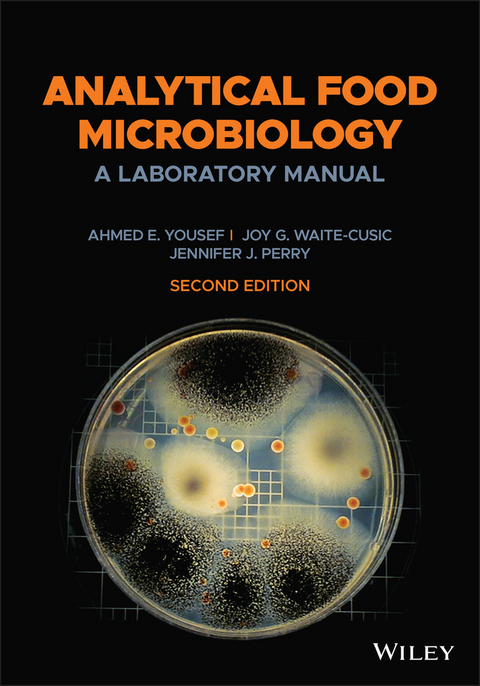
Analytical Food Microbiology (eBook)
John Wiley & Sons (Verlag)
978-1-119-42801-5 (ISBN)
The new edition of the highly regarded laboratory manual for courses in food microbiology
Analytical Food Microbiology: A Laboratory Manual develops the practical skills and knowledge required by students and trainees to assess the microbiological quality and safety of food. This user-friendly textbook covers laboratory safety, basic microbiological techniques, evaluation of food for various microbiological groups, detection and enumeration of foodborne pathogens, and control of undesirable foodborne microorganisms. Each well-defined experiment includes clear learning objectives and detailed explanations to help learners understand essential techniques and approaches in applied microbiology.
The fully revised second edition presents improved conventional techniques, advanced analytical methodologies, updated content reflecting emerging food safety concerns, and new laboratory experiments incorporating commercially available microbiological media. Throughout the book, clear and concise chapters explain culture- and molecular-based approaches for assessing microbial quality and safety of diverse foods. This expanded and updated resource:
- Reviews aseptic techniques, dilution, plating, streaking, isolation, and other basic microbiological procedures
- Introduces exercises and relevant microorganisms with pertinent background information and reference material
- Describes each technique using accessible explanatory text, detailed illustrations, and easy-to-follow flowcharts
- Employs a proven 'building block' approach throughout, with each new chapter building upon skills from the previous chapter
- Provides useful appendices of microbiological media, recommended control organisms, available supplies and equipment, and laboratory exercise reports
With methods drawn from the authors' extensive experience in academic, regulatory, and industry laboratories, Analytical Food Microbiology: A Laboratory Manual, Second Edition, is ideal for undergraduate and graduate students in food microbiology courses, as well as food processors and quality control personnel in laboratory training programs.
Ahmed E. Yousef, Professor, Department of Food Science and Technology, The Ohio State University, Columbus, Ohio, USA. His research focuses on decontamination of food with gaseous sanitizers, discovery of novel antimicrobial preservatives, and safety of food processed by emerging technology.
Joy G. Waite-Cusic, Associate Professor, Department of Food Science and Technology, Oregon State University, Corvallis, Oregon, USA. Her research examines pre-harvest food safety, process validation, pathogens in food systems, and microbiological quality.
Jennifer J. Perry, Associate Professor, School of Food and Agriculture, University of Maine, Orono, Maine, USA. Her research interests include food fermentation, biocontrol and biopreservation, and sources of contamination within the food production chain.
Ahmed E. Yousef, Professor, Department of Food Science and Technology, The Ohio State University, Columbus, Ohio, USA. His research focuses on decontamination of food with gaseous sanitizers, discovery of novel antimicrobial preservatives, and safety of food processed by emerging technology. Joy G. Waite-Cusic, Associate Professor, Department of Food Science and Technology, Oregon State University, Corvallis, Oregon, USA. Her research examines pre-harvest food safety, process validation, pathogens in food systems, and microbiological quality. Jennifer J. Perry, Associate Professor, School of Food and Agriculture, University of Maine, Orono, Maine, USA. Her research interests include food fermentation, biocontrol and biopreservation, and sources of contamination within the food production chain.
Preface vii
Part I. Basics of Food Microbiology Laboratory 1
1. Laboratory Safety 3
2. Sampling For Microbiological Analysis of Food and Processing Environment 13
3. Enumeration of Microorganisms In Food 28
4. Practicing Basic Techniques 46
Part II. Food Microbiota 63
5. Aerobic Mesophilic Plate Count 71
6. Mesophilic Sporeforming Bacteria 88
7. Pseudomonas Species and Other Spoilage Psychrotrophs 108
8. Detection and Enumeration of Enterobacteriaceae In Food 121
9. Examination and Enumeration of Foodborne Fungi 138
Part III. Foodborne Pathogens 171
10. Staphylococcus Aureus 183
11. Listeria Monocytogenes 220
12. Salmonella Enterica 254
13. Shiga Toxin-Producing Escherichia Coli 278
Part IV. Control of Foodborne Microorganisms 303
14. Thermal Resistance of Microorganisms In Food 307
15. Production of Bacteriocins In Milk 328
Appendix I Laboratory Exercise Report 346
Appendix II Bacterial and Fungal Strains Recommended For Use As Control Organisms 351
Appendix III Microbiological Media 354
Appendix IV Supplies and Equipment Availability 372
Index 379
CHAPTER 1
LABORATORY SAFETY
This chapter is intended to help students and other analysts maintain safety for themselves and coworkers while receiving microbiological training or executing laboratory exercises. Although the chapter does not cover every aspect of laboratory safety, it familiarizes laboratory workers with essential components of that safety. Successful and safe execution of a laboratory exercise by a student or a professional analyst requires the compliance with safety guidelines presented here, as well as those found in other resources. Additionally, it is important to emphasize that observance of common‐sense safety precautions is important in many situations.
BACKGROUND
Live microorganisms that are handled in microbiology laboratories may cause laboratory‐acquired infections (LAI). Safety of students in these laboratories requires observing and obeying a set of laboratory safety rules. It is essential that one becomes familiar with the food microbiology laboratory setup and safety guidelines before conducting any exercises. This knowledge not only minimizes the risk of LAI, but also leads to efficient use of time and laboratory resources. Once these rules are read and understood, students should sign a form indicating that they have read, understood, and are willing to comply with these rules. Completion of this step is needed before students can practice basic techniques and the instructor can ensure their compliance with the safety guidelines. Additionally, online or in‐person training may be required before students use certain microbiology laboratories.
Laboratory Environment and Personal Safety
There are many facets to the laboratory environment, ranging from tangible items such as fixtures, equipment, supplies, and waste disposal containers to more conceptual aspects such as safety. Laboratory instructors and students should be familiar enough with the laboratory environment to respond appropriately to safety issues and emergencies.
Microbiology laboratory equipment includes basic items such as incubators, refrigerators, water baths, autoclaves, centrifuges, and microscopes, to more contemporary equipment such as gel electrophoresis systems, multiple‐well (or microtiter) plate readers, and polymerase chain reaction (PCR) thermocyclers. Microbiology laboratories often contain biological safety cabinets and chemical fume hoods. A large array of small laboratory tools that are used routinely include pipettes, Bunsen burners, cell spreaders, streaking loops, and thermometers. Supplies and disposable items used in various exercises are also part of the laboratory environment.
Students will be able to complete various laboratory exercises successfully when all required equipment is available and in working order. To this end, a list of required equipment is included with each laboratory exercise in this manual. The students must understand the function of each piece of equipment and how to use it safely and correctly.
Food microbiology involves the study of numerous organisms, including those known to cause human diseases. Therefore, careful work habits are important to prevent the spread of disease to analysts or other workers who may use the laboratory space. Familiarity with the laboratory environment itself and with the procedures required to keep that environment safe and clean is a key component in good microbiology laboratory work.
Biosafety Levels
The health authorities in the US have created a publication regarding biosafety in microbiological and biomedical laboratories (see the reference listed at the end of this chapter). This manual sets forth guidelines for best practices for four biosafety levels. Each biosafety level has a particular set of protocols that laboratory users must follow to minimize risks to the laboratory workers and the public. There are protocols for primary containment (protection of individual workers) and secondary containment (protection of the public). The protocols provide guidance on laboratory security, laboratory practice and technique, required safety precautions, facility design and construction, and required training of supervisors and workers, as well as specific information regarding animal facilities, clinical facilities, and transportation of materials. The publication also contains listings of specific organisms and their assignment to risk groups (RG) with their recommended biosafety level. The following is a brief description of the four biosafety levels.
- Biosafety level 1 (BSL‐1)
- Appropriate for handling agents (RG‐1) that are not known to cause disease and are well characterized; examples include Bacillus subtilis and non‐pathogenic Escherichia coli.
- Required protective devices include doors, sinks for handwashing, easily cleaned work surfaces, screened windows, and bench tops that are impervious to water.
- No special construction or ventilation is required.
- Primary barriers (lab coat and gloves) are required.
- Biosafety level 2 (BSL‐2)
- Appropriate for handling moderate‐risk agents (RG‐2). These include agents associated with human disease, but for which immunization or antibiotic treatment is available; examples include Salmonella and Measles virus.
- All precautions for BSL‐1 are observed, plus doors must be lockable and marked with biohazard signs, eyewash station is available, air does not recirculate to non‐laboratory areas, and autoclave is available.
- Special work areas (e.g., biosafety cabinets) should be assigned for activities that might generate aerosols or splashing and for handling large volume or high concentration of organisms.
- Biosafety level 3 (BSL‐3)
- Appropriate for handling agents that may cause serious and potentially lethal infections (RG‐3). These include agents that are transmittable by aerosols. Examples of these agents are Mycobacterium tuberculosis and St. Louis encephalitis virus.
- All precautions for BSL‐2 are observed plus separate facility or zone with double door entry; inward only airflow with 10–12 air changes/hour; water‐resistant walls, floors, and ceilings; filtered vacuum lines; and respiratory protection may be required.
- Biosafety level 4 (BSL‐4)
- Appropriate for handling exotic agents (RG‐4) that (a) pose high risk of life‐threatening diseases, (b) are transmittable by infectious aerosols, and (c) for which no treatment is available. An example of these agents is Ebola virus.
- All precautions for BSL‐3 are observed plus single‐pass dedicated air system; walls, ceilings, and floors create an internal seal; all liquid effluent and solid waste are decontaminated; entry doors cannot be opened simultaneously; communication system; emergency generator, positive pressure personnel suit, and showering upon exit are required.
Note: Food microbiology laboratories that accommodate pathogen work are classified as BSL‐2.
Decontamination and Waste Disposal
Contaminated but reusable laboratory utensils and glassware should be decontaminated before cleaning. Chemical disinfection or autoclaving are often used in this case. Contaminated disposable items (e.g., disposable gloves, pipettes, and agar plates) should be placed in designated biohazard boxes with liners. Disposal of these biohazard boxes should be managed by a professional service, which may subject these items to incineration or other validated decontamination method.
PERSONAL SAFETY IN THE LABORATORY
It is important that students become familiar with the personal protective equipment required for working in a microbiology laboratory as well as safety‐associated procedures and etiquette.
Personal Protective Equipment
Personal protective equipment (PPE) is needed to protect against physical, chemical, and biological laboratory hazards. Availability of this equipment is important but adequate training on how to use it is equally important. The following is a partial list of PPE, but others may be needed:
- Safety glasses: These should be cleaned and sanitized before and after use. Alcohol wipes may be adequate for the sanitization.
- Laboratory gowns or coats: These should be used and kept in the laboratory.
- Face masks and face shields: Masks and shields protect against splashes and aerosolized droplets and particles. These are also essential to prevent the spread of infectious airborne agents.
- Gloves: Use of disposable gloves is essential for most laboratory activities.
Observing Personal Safety
- Appropriate attire. Wear appropriate clothing for laboratory work. Closed‐toe shoes must be worn during each laboratory period. No sandals, open‐toe shoes, or bare feet are permitted. Shorts may be disallowed.
- Winter coats and backpacks are stored away from the bench. Keep these items at a safe distance from the laboratory bench and preferably outside of the laboratory. Coat hangers, cupboards, or preferably lockers should be used to store these items temporarily while students are working in the laboratory.
- Items brought to the bench are subject to contamination; these should be kept to a minimum. Keep...
| Erscheint lt. Verlag | 5.1.2022 |
|---|---|
| Sprache | englisch |
| Themenwelt | Naturwissenschaften ► Biologie |
| Naturwissenschaften ► Chemie ► Analytische Chemie | |
| Technik | |
| Weitere Fachgebiete ► Land- / Forstwirtschaft / Fischerei | |
| Schlagworte | Analytical Chemistry • analytical microbiology lab manual • Analytische Chemie • applied food microbiology manual • Biowissenschaften • Chemie • Chemistry • food microbiology exercises • food microbiology experiments • food pathogens lab manual</p> • Food Science & Technology • Lebensmittelforschung u. -technologie • Lebensmittelsicherheit • Lebensmitteltechnik • Life Sciences • <p>food microbiology lab manual • microbiological lab methods • microbiological lab techniques • Microbiology & Virology • Mikrobiologie • Mikrobiologie u. Virologie |
| ISBN-10 | 1-119-42801-7 / 1119428017 |
| ISBN-13 | 978-1-119-42801-5 / 9781119428015 |
| Informationen gemäß Produktsicherheitsverordnung (GPSR) | |
| Haben Sie eine Frage zum Produkt? |
 EPUB (Adobe DRM)
Kopierschutz: Adobe-DRM
Adobe-DRM ist ein Kopierschutz, der das eBook vor Mißbrauch schützen soll. Dabei wird das eBook bereits beim Download auf Ihre persönliche Adobe-ID autorisiert. Lesen können Sie das eBook dann nur auf den Geräten, welche ebenfalls auf Ihre Adobe-ID registriert sind.
Details zum Adobe-DRM
Dateiformat: EPUB (Electronic Publication)
EPUB ist ein offener Standard für eBooks und eignet sich besonders zur Darstellung von Belletristik und Sachbüchern. Der Fließtext wird dynamisch an die Display- und Schriftgröße angepasst. Auch für mobile Lesegeräte ist EPUB daher gut geeignet.
Systemvoraussetzungen:
PC/Mac: Mit einem PC oder Mac können Sie dieses eBook lesen. Sie benötigen eine
eReader: Dieses eBook kann mit (fast) allen eBook-Readern gelesen werden. Mit dem amazon-Kindle ist es aber nicht kompatibel.
Smartphone/Tablet: Egal ob Apple oder Android, dieses eBook können Sie lesen. Sie benötigen eine
Geräteliste und zusätzliche Hinweise
Buying eBooks from abroad
For tax law reasons we can sell eBooks just within Germany and Switzerland. Regrettably we cannot fulfill eBook-orders from other countries.
aus dem Bereich