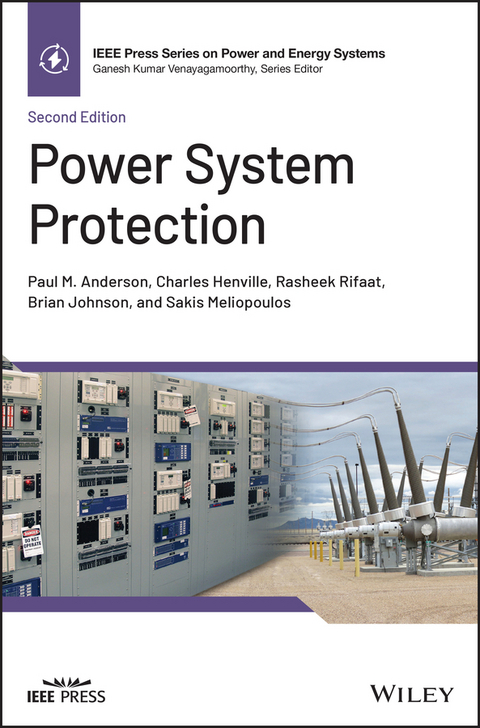
Power System Protection (eBook)
John Wiley & Sons (Verlag)
978-1-119-51311-7 (ISBN)
Power System Protection, 2nd Edition combines brand new information about the technological and business developments in the field of power system protection that have occurred since the last edition was published in 1998.
The new edition includes updates on the effects of short circuits on:
- Power quality
- Multiple setting groups
- Quadrilateral distance relay characteristics
- Loadability
It also includes comprehensive information about the impacts of business changes, including deregulation, disaggregation of power systems, dependability, and security issues. Power System Protection provides the analytical basis for design, application, and setting of power system protection equipment for today's engineer. Updates from protection engineers with distinct specializations contribute to a comprehensive work covering all aspects of the field.
New regulations and new components included in modern power protection systems are discussed at length. Computer-based protection is covered in-depth, as is the impact of renewable energy systems connected to distribution and transmission systems.
PAUL M. ANDERSON, PhD, served as a professor of engineering at Iowa State University, Arizona State University, and as a visiting professor at Washington State University. He also founded consulting firm Power Math Associates, and was elected to the National Academy of Engineering in 2009. Dr. Anderson passed away in 2011.
CHARLES F. HENVILLE is the President and Principal Engineer of Henville Consulting, Inc. He is a Fellow of the IEEE Power Engineering Society, as well as a certified trainer in ASPEN OneLinertm Power System and Protective Relaying modeling software.
RASHEEK RIFAAT is a Technical Director, Electrical with more than 40 years of Canadian and overseas experience with various projects, ranging from installation of control panels and 600 V MCCs for material handling systems to large 800 MW thermal generating stations.
BRIAN JOHNSON, PhD, is a University Distinguished Professor of Electrical Engineering and Schweitzer Engineering Laboratories Endowed Chair in Power Engineering. He is a Senior Member of the IEEE, and an Individual Member of CIGRE.
SAKIS MELIOPOULOS, PhD, is a Distinguished Professor at Georgia Tech. He is the co-inventor of the Smart Ground Multimeter and the Macrodyne PMU-based Harmonic Measurement System for transmission networks.
A newly updated guide to the protection of power systems in the 21st century Power System Protection, 2nd Edition combines brand new information about the technological and business developments in the field of power system protection that have occurred since the last edition was published in 1998. The new edition includes updates on the effects of short circuits on: Power quality Multiple setting groups Quadrilateral distance relay characteristics Loadability It also includes comprehensive information about the impacts of business changes, including deregulation, disaggregation of power systems, dependability, and security issues. Power System Protection provides the analytical basis for design, application, and setting of power system protection equipment for today's engineer. Updates from protection engineers with distinct specializations contribute to a comprehensive work covering all aspects of the field. New regulations and new components included in modern power protection systems are discussed at length. Computer-based protection is covered in-depth, as is the impact of renewable energy systems connected to distribution and transmission systems.
PAUL M. ANDERSON, PhD, (deceased) served as a professor of engineering at Iowa State University, Arizona State University, and as a visiting professor at Washington State University. He also founded consulting firm Power Math Associates, and was elected to the National Academy of Engineering in 2009. Dr. Anderson passed away in 2011. CHARLES F. HENVILLE is the President and Principal Engineer of Henville Consulting, Inc. He is a Fellow of the IEEE Power and Energy Systems Society, and past Chairman of the Power Systems Relaying Committee of the IEEE Power and Energy Systems Society. RASHEEK RIFAAT is a Technical Director, Electrical with more than 40 years of Canadian and overseas experience with various projects, ranging from installation of control panels and 600 V MCCs for material handling systems to large 800 MW thermal generating stations. BRIAN JOHNSON, PhD, is a University Distinguished Professor of Electrical Engineering and Schweitzer Engineering Laboratories Endowed Chair in Power Engineering. He is a Senior Member of the IEEE, and an Individual Member of CIGRE. SAKIS MELIOPOULOS, PhD, is a Distinguished Professor at Georgia Tech. He is the co-inventor of the Smart Ground Multimeter and the Macrodyne PMU-based Harmonic Measurement System for transmission networks.
List of Symbols
The general rules used for symbols in this book are as follows. Letter symbols for units of physical quantities (unit symbol abbreviations) are given in Roman or Greek typeface, e.g. A for amperes, VA for voltamperes, or Ω for ohms. Mathematical variables are always given in italic typeface, and may be either Roman or Greek, e.g. v for instantaneous voltage, V for rms phasor voltage magnitude, or λ for failure rate of a component. Complex numbers, such as phasors, are given in bold italic typeface, e.g. I for current and V for voltage. Matrices are specified by bold Roman typeface, e.g. Z for an impedance matrix. The following tabulations give specific examples of symbols used in this book.
1. Capitals
| A | ampere; unit symbol abbreviation for current |
| A | complex two port network transmission parameter |
| B | = Im Y, susceptance |
| B | complex two‐port transmission parameter |
| C | capacitance |
| CTI | coordination time interval |
| C | complex two‐port transmission parameter |
| D | damping constant |
| D | complex two‐port transmission parameter |
| E | source emf; voltage |
| ES | source voltage, relay equivalent circuit |
| EU | source voltage, relay equivalent circuit |
| F | failure probability |
| F | farad; unit symbol abbreviation for capacitance |
| G | = Re Y, conductance |
| H | inertia constant |
| H | henry, unit symbol abbreviation for inductance |
| Hz | hertz, unit symbol abbreviation for frequency |
| I | rms current magnitude |
| I | rms phasor current |
| K | spring constant; controller gain |
| L | inductance |
| LL | line‐to‐line |
| LN | line‐to‐neutral |
| M | = 106, mega, a prefix |
| M | matrix defining relay voltage and current |
| MOC | minimum operating current, overcurrent relay |
| N | newton, unit symbol abbreviation for force |
| P | average real power |
| Pn | natural power of a transmission line, SIL |
| Q | average reactive power, unavailability |
| R | = Re Z, resistance |
| S | = P + jQ, complex apparent power |
| SB | base complex or apparent power, VA |
| SIL | surge impedance loading of a transmission line |
| T | time constant |
| V | rms voltage magnitude |
| V | rms phasor voltage |
| V | volt, unit symbol abbreviation for voltage |
| VA | volt‐ampere, unit symbol abbreviation for apparent power |
| VAR | volt‐ampere, reactive, unit symbol abbreviation for var |
| W | number of failures in a specified time period |
| W | watt, unit symbol abbreviation for active power |
| X | = Im Z, reactance |
| Y | = G + jB, complex admittance |
| YC | characteristic admittance of a transmission line +1/ZC |
| Y | admittance magnitude |
| Y | admittance matrix |
| Z | = R + jX, complex impedance |
| ZR | impedance seen at the relay at R |
| ZE | external system impedance of a network equivalent |
| ZS | source impedance of a network equivalent |
| ZU | source impedance of a network equivalent |
| ZF | fault impedance |
| Z | impedance magnitude |
| Z | impedance matrix |
2. Lowercase
| ac | alternating current |
| a–b–c | phase designation of three phase currents or voltages |
| b | = ωc, line susceptance per unit length |
| c | capacitance per unit length |
| dc | direct current |
| det | determinant of a matrix |
| e | base for natural logarithms |
| f | frequency |
| h | distance measurement parameter |
| i | instantaneous current designation |
| j | , a 90° operator |
| k | = 103, kilo, an mks prefix |
| k | degree of series compensation |
| l | inductance per unit length |
| ℓ | length of a transmission line |
| In, log | natural (base e) logarithm, base 10 logarithm |
| m | = 10−3, milli…, an mks prefix |
| m | mutual inductance per unit length |
| pu | per unit |
| p | instantaneous power; Maxwell's coefficient |
| r | apparatus resistance |
| s | distance along a transmission line |
| t | time |
| v | instantaneous voltage |
| var | voltampere reactive, when used as a noun or adjective |
| w | frequency of failure |
| x | line reactance per unit length; apparatus reactance |
| y | line shunt admittance per unit length |
| z | line impedance per unit length |
3. Uppercase Greek
| Δ | delta connection; determinant (of a matrix) |
| Σ | summation notation |
| Ω | ohm, unit symbol abbreviation for impedance |
4. Lowercase Greek
| γ | propagation constant of a transmission line |
| δ | voltage phase angle |
| ζ | magnitude of impedance |
| θ | phase angle of voltage or current, angle of impedance |
| λ | item failure in reliability calculations |
| μ | = 10−6, micro, an mks prefix |
| π | pi |
| ρ | resistivity, magnitude of admittance |
| τ | time constant |
| φ | phase angle of voltage or current, angle of admittance |
| ω | radian frequency |
5. Subscripts
| a | phase a |
| A | phase... |
| Erscheint lt. Verlag | 29.12.2021 |
|---|---|
| Reihe/Serie | IEEE Press Series on Power and Energy Systems |
| IEEE Press Series on Power Engineering | IEEE Press Series on Power Engineering |
| Sprache | englisch |
| Themenwelt | Technik ► Elektrotechnik / Energietechnik |
| Schlagworte | developments in power system protection • Electrical & Electronics Engineering • electric power systems • Elektrische Energietechnik • Elektrotechnik u. Elektronik • Energie • Energy • Erneuerbare Energien • foundations of power system protection • fundamentals of power system protection • Power engineering • power protection engineering • Power System Engineering • protection engineering • Qualität u. Zuverlässigkeit • Quality & Reliability • renewable energy • Systems Engineering • Technische Zuverlässigkeit |
| ISBN-10 | 1-119-51311-1 / 1119513111 |
| ISBN-13 | 978-1-119-51311-7 / 9781119513117 |
| Informationen gemäß Produktsicherheitsverordnung (GPSR) | |
| Haben Sie eine Frage zum Produkt? |
 EPUB (Adobe DRM)
Kopierschutz: Adobe-DRM
Adobe-DRM ist ein Kopierschutz, der das eBook vor Mißbrauch schützen soll. Dabei wird das eBook bereits beim Download auf Ihre persönliche Adobe-ID autorisiert. Lesen können Sie das eBook dann nur auf den Geräten, welche ebenfalls auf Ihre Adobe-ID registriert sind.
Details zum Adobe-DRM
Dateiformat: EPUB (Electronic Publication)
EPUB ist ein offener Standard für eBooks und eignet sich besonders zur Darstellung von Belletristik und Sachbüchern. Der Fließtext wird dynamisch an die Display- und Schriftgröße angepasst. Auch für mobile Lesegeräte ist EPUB daher gut geeignet.
Systemvoraussetzungen:
PC/Mac: Mit einem PC oder Mac können Sie dieses eBook lesen. Sie benötigen eine
eReader: Dieses eBook kann mit (fast) allen eBook-Readern gelesen werden. Mit dem amazon-Kindle ist es aber nicht kompatibel.
Smartphone/Tablet: Egal ob Apple oder Android, dieses eBook können Sie lesen. Sie benötigen eine
Geräteliste und zusätzliche Hinweise
Buying eBooks from abroad
For tax law reasons we can sell eBooks just within Germany and Switzerland. Regrettably we cannot fulfill eBook-orders from other countries.
aus dem Bereich