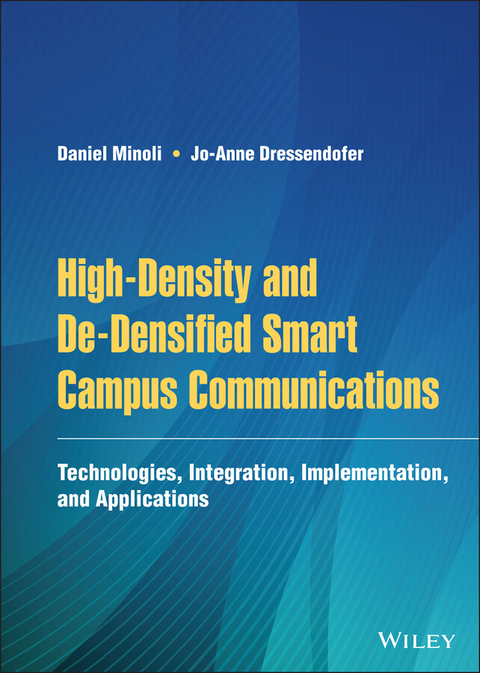
High-Density and De-Densified Smart Campus Communications (eBook)
368 Seiten
John Wiley & Sons (Verlag)
978-1-119-71608-2 (ISBN)
Design, deliver, and implement high-density communications solutions
High-density campus communications are critical in the operation of densely populated airports, stadiums, convention centers, shopping malls, classrooms, hospitals, dense smart cities, and more. They also drive Smart City and Smart Building use cases as High-Density Communications (HDC) become recognized as an essential fourth utility. However, the unique requirements and designs demanded by HDC make implementation challenging.
In High-Density and De-Densified Smart Campus Communications: Technologies, Integration, Implementation and Applications, a team of experienced technology strategists delivers a one-of-a-kind treatment of the requirements, technologies, designs, solutions, and trends associated with HDC. From the functional requirements for HDC and emerging data/Wi-Fi 6/internet access/5G cellular/OTT video, and IoT automation--including pandemic-related de-densification--to the economics of broad deployment of HDC, this book includes coverage of every major issue faced by the professionals responsible for the design, installation, and maintenance of high-density communication networks. It also includes:
* A thorough introduction to traditional and emerging voice/cellular design for campus applications, including the Distributed Antenna System (DAS)
* Comprehensive explorations of traditional sensor networks and Internet of Things services approaches
* Practical discussions of high-density Wi-Fi hotspot connectivity and related technologies, like Wi-Fi 5, Wi-Fi 6, spectrum, IoT, VoWiFi, DASs, microcells issues, and 5G versus Wi-Fi issues
* In-depth examinations of de-densification, office social distancing, and Ultra-Wideband (UWB) technologies
Perfect for telecommunication researchers and engineers, networking professionals, technology planners, campus administrators, and equipment vendors, High-Density Smart Campus Communications will also earn a place in the libraries of senior undergraduate and graduate students in applied communications technologies.
David Minoli is the principal consultant at DVI Communications. He has testified as an expert witness in approximately twenty cases and been affiliated with Nokia, Ericsson, AT&T, SES, NYU, and the Stevens Institute of Technology. He is the author or co-author of numerous networking and wireless books, including Innovations in Satellite Communications and Satellite Technology: The Industry Implications of DVB-S2X, High Throughput Satellites, Ultra HD, M2M, and IP. Jo-Anne Dressendofer is the Founder of Slice Wireless Solutions (SliceWiFi) and has over 25 years' experience as a recognized top performer and leader driving creativity into the network technology industry. Covered in this publication, her award-winning organization is responsible for developing and deploying the patent-pending HDC super-integrated network known as WiSNET¯®.
PREFACE
ACKNOWLEDGMENTS
ACRONYMS
SYMBOLS
1 Introduction
1.1 Solar Energy
1.2 Diverse Solar Energy Applications
1.3 Global PV Power Plants
1.4 Perspective of PV Power Plants
1.5 A Review on the Design of Large-Scale PV Power Plant
1.6 Outline of the Book
References
2 Design Requirements
2.1 Overview
2.2 Development Phases
2.3 Project Predesign
2.4 Project Detailed Design
2.5 The Main Components Required for Realizing an LS-PVPP
2.6 An Overview of PV Technologies
2.7 Solar Inverter Topologies Overview
2.8 Solar Panel Mounting
2.9 Solar Panel Tilt
2.10 Solar Tracking System
References
3 Feasibility Studies
3.1 Introduction
3.2 Preliminary Feasibility Studies
3.3 Technical Feasibility Study
3.4 Environmental Feasibility
3.5 Social Feasibility
3.6 Economic Feasibility
3.7 Timing Feasibility
3.8 Summary
References
4 Grid Connection Studies
4.1 Introduction
4.2 Introducing Topics of Grid Connection Studies
4.3 Modeling of Grid and PV Power Plants
4.4 Summary
References
5 Solar Resource and Irradiance
5.1 Introduction
5.2 Radiometric Terms
5.3 Solar Resources
5.4 Solar Energy Radiation on Panels
5.5 Solar Azimuth and Altitude Angle
5.6 Tilt Angle and Orientation
5.7 Shadow Distances and Row Spacing
References
6 Large-Scale PV Plant Design Overview
6.1 Introduction
6.2 Classification of LSPVPP Engineering Documents
6.3 Roadmap Proposal for LSPVPP Design
6.4 Conclusion
References
7 PV Power Plant DC Side Design
7.1 Introduction
7.2 DC Side Design Methodology
7.3 PV Modules Selection
7.4 Inverter Selection
7.5 PV Modules Number
7.6 Size of PV Plant DC Side
7.7 DC Cables
7.8 DC Box Combiner
7.9 String Diode
7.10 Fuse
7.11 Surge Arrester
7.12 DC Switch
7.13 Conclusion
Note
References
8 PV System Losses and Energy Yield
8.1. Introduction
8.2. PV System Losses
8.3. Energy Yield Prediction
8.4. Conclusion
References
| Erscheint lt. Verlag | 6.12.2021 |
|---|---|
| Sprache | englisch |
| Themenwelt | Technik ► Elektrotechnik / Energietechnik |
| Schlagworte | Communication Technology - Networks • Drahtlose Kommunikation • Electrical & Electronics Engineering • Elektrotechnik u. Elektronik • Energie • Energy • Kommunikationsnetz • Kommunikationsnetze • Mobile & Wireless Communications • Smart Grid |
| ISBN-10 | 1-119-71608-X / 111971608X |
| ISBN-13 | 978-1-119-71608-2 / 9781119716082 |
| Informationen gemäß Produktsicherheitsverordnung (GPSR) | |
| Haben Sie eine Frage zum Produkt? |
 EPUB (Adobe DRM)
Kopierschutz: Adobe-DRM
Adobe-DRM ist ein Kopierschutz, der das eBook vor Mißbrauch schützen soll. Dabei wird das eBook bereits beim Download auf Ihre persönliche Adobe-ID autorisiert. Lesen können Sie das eBook dann nur auf den Geräten, welche ebenfalls auf Ihre Adobe-ID registriert sind.
Details zum Adobe-DRM
Dateiformat: EPUB (Electronic Publication)
EPUB ist ein offener Standard für eBooks und eignet sich besonders zur Darstellung von Belletristik und Sachbüchern. Der Fließtext wird dynamisch an die Display- und Schriftgröße angepasst. Auch für mobile Lesegeräte ist EPUB daher gut geeignet.
Systemvoraussetzungen:
PC/Mac: Mit einem PC oder Mac können Sie dieses eBook lesen. Sie benötigen eine
eReader: Dieses eBook kann mit (fast) allen eBook-Readern gelesen werden. Mit dem amazon-Kindle ist es aber nicht kompatibel.
Smartphone/Tablet: Egal ob Apple oder Android, dieses eBook können Sie lesen. Sie benötigen eine
Geräteliste und zusätzliche Hinweise
Buying eBooks from abroad
For tax law reasons we can sell eBooks just within Germany and Switzerland. Regrettably we cannot fulfill eBook-orders from other countries.
aus dem Bereich