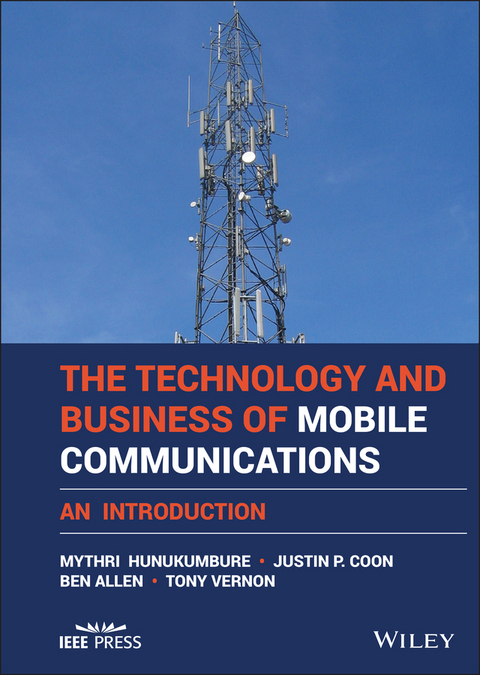
The Technology and Business of Mobile Communications (eBook)
John Wiley & Sons (Verlag)
978-1-119-13031-4 (ISBN)
An intuitive and insightful overview of the technical and business aspects of the telecoms industry
In The Technology and Business of Mobile Telecommunications: An Introduction, a team of expert telecommunications researchers and consultants delivers a rigorous exploration of the technical and business aspects of mobile telecommunications. The book offers a complete overview of an industry that has seen rapid technical and economic changes while retaining the ability to provide end users with communications coverage and capacity.
The authors demonstrate the technical foundations of the mobile industry and show how a communications network is deployed. They detail many of the main innovations introduced over the last few years and some of the most salient challenges facing the industry today. The business models of major mobile operators are examined as well, from the purchasing spectrum to network deployment and customer attraction and retention.
The role of the regulator is also thoroughly discussed, with explorations of its role in encouraging the maintenance of a competitive market in which the needs of consumers are met.
Readers will also enjoy:
- Thorough introductions to the social and economic impacts of mobile communications, as well as a brief history of mobile and cellular communications
- Comprehensive explorations of the mobile telecoms ecosystem, from spectrum regulation to standardization, research, end users, operators, vendors, and standard bodies
- Practical discussions of the business models and challenges of mobile operators, including mobile virtual network operators and the implementation of international roaming
- In-depth examinations of telecommunications standards, including 5G
Perfect for anyone studying mobile telecommunications technology at the undergraduate and graduate levels, The Technology and Business of Mobile Telecommunications: An Introduction is also an indispensable resource for practitioners within the telecommunications industry in a technical or business-oriented role.
Mythri Hunukumbure earned his PhD degree in Telecommunication Engineering from the University of Bristol in 2004. He is currently a Principal Research Engineer and a Project Lead at Samsung Electronics R&D Institute UK. He has contributed to and later led mobile communication research, standardisation, and product development activities. While at Samsung, he has participated in flagship EU projects mmMAGIC, ONE5G and 5G LOCUS as a work package leader. He is actively contributing to 3GPP RAN1 and SA2 standardisation topics, securing vital IPR. He has filed around 50 patents to date and has also published extensively in leading conferences and journals, receiving the best paper award at the World Telecommunications Congress (WTC) in 2012.
Justin P. Coon received his PhD in Communications from the University of Bristol, UK in 2005. From 2004 until 2013, he held various technical and management positions at Toshiba Research Europe Ltd. (TREL). Professor Coon also held a Reader position in the Department of Electrical and Electronic Engineering at the University of Bristol from 2012 until 2013. In 2013, he took a faculty position at Oxford University with a Tutorial Fellowship at Oriel College. Professor Coon is a Fellow of the Institute of Mathematics and Its Applications (FIMA) and a Senior Member of the Institute of Electrical and Electronics Engineers (IEEE).
Ben Allen completed his PhD degree at the University of Bristol in 2001. He completed a Royal Society Industry Fellowship with the University of Oxford and Network Rail, and has led several R&D activities involving telecoms for railways, several of which exhibit state-of-the-art advances. He is now working in the satellite communications industry. He has published numerous papers and several books on radio and telecommunications research developments. Dr Allen is a Chartered Engineer, Fellow of the Institution of Engineering & Technology, Institute of Telecommunications Professionals and the Higher Education Academy.
Tony Vernon graduated from the University of Glasgow, UK, in 1987 with a Joint Honours in Electronic Engineering with Physics. After a few years in the cellular industry, he obtained chartered status and in 2002 received a PhD in Mobile Telecoms from the University of Bristol, UK. His main interests and career contributions lie in the planning and optimisation of digital mobile networks ranging from the dawn of 2G in 1991 to 5G in 2021. Dr Vernon's focus has moved to the vehicular channel (V2X) and the future use of soon-to-be-ubiquitous mobile broadband networks for national and public-access broadcasting. He is based on the Scottish Outer Hebridean island of South Uist and is passionate about expanding 4G and 5G mobile broadband connectivity to rural and remote areas.
An intuitive and insightful overview of the technical and business aspects of the telecoms industry In The Technology and Business of Mobile Telecommunications: An Introduction, a team of expert telecommunications researchers and consultants delivers a rigorous exploration of the technical and business aspects of mobile telecommunications. The book offers a complete overview of an industry that has seen rapid technical and economic changes while retaining the ability to provide end users with communications coverage and capacity. The authors demonstrate the technical foundations of the mobile industry and show how a communications network is deployed. They detail many of the main innovations introduced over the last few years and some of the most salient challenges facing the industry today. The business models of major mobile operators are examined as well, from the purchasing spectrum to network deployment and customer attraction and retention. The role of the regulator is also thoroughly discussed, with explorations of its role in encouraging the maintenance of a competitive market in which the needs of consumers are met. Readers will also enjoy: Thorough introductions to the social and economic impacts of mobile communications, as well as a brief history of mobile and cellular communications Comprehensive explorations of the mobile telecoms ecosystem, from spectrum regulation to standardization, research, end users, operators, vendors, and standard bodies Practical discussions of the business models and challenges of mobile operators, including mobile virtual network operators and the implementation of international roaming In-depth examinations of telecommunications standards, including 5G Perfect for anyone studying mobile telecommunications technology at the undergraduate and graduate levels, The Technology and Business of Mobile Telecommunications: An Introduction is also an indispensable resource for practitioners within the telecommunications industry in a technical or business-oriented role.
Mythri Hunukumbure earned his PhD degree in Telecommunication Engineering from the University of Bristol in 2004. He is currently a Principal Research Engineer and a Project Lead at Samsung Electronics R&D Institute UK. He has contributed to and later led mobile communication research, standardisation, and product development activities. While at Samsung, he has participated in flagship EU projects mmMAGIC, ONE5G and 5G LOCUS as a work package leader. He is actively contributing to 3GPP RAN1 and SA2 standardisation topics, securing vital IPR. He has filed around 50 patents to date and has also published extensively in leading conferences and journals, receiving the best paper award at the World Telecommunications Congress (WTC) in 2012. Justin P. Coon received his PhD in Communications from the University of Bristol, UK in 2005. From 2004 until 2013, he held various technical and management positions at Toshiba Research Europe Ltd. (TREL). Professor Coon also held a Reader position in the Department of Electrical and Electronic Engineering at the University of Bristol from 2012 until 2013. In 2013, he took a faculty position at Oxford University with a Tutorial Fellowship at Oriel College. Professor Coon is a Fellow of the Institute of Mathematics and Its Applications (FIMA) and a Senior Member of the Institute of Electrical and Electronics Engineers (IEEE). Ben Allen completed his PhD degree at the University of Bristol in 2001. He completed a Royal Society Industry Fellowship with the University of Oxford and Network Rail, and has led several R&D activities involving telecoms for railways, several of which exhibit state-of-the-art advances. He is now working in the satellite communications industry. He has published numerous papers and several books on radio and telecommunications research developments. Dr Allen is a Chartered Engineer, Fellow of the Institution of Engineering & Technology, Institute of Telecommunications Professionals and the Higher Education Academy. Tony Vernon graduated from the University of Glasgow, UK, in 1987 with a Joint Honours in Electronic Engineering with Physics. After a few years in the cellular industry, he obtained chartered status and in 2002 received a PhD in Mobile Telecoms from the University of Bristol, UK. His main interests and career contributions lie in the planning and optimisation of digital mobile networks ranging from the dawn of 2G in 1991 to 5G in 2021. Dr Vernon's focus has moved to the vehicular channel (V2X) and the future use of soon-to-be-ubiquitous mobile broadband networks for national and public-access broadcasting. He is based on the Scottish Outer Hebridean island of South Uist and is passionate about expanding 4G and 5G mobile broadband connectivity to rural and remote areas.
List of Abbreviations
| 6G | 6th Generation |
| 5G | 5th Generation |
| 4G | 4th Generation |
| 3G | 3rd Generation |
| 2G | 2nd Generation |
| 1G | 1st Generation |
| 3GPP | 3rd Generation Partnership Project |
| 8-PSK | 8-Phase Shift Keying |
| AAA | Authentication, Authorisation and Accounting |
| ABS | Almost Blank Sub-frames |
| AI | Artificial Intelligence |
| AMF | Access and Mobility Function |
| AMPS | Advanced Mobile Phone System |
| ANDSF | Access Network Discovery and Selection Function |
| ANR | Automatic Neighbour Relation |
| API | Application Programming Interfaces |
| AR | Augmented Reality |
| ARPU | Average Revenue Per User |
| AUSF | Authentication Server Function |
| AWGN | Additive White Gaussian Noise |
| B2B | Business to business |
| BBU | Baseband Processing Unit |
| BER | Bit Error Rate |
| BiTA | Blockchain in Transport Alliance |
| BJCR | Bahl-Cocke-Jelinek-Raviv |
| bps | bits per second |
| BSC | Base Station Controller |
| BSS | Base Station Subsystem |
| BTS | Base Transceiver Station |
| BWP | Bandwidth Parts |
| CA | Carrier Aggregation |
| CAGR | Compound Annual Growth Rate |
| CAPEX | Capital Expenditure |
| CBRS | Citizen’s Broadband Radio Service |
| CDF | Cumulative Distribution Function |
| CDMA | Code Division Multiple Access |
| C-ITS | Co-operative Intelligent Transport Systems |
| CLSP | Close-loop Spatial Multiplexing |
| CN | Core Network |
| CO | Central Office |
| CoMP | Coordinated Multipoint |
| COTS | commercial off-the-shelf |
| CP | Control Plane |
| CPE | Common Phase Error |
| CPRI | Common Public Radio Interface |
| CQI | Channel Quality Indicator |
| C-RAN | Cloud Radio Access Network |
| CRC | Cyclic Redundancy Check |
| CRE | Cell Range Expansion |
| CRS | Common Reference Signal |
| CU | Centralised Unit |
| D2D | Device to Device |
| DAB | Digital Audio Broadcasting |
| DAS | Distributed Antenna Systems |
| DC | Dual Connectivity |
| DEM | Digital Evaluation Model |
| DFD | Division Free Duplex |
| DFE | Decision Feedback Equalizer |
| DFP | Dynamic Frequency Planning |
| DRX | Discontinuous Reception Cycle |
| DSCs | Drone Small Cells |
| DSP | Digital Signal Processing |
| DSRC | Dedicated Short Range Communications |
| DSSS | Direct-sequence spread spectrum |
| DTM | Digital Terrain Model |
| DU | Dense Urban |
| DVB | Digital Video Broadcasting |
| DWDM | Dense Wavelength Division Multiplexing |
| EB | Exabyte |
| ECC | Electronic Communications Committee |
| EDGE | Enhanced Data rates for GSM Evolution |
| EEA | European Economic Area |
| Eicic | Enhanced Inter-cell Interference Coordination |
| EMF | Electromagnetic Field |
| EPC | Evolved Packet Core |
| ESN | Emergency Services Network |
| ETSI | European Telecommunications Standards Institute |
| E-UTRAN | Evolved UTRAN |
| EV-DO | Evolution Data Only |
| EV-DO | Evolution Data Optimised |
| FAT | Frequency Allocation Table |
| FCC | Federal Communications Commission |
| FD | Full Duplex |
| FDD | Frequency Division Duplexing |
| FDMA | Frequency Division Multiple Access |
| FFM | Fast Fade Margin |
| FFR | Fractional Frequency Reuse |
| FOMA | Freedom of Mobile Multimedia Access |
| FPS | Full Power Sub-frames |
| FRAND | Fair, Reasonable and Non-Discriminatory |
| FSPL | Free-space Path Loss |
| FTP | File Transfer Protocol |
| FTTH | fibre-to-th-home |
| FWA | Fixed Wireless Access |
| GAN | Generic Access Network |
| Gbps | gigabits per second |
| GBT | Guaranteed Bit Rate |
| GCF | Global Certification Forum |
| GDP | Gross Domestic Product |
| GGSN | Gateway GPRS Support Node |
| GMSK | Gaussian Minimum Shift Keying |
| GPRS | General Packet Radio System |
| GSM | Groupe Spécial Mobile |
| HARQ | Hybrid Automatic Repeat Request |
| HEO | High Elliptical Satellite |
| GSMA | Global System for Mobile Communications |
| GSS | GPRS sub-system |
| HAP | High Altitude Platforms |
| H-CRAN | Heterogeneous Cloud Radio Access Network |
| HDD | Hard Disk Drive |
| HetNet | Heterogeneous Network |
| HH | Horizontal to Horizontal |
| HLR | Home Location Register |
| HeNB | Home eNodeB |
| HM | Hysteresis Margin |
| HNB | Home NodeB |
| HOFs | Hand Over Failures |
| HSS | Home Subscription Server |
| HSDPA | High Speed Downlink Packet Access |
| HSPA | High Speed Packet Access |
| HSUPA | High Speed Uplink Packet Access |
| IAB | Integrated Access and Backhaul |
| ICIC | Inter-cell Interference Coordination |
| ICNIRP | International Commission on Non-Ionising Radiation Protection |
| ICO | Intelligent Cell Optimisation |
| IETF | Internet Engineering Task Force |
| IFFT | Inverse Fast Fourier Transform |
| IMS | IP Multimedia Sub-system |
| IP | Internet Protocol |
| IPR | Intellectual Property Rights |
| IoT | Internet of Things |
| ISD | Inter-site Distance |
| ISG | Industry Specification Group |
| ISI | Inter-Symbol Interference |
| ITU | International Telecommunication Union |
| kbps | kilobits per second |
| KPI | Key Performance Indicator |
| LA | Location Area |
| LAA | Licensed Assisted Access |
| LAMM | Linear... |
| Erscheint lt. Verlag | 3.12.2021 |
|---|---|
| Reihe/Serie | IEEE Press |
| Wiley - IEEE | Wiley - IEEE |
| Sprache | englisch |
| Themenwelt | Technik ► Elektrotechnik / Energietechnik |
| Schlagworte | Business & Management • Business Technology • Communication technology • Drahtlose Kommunikation • Electrical & Electronics Engineering • Elektrotechnik u. Elektronik • Kommunikationstechnik • Mobile & Wireless Communications • Mobile Communications • mobile communications technology • mobile telecommunications basics • mobile telecommunications fundamentals • mobile telecommunications introduction • mobile telecommunications regulation • mobile telecommunications spectrum • Mobile Telekommunikation • Unternehmenstechnologie • Wirtschaft u. Management |
| ISBN-10 | 1-119-13031-X / 111913031X |
| ISBN-13 | 978-1-119-13031-4 / 9781119130314 |
| Informationen gemäß Produktsicherheitsverordnung (GPSR) | |
| Haben Sie eine Frage zum Produkt? |
 EPUB (Adobe DRM)
Kopierschutz: Adobe-DRM
Adobe-DRM ist ein Kopierschutz, der das eBook vor Mißbrauch schützen soll. Dabei wird das eBook bereits beim Download auf Ihre persönliche Adobe-ID autorisiert. Lesen können Sie das eBook dann nur auf den Geräten, welche ebenfalls auf Ihre Adobe-ID registriert sind.
Details zum Adobe-DRM
Dateiformat: EPUB (Electronic Publication)
EPUB ist ein offener Standard für eBooks und eignet sich besonders zur Darstellung von Belletristik und Sachbüchern. Der Fließtext wird dynamisch an die Display- und Schriftgröße angepasst. Auch für mobile Lesegeräte ist EPUB daher gut geeignet.
Systemvoraussetzungen:
PC/Mac: Mit einem PC oder Mac können Sie dieses eBook lesen. Sie benötigen eine
eReader: Dieses eBook kann mit (fast) allen eBook-Readern gelesen werden. Mit dem amazon-Kindle ist es aber nicht kompatibel.
Smartphone/Tablet: Egal ob Apple oder Android, dieses eBook können Sie lesen. Sie benötigen eine
Geräteliste und zusätzliche Hinweise
Buying eBooks from abroad
For tax law reasons we can sell eBooks just within Germany and Switzerland. Regrettably we cannot fulfill eBook-orders from other countries.
aus dem Bereich