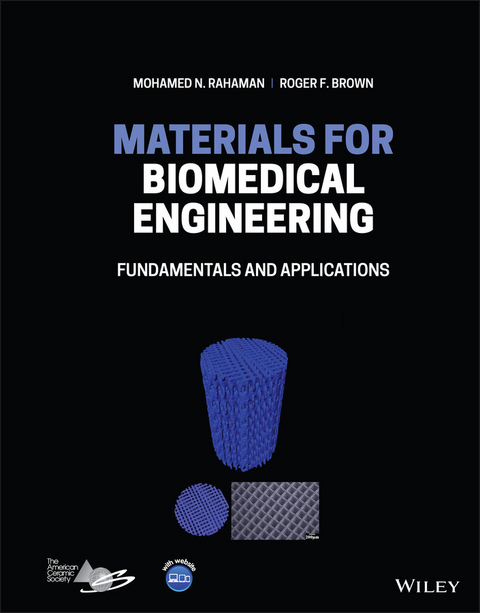
Materials for Biomedical Engineering (eBook)
John Wiley & Sons (Verlag)
978-1-119-55109-6 (ISBN)
A comprehensive yet accessible introductory textbook designed for one-semester courses in biomaterials
Biomaterials are used throughout the biomedical industry in a range of applications, from cardiovascular devices and medical and dental implants to regenerative medicine, tissue engineering, drug delivery, and cancer treatment. Materials for Biomedical Engineering: Fundamentals and Applications provides an up-to-date introduction to biomaterials, their interaction with cells and tissues, and their use in both conventional and emerging areas of biomedicine.
Requiring no previous background in the subject, this student-friendly textbook covers the basic concepts and principles of materials science, the classes of materials used as biomaterials, the degradation of biomaterials in the biological environment, biocompatibility phenomena, and the major applications of biomaterials in medicine and dentistry. Throughout the text, easy-to-digest chapters address key topics such as the atomic structure, bonding, and properties of biomaterials, natural and synthetic polymers, immune responses to biomaterials, implant-associated infections, biomaterials in hard and soft tissue repair, tissue engineering and drug delivery, and more.
- Offers accessible chapters with clear explanatory text, tables and figures, and high-quality illustrations
- Describes how the fundamentals of biomaterials are applied in a variety of biomedical applications
- Features a thorough overview of the history, properties, and applications of biomaterials
- Includes numerous homework, review, and examination problems, full references, and further reading suggestions
Materials for Biomedical Engineering: Fundamentals and Applications is an excellent textbook for advanced undergraduate and graduate students in biomedical materials science courses, and a valuable resource for medical and dental students as well as students with science and engineering backgrounds with interest in biomaterials.
Mohamed N. Rahaman, Professor Emeritus of Materials Science and Engineering, Missouri University of Science and Technology, USA. Dr. Rahaman is a Fellow of the American Ceramic Society, the author of five textbooks, the author and co-author of over 280 reviewed journal articles and conference proceedings, and the co-inventor on three US patents in the area of medical devices.
Roger F. Brown, Professor Emeritus of Biological Sciences, Missouri University of Science and Technology, USA. Dr Brown is the author and co-author of over 60 reviewed journal articles and conference proceedings, and is a co-inventor on one US patent pertaining to the use of bioactive borate glass microfibers for soft tissue repair.
MATERIALS FOR BIOMEDICAL ENGINEERING A comprehensive yet accessible introductory textbook designed for one-semester courses in biomaterials Biomaterials are used throughout the biomedical industry in a range of applications, from cardiovascular devices and medical and dental implants to regenerative medicine, tissue engineering, drug delivery, and cancer treatment. Materials for Biomedical Engineering: Fundamentals and Applications provides an up-to-date introduction to biomaterials, their interaction with cells and tissues, and their use in both conventional and emerging areas of biomedicine. Requiring no previous background in the subject, this student-friendly textbook covers the basic concepts and principles of materials science, the classes of materials used as biomaterials, the degradation of biomaterials in the biological environment, biocompatibility phenomena, and the major applications of biomaterials in medicine and dentistry. Throughout the text, easy-to-digest chapters address key topics such as the atomic structure, bonding, and properties of biomaterials, natural and synthetic polymers, immune responses to biomaterials, implant-associated infections, biomaterials in hard and soft tissue repair, tissue engineering and drug delivery, and more. Offers accessible chapters with clear explanatory text, tables and figures, and high-quality illustrations Describes how the fundamentals of biomaterials are applied in a variety of biomedical applications Features a thorough overview of the history, properties, and applications of biomaterials Includes numerous homework, review, and examination problems, full references, and further reading suggestions Materials for Biomedical Engineering: Fundamentals and Applications is an excellent textbook for advanced undergraduate and graduate students in biomedical materials science courses, and a valuable resource for medical and dental students as well as students with science and engineering backgrounds with interest in biomaterials.
Mohamed N. Rahaman, Professor Emeritus of Materials Science and Engineering, Missouri University of Science and Technology, USA. Dr. Rahaman is a Fellow of the American Ceramic Society, the author of five textbooks, the author and co-author of over 280 reviewed journal articles and conference proceedings, and the co-inventor on three US patents in the area of medical devices. Roger F. Brown, Professor Emeritus of Biological Sciences, Missouri University of Science and Technology, USA. Dr Brown is the author and co-author of over 60 reviewed journal articles and conference proceedings, and is a co-inventor on one US patent pertaining to the use of bioactive borate glass microfibers for soft tissue repair.
1
Biomaterials – An Introductory Overview
1.1 Introduction
Materials have been used to treat, replace, or augment tissues and organs in the human body since antiquity but their use and degree of sophistication have increased significantly over time, particularly over the last several decades. Advances in materials science, biological sciences, physical sciences, and engineering along with an evolution in medical treatment over the last several decades have led to the creation of biomaterials with more reproducible properties, better performance, and increased functionality. These advances have resulted in a considerable increase in the range of use and the efficacy of biomaterials. Nowadays, millions of lives are being improved or saved by the use of biomaterials in fracture fixation plates, implants for total hip and knee joint replacement, dental implants and restorations, heart valves, vascular grafts and stents, contact and intraocular lenses, skin substitutes, and wound healing materials, for example (Figure 1.1).
Figure 1.1 Examples of biomaterials in use for medical and dental applications. (a) Fracture fixation plate; (b) implant for total hip replacement; (c) implant for total knee replacement; (d) dental implant; (e) heart valve; (f) vascular graft; (g) intravascular stent; (h) intraocular lens; (i) degradable suture; (j) degradable screw for fracture fixation; (k) degradable polymer microsphere for delivery of therapeutics; (l) functional skin substitute.
The applications of biomaterials are many. Table 1.1 provides a list of selected applications and the types of materials used in these applications. Many of the biomaterials used in these applications were selected from durable, chemically inert materials that were available off the shelf, and they were designed to serve, mainly, a mechanical (or physical) function. The last few decades have seen a shift in emphasis in which the biological sciences are playing a role in the design of biomaterials of significance comparable to that of materials science. Biomaterials are now no longer designed to be chemically inert or to just serve a mechanical function. Instead, advances in biological sciences are being used to design biomaterials to regenerate tissues and organs and to direct the response of specific cells and tissues. In doing so, these biomaterials stimulate the body to heal itself. An example is the creation of functional skin substitutes to treat patients with severe burns (Figure 1.1l).
Table 1.1 Key applications of synthetic materials and modified natural materials in medicinea.
Source: Modified from Ratner (2013).
| Application | Biomaterial | Number used per year worldwide (or market in US$) |
|---|
| Skeletal system |
| Joint replacement (hip; knee; shoulder) | Titanium; stainless steel; polyethylene | 2.5 million |
| Bone fixation plates and screws | Metals; polylactic acid | 1.5 million |
| Spine repair | Titanium; polyether ether ketone; silicon nitride | 800 000 |
| Bone cement | Polymethylmethacrylate | ($600 million) |
| Bone defect repair | Calcium phosphates | — |
| Artificial tendon or ligament | Polyester fibers | — |
| Dental implants | Titanium | ($4 billion) |
| Cardiovascular system |
| Blood vessel prosthesis | Dacron; expanded polyethylene | 200 000 |
| Heart valve | Dacron; carbon; metal; treated natural tissue | 400 000 |
| Pacemaker | Titanium; polyurethane | 600 000 |
| Implantable defibrillator | Titanium; polyurethane | 300 000 |
| Stents | Stainless steel; cobalt–chromium alloy; nickel–titanium alloy | 1.5 million |
| Catheters | Teflon; silicone; polyurethane | 1 billion ($20 billion) |
| Organs |
| Heart assist devices | Polyurethane; titanium; stainless steel | 4000 |
| Hemodialysis | Polysulfone; silicone | 1.8 million patients ($70 billion) |
| Blood oxygenator | Silicone | 1 million |
| Skin substitute | Collagen; cadaver skin; nylon; silicone | ($1 billion) |
| Ophthalmologic |
| Contact lens | Acrylate, methacrylate and silicone polymers | 150 million |
| Intraocular lens | Acrylate and methacrylate polymers | 7 million |
| Corneal bandage lens | Hydrogel | — |
| Glaucoma drain | Silicone; polypropylene | ($200 million) |
| Other |
| Cochlear prosthesis | Platinum; platinum–iridium; silicone | 250 000 users |
| Breast implant | Silicone | 700 000 |
| Hernia mesh | Silicone; polypropylene; teflon | 200 000 ($4 billion) |
| Sutures | Polylactic acid; polydioxanone; polypropylene; stainless steel | ($2 billion) |
| Blood bags | Polyvinyl chloride | — |
| Ear tubes (Tympanostomy) | Silicone; teflon | 1.5 million |
| Intrauterine device | Silicone; copper | 1 million |
a Data compiled from many sources – these numbers should be considered rough estimates that are growing with changing markets and new technologies. Where only US numbers are available, world usage is estimated at 2.5 times the US usage.
The importance of biomaterials to society has been increasing significantly in the last several decades, both as an academic field, an area of research to develop new or improved devices, and as an industry (Figure 1.2). The number of biomedical engineering (or bioengineering) departments in academic institutions has increased rapidly over the last few decades. There are over 75 biomedical engineering (or bioengineering) departments in the United States alone. Biomaterials are an important area of teaching and research in these departments and they are often emphasized in engineering disciplines such as materials science and engineering, chemical engineering, and mechanical engineering.
Figure 1.2 Schematic showing the major components of the biomaterials field.
Outside of academic institutions, biomaterials are also an important area of research, development, and manufacturing in several industries, such as in the production of medical devices, dental restorations, and devices for drug delivery. The size of companies that manufacture biomaterials and devices for these applications cover a wide range, from small start‐up companies to large established companies that are among the so‐called Fortune 500 companies in the United States. The commercial market for devices that incorporate biomaterials is immense and it is projected to grow at a healthy rate. Estimates of the commercial market and the number of implantable medical devices that incorporate biomaterials annually are presented in Table 1.1.
1.2 Definition and Meaning of Common Terms
Several terms are commonly used in the biomaterials literature and throughout this book. This section provides a description of the meaning and definition of some of these common terms that are particularly relevant to this chapter.
Biomaterial
Our understanding of what a biomaterial is and, consequently, proposed definitions of the term biomaterial have evolved over time in response to advances in science and technology. An early use of the term and the beginnings of the biomaterials field emerged from symposia held in the United States around the late 1960s and early 1970s. One definition, endorsed by a consensus of experts in the field, is
- A biomaterial is a nonviable material used in a medical device, intended to interact with biological systems.
As biomaterials evolved, another definition was proposed:
- A biomaterial is a material intended to interface with biological systems to evaluate, treat, augment, or replace any tissue, organ or function in the body (Williams 1999).
While these early definitions reflected our understanding and use of biomaterials at that time, they are now too restrictive because of the evolution of biomaterials over the last two to three decades. Biological sciences, as noted earlier, are now playing an increasing role in designing biomaterials. At the same time,...
| Erscheint lt. Verlag | 1.11.2021 |
|---|---|
| Sprache | englisch |
| Themenwelt | Naturwissenschaften ► Chemie ► Technische Chemie |
| Technik ► Maschinenbau | |
| Technik ► Umwelttechnik / Biotechnologie | |
| Schlagworte | biochemical engineering • Biochemische Verfahrenstechnik • biomaterials applications • biomaterials biocompatibility</p> • biomaterials classes • biomaterials degradation • biomaterials fundamentals • biomedical engineering materials textbook • Biomedical Materials Science • chemical engineering • Chemie • Chemische Verfahrenstechnik • Chemistry • <p>Biomaterials textbook • Materials Science • Materialwissenschaften • Pharmaceutical & Medicinal Chemistry • Pharmazeutische u. Medizinische Chemie |
| ISBN-10 | 1-119-55109-9 / 1119551099 |
| ISBN-13 | 978-1-119-55109-6 / 9781119551096 |
| Informationen gemäß Produktsicherheitsverordnung (GPSR) | |
| Haben Sie eine Frage zum Produkt? |
 EPUB (Adobe DRM)
Kopierschutz: Adobe-DRM
Adobe-DRM ist ein Kopierschutz, der das eBook vor Mißbrauch schützen soll. Dabei wird das eBook bereits beim Download auf Ihre persönliche Adobe-ID autorisiert. Lesen können Sie das eBook dann nur auf den Geräten, welche ebenfalls auf Ihre Adobe-ID registriert sind.
Details zum Adobe-DRM
Dateiformat: EPUB (Electronic Publication)
EPUB ist ein offener Standard für eBooks und eignet sich besonders zur Darstellung von Belletristik und Sachbüchern. Der Fließtext wird dynamisch an die Display- und Schriftgröße angepasst. Auch für mobile Lesegeräte ist EPUB daher gut geeignet.
Systemvoraussetzungen:
PC/Mac: Mit einem PC oder Mac können Sie dieses eBook lesen. Sie benötigen eine
eReader: Dieses eBook kann mit (fast) allen eBook-Readern gelesen werden. Mit dem amazon-Kindle ist es aber nicht kompatibel.
Smartphone/Tablet: Egal ob Apple oder Android, dieses eBook können Sie lesen. Sie benötigen eine
Geräteliste und zusätzliche Hinweise
Buying eBooks from abroad
For tax law reasons we can sell eBooks just within Germany and Switzerland. Regrettably we cannot fulfill eBook-orders from other countries.
aus dem Bereich