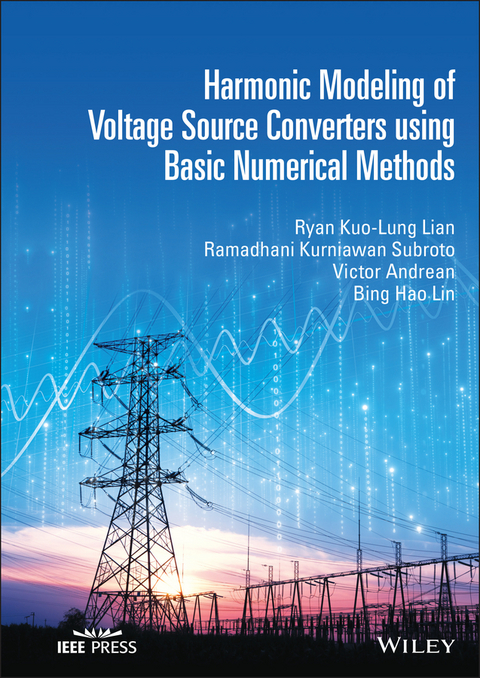
Harmonic Modeling of Voltage Source Converters using Basic Numerical Methods (eBook)
416 Seiten
John Wiley & Sons (Verlag)
978-1-119-52714-5 (ISBN)
One of the first books to bridge the gap between frequency domain and time-domain methods of steady-state modeling of power electronic converters
Harmonic Modeling of Voltage Source Converters using Basic Numerical Methods presents detailed coverage of steady-state modeling of power electronic devices (PEDs). This authoritative resource describes both large-signal and small-signal modeling of power converters and how some of the simple and commonly used numerical methods can be applied for harmonic analysis and modeling of power converter systems. The book covers a variety of power converters including DC-DC converters, diode bridge rectifiers (AC-DC), and voltage source converters (DC-AC).
The authors provide in-depth guidance on modeling and simulating power converter systems. Detailed chapters contain relevant theory, practical examples, clear illustrations, sample Python and MATLAB codes, and validation enabling readers to build their own harmonic models for various PEDs and integrate them with existing power flow programs such as OpenDss.
This book:
* Presents comprehensive large-signal and small-signal harmonic modeling of voltage source converters with various topologies
* Describes how to use accurate steady-state models of PEDs to predict how device harmonics will interact with the rest of the power system
* Explains the definitions of harmonics, power quality indices, and steady-state analysis of power systems
* Covers generalized steady-state modeling techniques, and accelerated methods for closed-loop converters
* Shows how the presented models can be combined with neural networks for power system parameter estimations
Harmonic Modeling of Voltage Source Converters using Basic Numerical Methods is an indispensable reference and guide for researchers and graduate students involved in power quality and harmonic analysis, power engineers working in the field of harmonic power flow, developers of power simulation software, and academics and power industry professionals wanting to learn about harmonic modeling on power converters.
Ryan Kuo-Lung Lian, Professor, Department of Electrical Engineering, National Taiwan University of Science and Technology, Taipei, Taiwan. He has been working in power system modeling for more than 10 years. His research interests are in power quality analysis, energy management systems, renewable energy systems, real time simulation, and power electronic control systems. Dr. Lian received his Ph.D. degree in Electrical Engineering from the University of Toronto, Canada, and he is a Senior Member of the Institute of Electrical and Electronics Engineers (IEEE). Ramadhani Kurniawan Subroto, Postdoctoral Researcher, Department of Electrical Engineering, Technical University of Denmark, Denmark. Dr. Subroto received his Ph.D. degree in Electrical Engineering from National Taiwan University of Science and Technology, Taiwan in 2021. His research interests include power converter control, power system control, energy storage control, model predictive control, sliding mode control, and harmonics modeling of power converter. Victor Andrean, received his M.Sc. degree from the Department of Electrical Engineering at National Taiwan University of Science and Technology, Taipei City, Taiwan, in 2019. Victor is currently working as a data scientist for HedgeDesk, CA, USA. Bing Hao Lin, Associate Researcher, Green Energy and Environment Research Laboratories, Industrial Technology Research Institute, Hsinchu, Taiwan. He received his B.Sc. and M.Sc. degrees in Electrical Engineering from the National Taiwan University of Science and Technology in 2018 and 2020, respectively.
| Erscheint lt. Verlag | 27.10.2021 |
|---|---|
| Reihe/Serie | Wiley - IEEE |
| Sprache | englisch |
| Themenwelt | Technik ► Elektrotechnik / Energietechnik |
| Schlagworte | Electrical & Electronics Engineering • Electric Power Electronics • Elektrotechnik u. Elektronik • Energie • Energy • Leistungselektronik • Numerical Methods & Algorithms • Numerische Methoden u. Algorithmen • Power Electronics |
| ISBN-10 | 1-119-52714-7 / 1119527147 |
| ISBN-13 | 978-1-119-52714-5 / 9781119527145 |
| Informationen gemäß Produktsicherheitsverordnung (GPSR) | |
| Haben Sie eine Frage zum Produkt? |
 PDF (Adobe DRM)
Kopierschutz: Adobe-DRM
Adobe-DRM ist ein Kopierschutz, der das eBook vor Mißbrauch schützen soll. Dabei wird das eBook bereits beim Download auf Ihre persönliche Adobe-ID autorisiert. Lesen können Sie das eBook dann nur auf den Geräten, welche ebenfalls auf Ihre Adobe-ID registriert sind.
Details zum Adobe-DRM
Dateiformat: PDF (Portable Document Format)
Mit einem festen Seitenlayout eignet sich die PDF besonders für Fachbücher mit Spalten, Tabellen und Abbildungen. Eine PDF kann auf fast allen Geräten angezeigt werden, ist aber für kleine Displays (Smartphone, eReader) nur eingeschränkt geeignet.
Systemvoraussetzungen:
PC/Mac: Mit einem PC oder Mac können Sie dieses eBook lesen. Sie benötigen eine
eReader: Dieses eBook kann mit (fast) allen eBook-Readern gelesen werden. Mit dem amazon-Kindle ist es aber nicht kompatibel.
Smartphone/Tablet: Egal ob Apple oder Android, dieses eBook können Sie lesen. Sie benötigen eine
Geräteliste und zusätzliche Hinweise
Buying eBooks from abroad
For tax law reasons we can sell eBooks just within Germany and Switzerland. Regrettably we cannot fulfill eBook-orders from other countries.
aus dem Bereich