


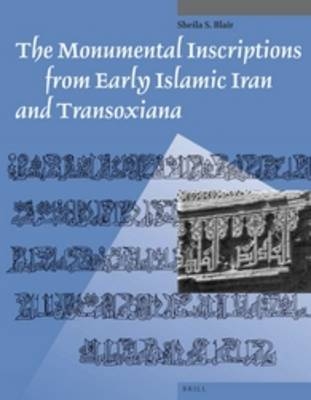
The Monumental Inscriptions from Early Islamic Iran and Transoxiana
Seiten
1991
Brill (Verlag)
978-90-04-09367-6 (ISBN)
Brill (Verlag)
978-90-04-09367-6 (ISBN)
- Titel ist leider vergriffen;
keine Neuauflage - Artikel merken
This book studies the surviving 79 monumental inscriptions from the Iranian world that date to the first five centuries of the Muslim era (ad 622-1106). Each is presented with photographs, drawings, transcriptions, translations and an extensive commentary, which explains the text in its larger historical and artistic context.
Inscriptions on buildings are a distinctive feature of Islamic architecture, and this book studies the 79 surviving monumental inscriptions in the Iranian world from the first five centuries of the Muslim era (A.D. 622-1106), the period in which all the major trends of monumental epigraphy in the area were set.
These foundation, commemorative, and funerary texts come from the region between Iraq and Soviet Central Asia. Written primarily in Arabic, they embellished architectural monuments and furnishings whose nature implies the construction of major buildings. An extended introduction discusses such general topics as titulature, patronage, and stylistic development. Each text is then presented individually with photographs, drawings, transcriptions, translations and an extensive commentary, which presents the inscription in its larger palaeographic and historical contexts.
Inscriptions on buildings are a distinctive feature of Islamic architecture, and this book studies the 79 surviving monumental inscriptions in the Iranian world from the first five centuries of the Muslim era (A.D. 622-1106), the period in which all the major trends of monumental epigraphy in the area were set.
These foundation, commemorative, and funerary texts come from the region between Iraq and Soviet Central Asia. Written primarily in Arabic, they embellished architectural monuments and furnishings whose nature implies the construction of major buildings. An extended introduction discusses such general topics as titulature, patronage, and stylistic development. Each text is then presented individually with photographs, drawings, transcriptions, translations and an extensive commentary, which presents the inscription in its larger palaeographic and historical contexts.
Sheila Blair shares the Norma Jean Calderwood University Professorship of Islamic and Asian Art at Boston College and the Hamad bin Khalifa Endowed Chair in Islamic Art at Virginia Commonwealth University with her husband and colleague Jonathan Bloom. Author, co-author and editor of dozens of books and hundreds of articles on all aspects of Islamic art, she is particularly interested in the arts of the Mongol period and the uses of writing.
| Erscheint lt. Verlag | 1.11.1991 |
|---|---|
| Reihe/Serie | Muqarnas ; BD 5 | 1.20 |
| Verlagsort | Leiden |
| Sprache | englisch |
| Gewicht | 1308 g |
| Einbandart | Leinen |
| Themenwelt | Geisteswissenschaften ► Archäologie |
| Geisteswissenschaften ► Geschichte ► Hilfswissenschaften | |
| Geisteswissenschaften ► Sprach- / Literaturwissenschaft ► Sprachwissenschaft | |
| Sozialwissenschaften ► Soziologie ► Spezielle Soziologien | |
| Technik ► Architektur | |
| ISBN-10 | 90-04-09367-2 / 9004093672 |
| ISBN-13 | 978-90-04-09367-6 / 9789004093676 |
| Zustand | Neuware |
| Informationen gemäß Produktsicherheitsverordnung (GPSR) | |
| Haben Sie eine Frage zum Produkt? |
Mehr entdecken
aus dem Bereich

aus dem Bereich
die Geburt der Grafiksammlung des Kunstmuseums Stuttgart im …
Buch | Hardcover (2024)
VDG Weimar - Verlag und Datenbank für Geisteswissenschaften
CHF 36,90
kulturelles Erbe und Identität in historischen und jüdischen Museen …
Buch | Hardcover (2025)
De Gruyter Oldenbourg (Verlag)
CHF 41,90
kartografische Wissenskulturen um 1448
Buch | Hardcover (2024)
De Gruyter (Verlag)
CHF 139,90


