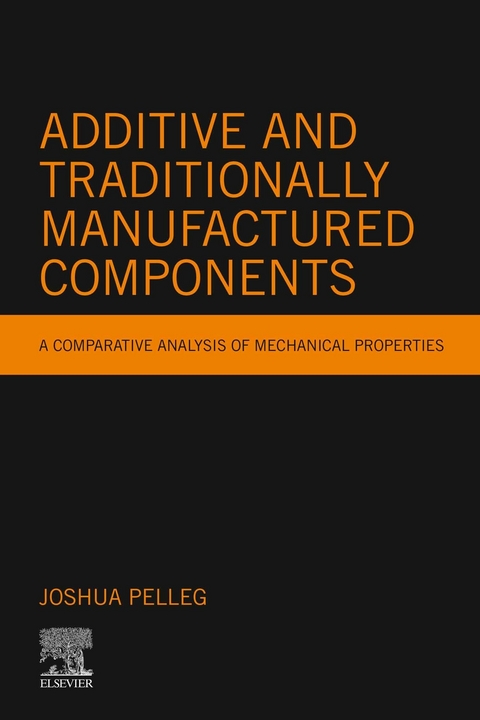
Additive and Traditionally Manufactured Components (eBook)
656 Seiten
Elsevier Science (Verlag)
978-0-12-821919-5 (ISBN)
Joshua Pelleg received his B.Sc. in Chemical Engineering at the Technion - Institute of Technology, Haifa, Israel; a M.Sc. in Metallurgy at the Illinois Institute of Technology, Chicago, IL and a Ph.D. in Metallurgy at the University of Wisconsin, Madison, WI. He has been in the Ben-Gurion University of the Negev (BGU) Materials Engineering Department in Beer-Sheva, Israel since 1970, and was among the founders of the department, and served as its second chairman. Professor Pelleg was the recipient of the Samuel Ayrton Chair in Metallurgy. He specializes in the mechanical properties of materials and the diffusion and defects in solids. He has chaired several university committees and served four terms as the Chairman of Advanced Studies at Ben-Gurion University of the Negev. Prior to his work at BGU, Pelleg acted as Assistant Professor and then Associate Professor in the Department of Materials and Metallurgy at the University of Kansas, Lawrence, KS. Professor Pelleg was also a Visiting Professor: in the Department of Metallurgy at Iowa State University; at the Institute for Atomic Research, US Atomic Energy Commission, Ames, IA; at McGill University, Montreal, QC; at the Tokyo Institute of Technology, Applied Electronics Department, Yokohama, Japan; and in Curtin University, Department of Physics, Perth, Australia. His non-academic research and industrial experience includes: Chief Metallurgist in Urdan Metallurgical Works Ltd., Netanyah, Israel; Research Engineer in International Harvester Manufacturing Research, Chicago, IL; Associate Research Officer for the National Research Council of Canada, Structures and Materials, National Aeronautical Establishment, Ottawa, ON; Physics Senior Research Scientist, Nuclear Research Center, Beer-Sheva, Israel; Materials Science Division, Argonne National Labs, Argonne, IL; Atomic Energy of Canada, Chalk River, ON; Visiting Scientist, CSIR, National Accelerator Centre, Van de Graaf Group Faure, South Africa; Bell Laboratories, Murray Hill, NJ; and GTE Laboratories, Waltham, MA. His current research interests are diffusion in solids, thin film deposition and properties (mostly by sputtering) and the characterization of thin films, among them various silicides.
Additive and Traditionally Manufactured Components: A Comparative Analysis of Mechanical Properties looks at the mechanical properties of materials produced by additive manufacturing (AM) and compares them with conventional methods. Since the production of objects by AM techniques can used in a broad array of materials, the alloys presented are the ones most commonly produced by AM - Al alloys, Ti alloys and steel. The book explores the six main types of techniques: Fused Deposition Method (FDM), Powder Bed Fusion (PBF), Inkjet Printing, Stereolithography (SLA), Direct Energy Deposition (DED) and Laminated Object Manufacturing (LOM), and follows with the techniques being utilized for fabrication. Testing of AM fabricated specimens, including tension, compression and hardness is included, along with a comparison of those results to specimens obtained by conventional fabrication methods. Topics covered include static deformation, time dependent deformation (creep), cyclic deformation (fatigue) and fracture in specimens. The book concludes with a review of the mechanical properties of nanoscale specimens obtained by AM. - Thoroughly explores AM processes that can be utilized for experimental design- Includes a review of dislocations observed in specimens obtained by AM- Compares the impact of both additive and traditional manufacturing techniques on the mechanical properties of materials
| Erscheint lt. Verlag | 30.4.2020 |
|---|---|
| Sprache | englisch |
| Themenwelt | Technik ► Maschinenbau |
| ISBN-10 | 0-12-821919-X / 012821919X |
| ISBN-13 | 978-0-12-821919-5 / 9780128219195 |
| Informationen gemäß Produktsicherheitsverordnung (GPSR) | |
| Haben Sie eine Frage zum Produkt? |
 EPUB (Adobe DRM)
Kopierschutz: Adobe-DRM
Adobe-DRM ist ein Kopierschutz, der das eBook vor Mißbrauch schützen soll. Dabei wird das eBook bereits beim Download auf Ihre persönliche Adobe-ID autorisiert. Lesen können Sie das eBook dann nur auf den Geräten, welche ebenfalls auf Ihre Adobe-ID registriert sind.
Details zum Adobe-DRM
Dateiformat: EPUB (Electronic Publication)
EPUB ist ein offener Standard für eBooks und eignet sich besonders zur Darstellung von Belletristik und Sachbüchern. Der Fließtext wird dynamisch an die Display- und Schriftgröße angepasst. Auch für mobile Lesegeräte ist EPUB daher gut geeignet.
Systemvoraussetzungen:
PC/Mac: Mit einem PC oder Mac können Sie dieses eBook lesen. Sie benötigen eine
eReader: Dieses eBook kann mit (fast) allen eBook-Readern gelesen werden. Mit dem amazon-Kindle ist es aber nicht kompatibel.
Smartphone/Tablet: Egal ob Apple oder Android, dieses eBook können Sie lesen. Sie benötigen eine
Geräteliste und zusätzliche Hinweise
Buying eBooks from abroad
For tax law reasons we can sell eBooks just within Germany and Switzerland. Regrettably we cannot fulfill eBook-orders from other countries.
aus dem Bereich