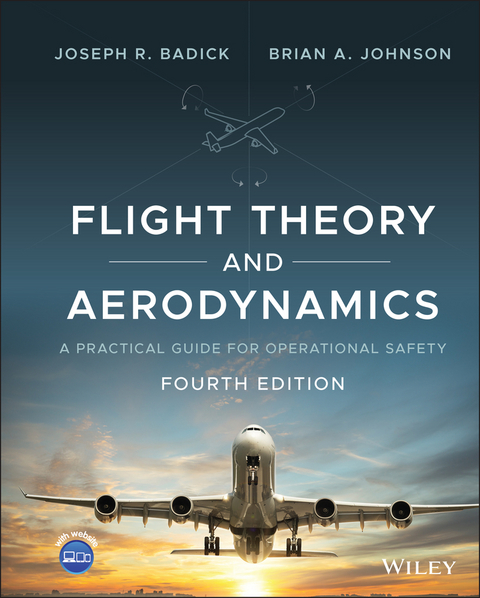
Flight Theory and Aerodynamics (eBook)
John Wiley & Sons (Verlag)
978-1-119-77241-5 (ISBN)
GET A PILOT'S PERSPECTIVE ON FLIGHT AERODYNAMICS FROM THE MOST UP-TO-DATE EDITION OF A CLASSIC TEXT
The newly revised Fourth Edition of Flight Theory and Aerodynamics delivers a pilot-oriented approach to flight aerodynamics without assuming an engineering background. The book connects the principles of aerodynamics and physics to their practical applications in a flight environment. With content that complies with FAA rules and regulations, readers will learn about atmosphere, altitude, airspeed, lift, drag, applications for jet and propelleor aircraft, stability controls, takeoff, landing, and other maneuvers.
The latest edition of Flight Theory and Aerodynamics takes the classic textbook first developed by Charles Dole and James Lewis in a more modern direction and includes learning objectives, real world vignettes, and key idea summaries in each chapter to aid in learning and retention. Readers will also benefit from the accompanying online materials, like a test bank, solutions manual, and FAA regulatory references.
Updated graphics included throughout the book correlate to current government agency standards. The book also includes:
- A thorough introduction to basic concepts in physics and mechanics, aerodynamic terms and definitions, and the primary and secondary flight control systems of flown aircraft
- An exploration of atmosphere, altitude, and airspeed measurement, with an increased focus on practical applications
- Practical discussions of structures, airfoils, and aerodynamics, including flight control systems and their characteristics
- In-depth examinations of jet aircraft fundamentals, including material on aircraft weight, atmospheric conditions, and runway environments
- New step-by-step examples of how to apply math equations to real-world situations
Perfect for students and instructors in aviation programs such as pilot programs, aviation management, and air traffic control, Flight Theory and Aerodynamics will also appeal to professional pilots, dispatchers, mechanics, and aviation managers seeking a one-stop resource explaining the aerodynamics of flight from the pilot's perspective.
JOSEPH R. BADICK is an Adjunct Faculty Member with Embry-Riddle Aeronautical University, now retired from Guilford Technical Community College. He has over 30 years of experience as an Aeronautical Engineer Duty Officer in the U.S. Navy and over forty years of flight experience in both single and multi-engine land/seaplane aircraft, with an airline transport certificate.
BRIAN A. JOHNSON is an Adjunct Faculty Member in the Aeronautical Science Department of Embry-Riddle Aeronautical University. Additionally, he is a former regional airline and corporate pilot who holds an airline transport pilot certificate with a multi-engine rating.
FLIGHT THEORY AND AERODYNAMICS GET A PILOT'S PERSPECTIVE ON FLIGHT AERODYNAMICS FROM THE MOST UP-TO-DATE EDITION OF A CLASSIC TEXT The newly revised Fourth Edition of Flight Theory and Aerodynamics delivers a pilot-oriented approach to flight aerodynamics without assuming an engineering background. The book connects the principles of aerodynamics and physics to their practical applications in a flight environment. With content that complies with FAA rules and regulations, readers will learn about atmosphere, altitude, airspeed, lift, drag, applications for jet and propeller aircraft, stability controls, takeoff, landing, and other maneuvers. The latest edition of Flight Theory and Aerodynamics takes the classic textbook first developed by Charles Dole and James Lewis in a more modern direction and includes learning objectives, real world vignettes, and key idea summaries in each chapter to aid in learning and retention. Readers will also benefit from the accompanying online materials, like a test bank, solutions manual, and FAA regulatory references. Updated graphics included throughout the book correlate to current government agency standards. The book also includes: A thorough introduction to basic concepts in physics and mechanics, aerodynamic terms and definitions, and the primary and secondary flight control systems of flown aircraft An exploration of atmosphere, altitude, and airspeed measurement, with an increased focus on practical applications Practical discussions of structures, airfoils, and aerodynamics, including flight control systems and their characteristics In-depth examinations of jet aircraft fundamentals, including material on aircraft weight, atmospheric conditions, and runway environments New step-by-step examples of how to apply math equations to real-world situations Perfect for students and instructors in aviation programs such as pilot programs, aviation management, and air traffic control, Flight Theory and Aerodynamics will also appeal to professional pilots, dispatchers, mechanics, and aviation managers seeking a one-stop resource explaining the aerodynamics of flight from the pilot's perspective.
JOSEPH R. BADICK is an Adjunct Faculty Member with Embry-Riddle Aeronautical University, now retired from Guilford Technical Community College. He has over 30 years of experience as an Aeronautical Engineer Duty Officer in the U.S. Navy and over forty years of flight experience in both single and multi-engine land/seaplane aircraft, with an airline transport certificate. BRIAN A. JOHNSON is an Adjunct Faculty Member in the Aeronautical Science Department of Embry-Riddle Aeronautical University. Additionally, he is a former regional airline and corporate pilot who holds an airline transport pilot certificate with a multi-engine rating.
1
Introduction to the Flight Environment
CHAPTER OBJECTIVES
After completing this chapter, you should be able to:
- Define basic units of measurement used in the introduction to aerodynamics in flight and convert from one unit of measurement to another.
- Identify the four forces on an airplane in constant altitude, unaccelerated flight.
- Calculate the mass of an aircraft.
- Define vector addition and apply to an aircraft in a climb.
- Describe Newton’s laws of motion and recognize how they apply to an introduction to aerodynamics.
- Define the purpose of linear motion in relation to constant acceleration, and then calculate aircraft acceleration, takeoff distance, and takeoff time.
- Describe the difference between energy and work and calculate the potential and kinetic energy of an aircraft in flight.
- Calculate the equivalent horsepower of an aircraft from a known thrust and speed.
- Define friction as it applies to an aircraft.
A basic understanding of the physical laws of nature that affect aircraft in flight and on the ground is a prerequisite for the study of aerodynamics. Modern aircraft have become more sophisticated, and more automated, using advanced materials in their construction requiring pilots to renew their understanding of the natural forces encountered during flight. Understanding how pilots control and counteract these forces better prepares pilots and engineers for the art of flying for harnessing the fundamental physical laws that guide them. Though at times this textbook will provide a quantitative approach to various principles and operating practices with formulas and examples using equations, it is more important that the reader understand WHY a principle of flight theory is discussed and how that subject matter intertwines with other materials presented; thus a qualitative approach is used throughout this textbook.
Perhaps your goal is to be a pilot, who will “slip the surly bonds of earth,” as John Gillespie Magee wrote in his classic poem “High Flight.” Or you may wish to build or maintain aircraft as a skilled technician. Or possibly you wish to serve in another vital role in the aviation industry, such as manager, dispatcher, meteorologist, engineer, teacher, or another capacity. Whichever area you might be considering, this textbook will build on what you already know and will help prepare you for a successful aviation career.
INTRODUCTION
This chapter begins with a review of the basic principles of physics and concludes with a summary of linear motion, mechanical energy, and power. A working knowledge of these areas, and how they relate to basic aerodynamics, is vital as we move past the rudimentary “four forces of flight” and introduce thrust and power‐producing aircraft, lift and drag curves, stability and control, maneuvering performance, slow‐speed flight, and other topics.
You may already have been introduced to the four basic forces acting on an aircraft in flight: lift, weight, thrust, and drag. Now, we must understand how these forces change as an aircraft accelerates down the runway, or descends on final approach to a runway and gently touches down even when traveling twice the speed of a car on the highway. Once an aircraft has safely made it into the air, what effect does weight have on its ability to climb, and should the aircraft climb up to the flight levels or stay lower and take “advantage” of the denser air closer to the ground?
By developing an understanding of the aerodynamics of flight, and of the ways in which design, weight, load factors, and gravity affect an aircraft during flight maneuvers from stalls to high‐speed flight, the pilot learns how to control the balance between these forces. This textbook will help clarify these concepts among others, leaving you with a better understanding of the flight environment.
BASIC QUANTITIES
An introduction to aerodynamics must begin with a review of physics, and, in particular, the branch of physics that will be presented here is called mechanics. We will examine the fundamental physical laws governing the forces acting on an aircraft in flight, and what effect these natural laws and forces have on the performance characteristics of aircraft. To control an aircraft, whether it is an airplane, helicopter, glider, or balloon, the pilot must understand the principles involved and learn to use or counteract these natural forces.
We will start with the concepts of work, energy, power, and friction, and then build upon them as we move forward in future chapters.
Because the metric system of measurement has not yet been widely accepted in the United States, the English system of measurement is used in this book. The fundamental units are
| Force | Pounds (lb) |
| Distance | Feet (ft) |
| Time | Seconds (s) |
From the fundamental units, other quantities can be derived:
| Velocity (distance/time) | ft/s (fps) |
| Area (distance squared) | square ft (ft2) |
| Pressure (force/unit area) | lb/ft2 (psf) |
| Acceleration (rate of change in velocity) | ft/s/s (fps2) |
Aircraft measure airspeed in knots (nautical miles per hour) or in Mach number (the ratio of true airspeed to the speed of sound). Rates of climb and descent are measured in feet per minute, so quantities other than those above are used in some cases. Some useful conversion factors are listed below:
| Multiply | by | to get |
|---|
| knots (kts.) | 1.69 | feet per second (fps) |
| fps | 0.5925 | kts. |
| miles per hour (mph) | 1.47 | fps |
| fps | 0.6818 | mph |
| mph | 0.8690 | kts. |
| kts. | 1.15 | mph |
| nautical miles (nm) | 6076 | feet (ft) |
| nm | 1.15 | statute miles (sm) |
| sm | 0.869 | nm |
| kts. | 101.3 | feet per minute (fpm) |
EXAMPLES
- Convert 110 kts. to fps: 110 kts. × 1.69 = 185.9 fps
- Convert 50 kts. to fpm: 50 kts. × 101.3 = 5,065 fpm
- Convert 450 fps to kts. = 450 fps × 0.5925 = 267 kts.
- Convert 25 sm to nm: 25 sm × 0.869 = 21.7 nm
Application 1.1
An airplane flight manual (AFM) states a given aircraft should be rotated at 65 kts. indicated airspeed (IAS), yet the pilot misinterprets the airspeed indicator and rotates at 65 mph (IAS).
Does the aircraft rotate at a faster or slower airspeed than the manufacturer recommends? What are the implications?
FORCES
A force is a push or a pull tending to change the state of motion of a body. A resolution of the typical forces acting on an aircraft in steady flight is shown in Figure 1.1, while Figure 1.2 shows the four separate components of aerodynamic forces during straight‐and‐level, unaccelerated flight. The component that is 90° to the flight path and acts toward the top of the airplane is called lift. The component that is parallel to the flight path and acts toward the rear of the airplane is called drag; while the opposing forward force is thrust and is usually created by the engine. Weight opposes lift and as we will see is a function of the mass of the aircraft and gravity.
The sum of the opposing forces is always zero in steady flight, but this does not mean the four forces are equal. In future chapters of this textbook, we will further demonstrate the following statement regarding forces acting on an airplane in steady flight: The sum of all upward component of forces equals the sum of all downward components of forces, and the sum of all forward components of forces equals the sum of all backward components of forces.
Figure 1.1 Forces on an airplane in steady flight.
Figure 1.2 Resolved forces on an airplane in steady flight.
Source: U.S. Department of Transportation Federal Aviation Administration (2008a).
MASS
Mass is a measure of the amount of material contained in a body, usually measured in kilograms; we will use slugs as the unit in this textbook. Weight, on the other hand, is a force caused by the gravitational attraction of the earth (g = 32.2 ft/s2), moon, sun, or other heavenly bodies. Weight will vary depending on where the body is located in space (specifically, how far from the source of gravitational attraction), but mass will not vary with position.
Rearranging gives
This mass unit is called the slug.
EXAMPLE
Calculate the mass of an aircraft that weighs 2576 lb.
SCALAR...
| Erscheint lt. Verlag | 30.9.2021 |
|---|---|
| Sprache | englisch |
| Themenwelt | Technik ► Maschinenbau |
| Schlagworte | Aerodynamik • Aeronautic & Aerospace Engineering • Fliegen • Luft- u. Raumfahrttechnik • Maschinenbau • mechanical engineering |
| ISBN-10 | 1-119-77241-9 / 1119772419 |
| ISBN-13 | 978-1-119-77241-5 / 9781119772415 |
| Informationen gemäß Produktsicherheitsverordnung (GPSR) | |
| Haben Sie eine Frage zum Produkt? |
 EPUB (Adobe DRM)
Kopierschutz: Adobe-DRM
Adobe-DRM ist ein Kopierschutz, der das eBook vor Mißbrauch schützen soll. Dabei wird das eBook bereits beim Download auf Ihre persönliche Adobe-ID autorisiert. Lesen können Sie das eBook dann nur auf den Geräten, welche ebenfalls auf Ihre Adobe-ID registriert sind.
Details zum Adobe-DRM
Dateiformat: EPUB (Electronic Publication)
EPUB ist ein offener Standard für eBooks und eignet sich besonders zur Darstellung von Belletristik und Sachbüchern. Der Fließtext wird dynamisch an die Display- und Schriftgröße angepasst. Auch für mobile Lesegeräte ist EPUB daher gut geeignet.
Systemvoraussetzungen:
PC/Mac: Mit einem PC oder Mac können Sie dieses eBook lesen. Sie benötigen eine
eReader: Dieses eBook kann mit (fast) allen eBook-Readern gelesen werden. Mit dem amazon-Kindle ist es aber nicht kompatibel.
Smartphone/Tablet: Egal ob Apple oder Android, dieses eBook können Sie lesen. Sie benötigen eine
Geräteliste und zusätzliche Hinweise
Buying eBooks from abroad
For tax law reasons we can sell eBooks just within Germany and Switzerland. Regrettably we cannot fulfill eBook-orders from other countries.
aus dem Bereich