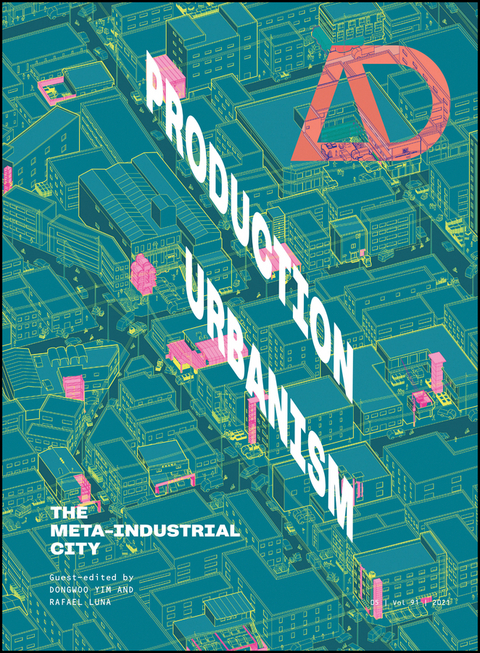
Production Urbanism (eBook)
136 Seiten
John Wiley & Sons (Verlag)
978-1-119-71772-0 (ISBN)
Contributors: Frank Barkow, Michele Bonino and Maria Paola Repellino, Kristiaan Borret, Vicente Guallart, Tali Hatuka, Doojin Hwang, Yerin Kang and Chihoon Lee, Kengo Kuma, Wesley Leeman, Scott Lloyd and Alexis Kalagas, Winy Maas, DK Osseo-Asare, Marina Otero Verzier, Nina Rappaport, and Shohei Shigematsu.
Featured architects: Barkow Leibinger, DJH Architects, Goldsmith, Kengo Kuma & Associates, MVRDV, OMA, and TEN.
Dongwoo Yim and Rafael Luna are the founding partners of PRAUD, a design and research firm based in Seoul and Boston, founded in 2010. Yim received his master's degree at Harvard University and the bachelor's degree at Seoul National University, and Luna received his master's degree at the Massachusetts Institute of Technology. Their practice has focused on researching production urbanism through an array of scales, typologies and mediums in order to investigate circular economies as catalysts of urban regeneration through hybrid architecture. Their investigations on hybrid typologies between production and housing, propelled by new manufacturing technologies, propose an alternative urban housing model for future equitable cities. Currently, their research focuses on the Seoul megalopolitan condition, where urban manufacturing is still valid within the city, through "makeshift" urban production typologies. This is expected to be presented at the upcoming Seoul Biennale of Architecture and Urbanism 2021. Their work on Production Urbanism extends from academia, published writings and exhibitions. Both, Luna and Yim, have taught for several years at various international institutions, including RISD, Washington University in St. Louis, and the Chinese Academy of Arts. Currently, Yim is an assistant professor at Hongik University and Luna is an assistant professor at Hanyang University. Their studio topics have focused on an evolution of the socialist microdistrict, which aggregated factories and dwellings together in a single urban block, adapting this model to capitalist scenarios and sites. Their findings have been published in international journals, and exhibited at key venues such as MoMA, the 2014 Venice Biennale Golden Lion winning Korean Pavilion, and at the Seoul Biennale in 2017, 2019, and expected 2021. Their curatorial roles have also promoted the topic, producing exhibitions such as the 2018 Factory for Urban Living. Most recently, they served as curators of the Cities Exhibition in the Seoul Biennale of Architecture and Urbanism 2019 where they presented a collective dialogue on new industrial models. Their publication includes, North Korean Atlas, I Want to be METROPOLITAN: Boston Case Study, City after Urbanism, and Unprecedented Pyongyang, among others. They are the award winning team of 2013 Architectural League Prize and DAM Publication Award in 2014.
Chapter 1 Introduction Factories for Urban Living: Retooling 21st-Century Production
Chapter 2 The New Industrial Urbanism
Chapter 3 The Digital Reindustrialisation of Cities
Chapter 4 Nothing Is Automatic: Producing More-Than- Human Relations in the Pearl River Delta
Chapter 5 Salad Days: Urban Food Futures
Chapter 6 The New Industrial Commons: Worker-Owners and Factory Space
Chapter 7 From Food Hub to Food Port: In Conversation with OMA's Shohei Shigematsu
Chapter 8 Occupying Africa: Prototyping a Transformal Makerspace Network
Chapter 9 A New Paradigm for the Periphery: The Case Against Reuniting City and Factory
Chapter 10 Architecture for Plateaus and Valleys: The Marketability of Industrial Mixing
Chapter 11 Floating Farms: Feeding Rotterdam from Within
Chapter 12 The Danwei System: Living with Production
Chapter 13 Freeland: How Residents Are Creating a Dutch City from Scratch
Chapter 14 Urban Production in Seoul's Historic Centre Choonwondang Hospital of Korean Medicine
Chapter 15 Seoul's Shoe Silo: A Vertical Smart Anchor for the Small Manufacturer
Chapter 16 Building Better: Brussels Production Urbanism as a Policy
Chapter 17 From Another Perspective - Ottawa 2120: Zachary Colbert
| Erscheint lt. Verlag | 23.9.2021 |
|---|---|
| Reihe/Serie | Architectural Design | Architectural Design |
| Sprache | englisch |
| Themenwelt | Technik ► Architektur |
| Schlagworte | Architecture • Architektur • Bauentwurf • Building Design • Industriestadt • Stadtentwicklung • Urban Development |
| ISBN-10 | 1-119-71772-8 / 1119717728 |
| ISBN-13 | 978-1-119-71772-0 / 9781119717720 |
| Informationen gemäß Produktsicherheitsverordnung (GPSR) | |
| Haben Sie eine Frage zum Produkt? |
 PDF (Adobe DRM)
Kopierschutz: Adobe-DRM
Adobe-DRM ist ein Kopierschutz, der das eBook vor Mißbrauch schützen soll. Dabei wird das eBook bereits beim Download auf Ihre persönliche Adobe-ID autorisiert. Lesen können Sie das eBook dann nur auf den Geräten, welche ebenfalls auf Ihre Adobe-ID registriert sind.
Details zum Adobe-DRM
Dateiformat: PDF (Portable Document Format)
Mit einem festen Seitenlayout eignet sich die PDF besonders für Fachbücher mit Spalten, Tabellen und Abbildungen. Eine PDF kann auf fast allen Geräten angezeigt werden, ist aber für kleine Displays (Smartphone, eReader) nur eingeschränkt geeignet.
Systemvoraussetzungen:
PC/Mac: Mit einem PC oder Mac können Sie dieses eBook lesen. Sie benötigen eine
eReader: Dieses eBook kann mit (fast) allen eBook-Readern gelesen werden. Mit dem amazon-Kindle ist es aber nicht kompatibel.
Smartphone/Tablet: Egal ob Apple oder Android, dieses eBook können Sie lesen. Sie benötigen eine
Geräteliste und zusätzliche Hinweise
Buying eBooks from abroad
For tax law reasons we can sell eBooks just within Germany and Switzerland. Regrettably we cannot fulfill eBook-orders from other countries.
aus dem Bereich