Global Environmental Careers (eBook)
John Wiley & Sons (Verlag)
978-1-119-05279-1 (ISBN)
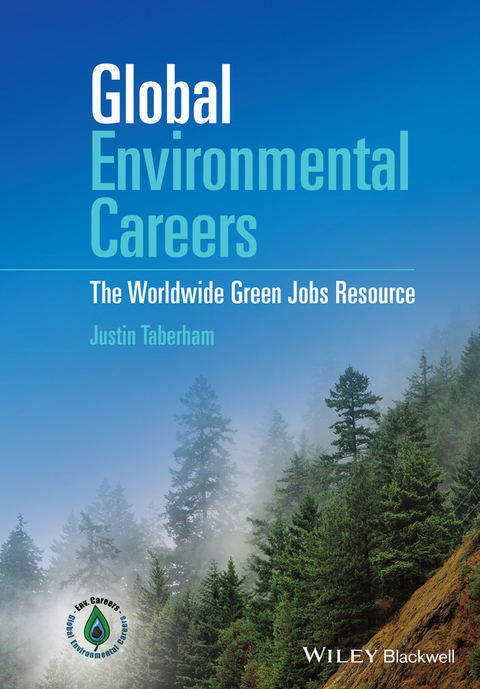
Global Environmental Careers - The Worldwide Green Jobs Resource
This book is the ideal guide to equipping you with the tools and know-how to develop an environmental career. It is filled with practical advice, case studies, personal profiles and top tips across the global environment sector.
An essential resource for anyone, from school students to those who are already in work but dreaming of a more meaningful career.
'This new book comes at exactly the right moment. There has never been a more critical time for effective, international action on our common ecological crisis, and success in that work requires a new generation of 21st Century environmental professionals.'
Kevin Doyle, Executive Director, Office of Career and Professional Development, Yale School of the Environment
'As an experienced green career coach, the top questions I hear from green job seekers are, 'What are the green jobs out there, which ones would be a good match, how do I get my foot in the door, and where do I find these jobs?' Taberham's book answers all of these in a refreshingly approachable way.'
Lisa Yee-Litzenberg, President, Green Career Advisor LLC
'One of the biggest challenges environmental career seekers face is understanding and muddling through the opportunities available to them based on their experience, education, and interest. Taberham's book is a great resource to help people navigate their options and grab some tips for the career journey.'
Laura Thorne, The Environmental Career Coach
'A fantastic book for those who are interested in pursuing a role in sustainability. Jam-packed with helpful resources, career insights, and real-life case studies this is a go-to resource for professionals who are launching their careers.'
Sharmila Singh, New Lens Consulting
'Justin Taberham provides an impressive global overview of a multifaceted, ever-changing sector that continues to evolve rapidly due to advances in technology and knowledge, changes in funding and incentives, and shifts in priorities and laws.'
Carol L. McClelland, PhD, Author of Green Careers for Dummies
About the Author
Justin Taberham is a Chartered Environmentalist and environmental consultant. He has worked in the global environment sector for over 30 years with a diverse range of organisations including Government regulators, charities, and professional bodies. He has considerable first-hand experience of environmental recruiting and mentoring.
Global Environmental Careers Global Environmental Careers The Worldwide Green Jobs Resource This book is the ideal guide to equipping you with the tools and know-how to develop an environmental career. It is filled with practical advice, case studies, personal profiles and top tips across the global environment sector. An essential resource for anyone, from school students to those who are already in work but dreaming of a more meaningful career. This new book comes at exactly the right moment. There has never been a more critical time for effective, international action on our common ecological crisis, and success in that work requires a new generation of 21st Century environmental professionals. Kevin Doyle, Executive Director, Office of Career and Professional Development, Yale School of the Environment As an experienced green career coach, the top questions I hear from green job seekers are, What are the green jobs out there, which ones would be a good match, how do I get my foot in the door, and where do I find these jobs? Taberham s book answers all of these in a refreshingly approachable way. Lisa Yee-Litzenberg, President, Green Career Advisor LLC One of the biggest challenges environmental career seekers face is understanding and muddling through the opportunities available to them based on their experience, education, and interest. Taberham s book is a great resource to help people navigate their options and grab some tips for the career journey. Laura Thorne, The Environmental Career Coach A fantastic book for those who are interested in pursuing a role in sustainability. Jam-packed with helpful resources, career insights, and real-life case studies this is a go-to resource for professionals who are launching their careers. Sharmila Singh, New Lens Consulting Justin Taberham provides an impressive global overview of a multifaceted, ever-changing sector that continues to evolve rapidly due to advances in technology and knowledge, changes in funding and incentives, and shifts in priorities and laws. Carol L. McClelland, PhD, Author of Green Careers for Dummies
About the Author Justin Taberham is a Chartered Environmentalist and environmental consultant. He has worked in the global environment sector for over 30 years with a diverse range of organisations including Government regulators, charities, and professional bodies. He has considerable first-hand experience of environmental recruiting and mentoring.
Acknowledgements ix
1 Introduction 1
2 Environmental Consultancy 51
3 Integrated Water Resources Management 80
4 Environmental Law 100
5 Environmental Policy, Legislation and Regulation 121
6 Conservation and Ecology 129
7 Greening Companies, Corporate Sustainability 154
8 Air Quality 176
9 Fisheries Management 189
10 Marine Science and Conservation 207
11 Protected Area Planning and Management 219
12 Waste and Resource Management and Contaminated Land 232
13 Renewables and Energy 246
14 Journalism and Writing/Blogging 264
15 Emerging and Other Sectors 276
16 Contributors 282
Index 000
1
Introduction
1.1 Author Introduction
The author, Justin Taberham, is an environmental professional and Chartered Environmentalist with more than 30 years’ experience in the global environment sector, working for Government agencies, a water utility, a lobbying charity and a global professional body. He is now a Consultant and Advisor, working in environmental publications, business and careers. He has significant experience of environmental recruiting, developing staff and advising and mentoring people globally who seek to develop a career in the environment sector. His website is www.justintaberham.com, and the site has a full professional profile.
Figure 1.1 The Green World of Work.
Source: Martens 2020. © Joanne Martens.
The Env.Careers Website
The author manages the Env.Careers website www.env.careers which is ‘The “one stop shop” for people who want to develop a career in the global environment sector’.
The Env.Careers website is an allied resource to this book, and it helps deliver ongoing additional content. The website is also a standalone resource with tips, advice and mentoring for those seeking a green career.
1.2 The Author’s Green Career – Any Lessons to Learn?
I grew up in the Norfolk countryside, in rural England. I was an enthusiastic scout, angler, hill walker and conservation volunteer. I was also keenly involved in environmental campaigns on issues such as Rainforest Conservation, Acid Rain and Species Loss. My parents were very tolerant of me bringing home ‘roadkill’ and other natural finds to ‘study’.
As I got older and had to make career direction and subject choices at school, I was often shunted into a specific area of interest which would enable me to more easily get a ‘standard’ job – early suggestions from careers questionnaires were Policeman, Insurer and Teacher. None of these were of much interest to me – it was a mystery why the questionnaires never asked, ‘What do you actually want to do?’ Careers advice tended to just look at the limited subjects I was studying and extrapolate what career field was broadly relevant; the more sophisticated current career survey techniques still extrapolate from your school subjects, general interests and personality traits and find you very common areas of work, in an almost apologetic attempt to pigeonhole you.
In the early 1980s, very few people worked in the environment sector and I struggle to remember any careers talks that mentioned it. ‘The Environment’ tended to be a subject for hippies and drop‐outs, and environmentalism was not perceived in the more positive light that it is today. The ‘Natural World’ was being promoted to the public by the likes of David Attenborough and Jacques Cousteau, but it seemed very exotic and separate from normal career options. Protecting and managing the environment as a career wasn’t promoted, even following the major nuclear reactor accident at Chernobyl in 1986 and the scourge of acid rain in the 1980s.
Many people I have met who work in the global environment sector have grown their passion from childhood experiences with nature and I’m an example of this. Just because a quality has been developed in early life, this doesn’t preclude it from playing a part in your future career decisions.
I decided at school that I would take ‘general’ A‐Levels (UK examinations pre‐university), investigate environmental degrees and consider what jobs were on offer. It must be noted that this was a time when internet searches were not possible, and university and jobs information had to be found in a school or public library, by searching the indexes and shelves. School careers services were very limited and only the most ‘popular’ career sectors had information booklets.
My parents were wonderfully supportive of my decisions and I enrolled in the leading Environmental ‘sandwich’ degree at what is now the University of Hertfordshire, UK (a sandwich degree is a degree that has a year in ‘industry’ in the middle). From the first day, I was hooked and realised that this was a career direction worth pursuing with a passion. Because of the sandwich degree format, I gained a year’s experience in fisheries management around London and Hertfordshire, which helped me to get on the jobs ladder after graduating, in 1990. However, getting my first job still took four months of odd jobbing, hundreds of applications and endless job hunting until things worked out.
One thing that strikes me, when I look back at my attitude at this time, was my ‘stickability’ in the light of people giving me advice to go for a mainstream job. In the global environment sector, this trait is hugely important. Throughout this book, the importance of personality and passion will be mentioned repeatedly, and I am unapologetic for comments that are made frequently when they are crucial.
To complete a degree is a great help for certain roles in the environment sector, but there are many jobs and organisations where your actual skills and personality count just as much as a higher‐level education. There is a significant move away from employers listing specific university qualifications towards the top of their adverts, and instead, professional skills and vocational qualifications are being actively listed. These skills might include specific job‐related safety and training courses, IT suite and other certifications. This is of relevance to employers who need to hire people with the professional skills they require, rather than just an academic qualification; it also can reduce the initial training costs for a new member of staff. In a commercial world with tight budgets, a candidate who has already completed some level of training is a plus. Many companies have recruitment sections that explain apprenticeships, internships, openings for ‘craft’ and manual professionals and school recruitment.
There is also a Masters/PhD dilemma for some people in the sector – they have a degree but wonder if going further in their studies will help them in finding a better job. There is no clear answer to this. I was faced with this dilemma towards the end of my degree – many friends were doing Master’s Degrees in Aquatic Resource Management in order to secure the best jobs, but I didn’t go down this route; the costs were unrealistic, and I wanted to get to work! It is true that some technical and academic roles will ask for higher level education, so researching your preferred area of work is essential.
My career development was an example of a career ‘curve’ rather than change. I worked in Fisheries Management for UK Government agencies for six years and within that period, I changed the focus of my work from fieldwork and monitoring, to management, policy development and research projects. This came partly from promotions, but also from seeing opportunities for new projects and taking them. I also took professional examinations to boost my qualifications and knowledge base. My increasing involvement in policy and strategy development led to me moving to London to work in lobbying and policy development. The career jump from a fisheries role to a lobbying role could be hard to explain and achieve, but the fact that I had ‘morphed’ my past role to include policy development, lobbying and public liaison was a major benefit in my career move. My view was always to see how I might develop different areas of expertise in case another role came up in a different area. However, it was never just a calculating move; I really enjoyed broadening my skills and experience.
My career in policy development also involved finance, management and project roles, which further developed my knowledge. I became a bit of a ‘jack of all trades, master of none’, which is why my current role, specialising in consulting, careers and books, is a wonderful return to a greater focus on fewer work areas. The balance between ‘generalism’ and specialism is considered several times in this book, as it has often been a point of discussion with other environmental professionals.
There were several learning points from the ‘middle’ period of my career. I had a degree of movement in my profession, but I always stayed within the environment sector. The reason that I was able to do this was due to me taking on new areas of work whenever I could, without affecting my day‐to‐day job. In fact, many of the new skills I learned greatly benefitted my role and in addition helped me build multi‐sectoral networks of new contacts. When a new job appeared, I already had a structured CV, which could be changed to match the numerous roles that were of interest to me. The ‘next role’ could have been financial, policy‐focused, governmental or in project management – I had gained work experience and skills in all of these sectors through tasks that I had added to my current role. In addition, I learned an important skill ‐ immerse yourself in the wider sector through networks, groups, newsletters and the like.
There is a significant debate between sector professionals, careers coaches and advisors over how much of a career plan you should have as well as the time span this should cover. My view, and my approach, is that a good practice to get into is to have a rough ‘game plan’, (not...
| Erscheint lt. Verlag | 20.9.2021 |
|---|---|
| Sprache | englisch |
| Themenwelt | Naturwissenschaften ► Biologie ► Ökologie / Naturschutz |
| Naturwissenschaften ► Geowissenschaften | |
| Technik ► Umwelttechnik / Biotechnologie | |
| Schlagworte | earth sciences • Environmental Science • Environmental Studies • Geographie • Geography • Geowissenschaften • Umweltforschung • Umweltwissenschaften |
| ISBN-10 | 1-119-05279-3 / 1119052793 |
| ISBN-13 | 978-1-119-05279-1 / 9781119052791 |
| Informationen gemäß Produktsicherheitsverordnung (GPSR) | |
| Haben Sie eine Frage zum Produkt? |
 EPUB (Adobe DRM)
Kopierschutz: Adobe-DRM
Adobe-DRM ist ein Kopierschutz, der das eBook vor Mißbrauch schützen soll. Dabei wird das eBook bereits beim Download auf Ihre persönliche Adobe-ID autorisiert. Lesen können Sie das eBook dann nur auf den Geräten, welche ebenfalls auf Ihre Adobe-ID registriert sind.
Details zum Adobe-DRM
Dateiformat: EPUB (Electronic Publication)
EPUB ist ein offener Standard für eBooks und eignet sich besonders zur Darstellung von Belletristik und Sachbüchern. Der Fließtext wird dynamisch an die Display- und Schriftgröße angepasst. Auch für mobile Lesegeräte ist EPUB daher gut geeignet.
Systemvoraussetzungen:
PC/Mac: Mit einem PC oder Mac können Sie dieses eBook lesen. Sie benötigen eine
eReader: Dieses eBook kann mit (fast) allen eBook-Readern gelesen werden. Mit dem amazon-Kindle ist es aber nicht kompatibel.
Smartphone/Tablet: Egal ob Apple oder Android, dieses eBook können Sie lesen. Sie benötigen eine
Geräteliste und zusätzliche Hinweise
Buying eBooks from abroad
For tax law reasons we can sell eBooks just within Germany and Switzerland. Regrettably we cannot fulfill eBook-orders from other countries.
aus dem Bereich