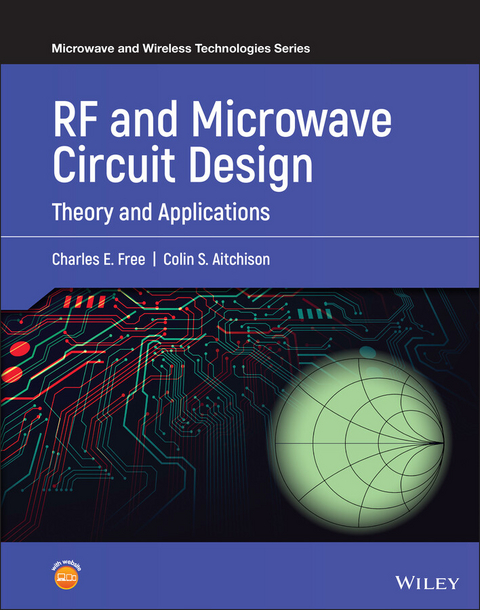
RF and Microwave Circuit Design (eBook)
John Wiley & Sons (Verlag)
978-1-119-11466-6 (ISBN)
This textbook covers a typical modern syllabus in radio frequency or microwave design at final year undergraduate or first year postgraduate level. The content has been chosen to include all of the basic topics necessary to give a rigorous introduction to high-frequency technology. Both the content and presentation reflect the considerable experience which both authors have in teaching and research at university level. The material is presented from first principles, and relies only on students having a reasonable grasp of basic electronic principles. One of the key features of the book is the inclusion of an extensive set of worked examples to guide the student reader who has no prior knowledge of the subject.
Dr Charles Free, Senior Lecturer, University of Sussex, UK. Free started his career as a Research Engineer at GEC-Marconi and went into academia in 1973. He specializes in RF electronics, systems and circuits, microwave engineering, and analogue communications. His teaching and research activities have taken him to Finland, Poland, Germany and Japan, and he has contributed to over 150 journal articles internationally.
Professor Colin S. Aitchison studied at Imperial College, London, and has had a diverse career within academia and industry. He is a part Chair of European Microwave Conference and has contributed to almost 200 articles and conference proceedings.
RF and Microwave Circuit Design Provides up-to-date coverage of the fundamentals of high-frequency microwave technology, written by two leading voices in the field RF and Microwave Circuit Design: Theory and Applications is an authoritative, highly practical introduction to basic RF and microwave circuits. With an emphasis on real-world examples, the text explains how distributed circuits using microstrip and other planar transmission lines can be designed and fabricated for use in modern high-frequency passive and active circuits and sub-systems. The authors provide clear and accurate guidance on each essential aspect of circuit design, from the theory of transmission lines to the passive and active circuits that form the basis of modern high-frequency circuits and sub-systems. Assuming a basic grasp of electronic concepts, the book is organized around first principles and includes an extensive set of worked examples to guide student readers with no prior grounding in the subject of high-frequency microwave technology. Throughout the text, detailed coverage of practical design using distributed circuits demonstrates the influence of modern fabrication processes. Filling a significant gap in literature by addressing RF and microwave circuit design with a central theme of planar distributed circuits, this textbook: Provides comprehensive discussion of the foundational concepts of RF and microwave transmission lines introduced through an exploration of wave propagation along a typical transmission line Describes fabrication processes for RF and microwave circuits, including etched, thick-film, and thin-film RF circuits Covers the Smith Chart and its application in circuit design, S-parameters, Mason???s non-touching loop rule, transducer power gain, and stability Discusses the influence of noise in high-frequency circuits and low-noise amplifier design Features an introduction to the design of high-frequency planar antennas Contains supporting chapters on fabrication, circuit parameters, and measurements Includes access to a companion website with PowerPoint slides for instructors, as well as supplementary resources Perfect for senior undergraduate students and first-year graduate students in electrical engineering courses, RF and Microwave Circuit Design: Theory and Applications will also earn a place in the libraries of RF and microwave professionals looking for a useful reference to refresh their understanding of fundamental concepts in the field.
Dr. Charles E. Free was formerly a Reader in Microwave Technology at the University of Surrey, United Kingdom. He specializes in RF electronics and microwave engineering and has contributed to approximately 150 scholarly publications. Professor Colin S. Aitchison was previously Chair of the European Microwave Conference and has contributed to approximately 185 scholarly publications. He was formerly Dean of the Technology faculty at Brunel University, United Kingdom.
1
RF Transmission Lines
1.1 Introduction
Transmission lines, in the form of cable and circuit interconnects, are essential components in RF and microwave systems. Furthermore, many distributed planar components rely on transmission line principles for their operation. This chapter will introduce the concepts of RF transmission along guided structures, and provide the foundations for the development of distributed components in subsequent chapters.
Four of the most common forms of RF and microwave transmission line are shown in Figure 1.1.
- Coaxial cable is an example of a shielded transmission line, in which the signal conductor is at the centre of a cylindrical conducting tube, with the intervening space filled with lossless dielectric. The dielectric is normally solid, although for higher-frequency applications it is often in the form of dielectric vanes so as to create a semi-air-spaced medium with lower transmission losses. A typical coaxial cable is flexible with an outer diameter around 5 mm, although much smaller diameters are available with 1 mm diameter cable being used for interconnections within millimetre-wave equipment. Also, for very high-frequency applications, the cable may have a rigid or semi-rigid construction. Further data on coaxial cables are provided in Appendix 1.A.
- Coplanar waveguide (CPW), in which all the conductors are on the same side of the substrate, is also shown in Figure 1.1. This type of structure is very convenient for the mounting of active components, and also for providing isolation between signal tracks. Coplanar lines are widely used in compact integrated circuits for high-frequency applications. Further data on coplanar lines are given in Appendix 1.B.
- Waveguide, formed from hollow metal tubes of rectangular or circular cross-section, is a traditional form of transmission line used for microwave frequencies above 1 GHz. For many circuit and interconnection applications, waveguide has been superseded by planar structures, and its use in modern RF and microwave systems is restricted to rather specialized applications. It is the only transmission line that can support the very high powers required in some transmitter applications. Another advantage of an air-filled metal waveguide is that it is a very low loss medium and therefore can be used to make very high-Q cavities, and this application is discussed in more detail in Chapter 3 in relation to dielectric measurements. A more recent application of traditional waveguides is in substrate integrated waveguide (SIW) structures for millimetre-wave applications, and this is explained in more detail in Chapter 4 in the context of emerging technologies. Further data on the theory of waveguides are given in Appendix 1.C.
- Microstrip is the most common form of interconnection used in planar circuits for RF and microwave applications. As shown in Figure 1.1, it consists of a low-loss insulating substrate, with one side completely covered with a conductor to form a ground plane, and a signal track on the other side. Further data on microstrip are given in Appendix 1.D. This is a particularly important medium for high-frequency circuit design and so Chapter 2 is devoted to an in-depth discussion of microstrip and the associated design techniques.
1.2 Voltage, Current, and Impedance Relationships on a Transmission Line
In its simplest form, a transmission line can be viewed as a two-conductor structure with a go and return path for the current. For the purpose of analysis we may regard any transmission line as made up of a large number of very short lengths (δz), each of which can be represented by a lumped equivalent circuit, as shown in Figure 1.2. In the equivalent circuits, R and L represent the series resistance and inductance per unit length of the conductors, respectively, C represents the capacitance between the lines per unit length, and G is the parallel conductance per unit length, and represents the very high resistance of the insulating medium between the conductors.
Figure 1.1 Common types of high-frequency transmission line.
Figure 1.2 Representation of a transmission line in terms of lumped components.
It should be noted that it is legitimate to represent a continuous transmission line by the lumped equivalent circuit shown in Figure 1.2 providing that δz is small compared to a wavelength. R, L, G, and C are normally referred to as the primary line constants, and have the units of Ω/m, H/m, S/m, and F/m, respectively.
In order to establish relationships between the voltage and current on a transmission line we need first to specify a line excited by a sinusoidal voltage at the sending end whose angular frequency is ω. If we then let the voltage and current at some arbitrary point on the line be V and I, respectively, we can consider the effect on an elemental length at this point. The voltage drop across the elemental length will be δV and the parallel current will be δI, as shown in Figure 1.3.
Using standard AC circuit theory, we can relate the change in voltage, δV, to the components of the equivalent circuit as
i.e.
Considering the limit, as δz → 0, giving
Figure 1.3 Equivalent circuit of an elemental length, δz, of a transmission line.
Considering the parallel current, δI, we have
i.e.
As δz → 0, giving
Differentiating Eq. (1.1) with respect to time gives
Substituting for from Eq. (1.2) gives
which can be written as
where
Similarly
To determine the variation of V along the line, we have to solve the differential Eq. (1.3) for V. This is a second-order differential equation with a standard solution in the form
The two terms on the right-hand side of Eq. (1.6) show how the peak amplitudes and phases of waves travelling in the forward and reverse directions vary with distance. The values of the amplitudes and phases of these waves are determined by the value of γ, which is defined as the propagation constant (this is considered in more detail in Section 1.3).
Differentiating the expression in Eq. (1.6) gives
Combining Eqs. (1.7) and (1.1) gives
i.e.
Remembering that we can rewrite Eq. (1.8) as
or
where
The impedance, ZO, is termed the characteristic impedance of the transmission line. Characteristic impedance is an important property of any transmission line and it is useful to have an appreciation of its physical significance. Theoretically, it is the ratio of the voltage to current at an arbitrary position on an infinitely long transmission line that supports a wave travelling in one direction. If the line is lossless, i.e. R = 0 and G = 0, then we see from Eq. (1.10) that and has a constant value that is independent of frequency. It follows that if such a line is terminated by an impedance equal to the characteristic impedance, there will be no reflections from the termination. Moreover, if a transmission line is terminated with its characteristic impedance, then the impedance at the input of the line will be equal to the characteristic impedance; under these conditions the line is said to be matched.
Considering the sending end of the line, i.e. z = 0, then from Eqs. (1.6) and (1.9) we obtain
where VS and IS are the voltage and current at the sending end of the line, respectively.
Rearranging Eq. (1.11) to obtain V1 and V2 gives:
The voltage, V, and current, I, at any distance, z, along the transmission line can now be found in terms of the voltage and current at the sending end by substituting V1 and V2 from Eq. (1.12) into Eqs. (1.6) and (1.9) giving
Equation (1.13) may be written in terms of hyperbolic functions as
Similarly,
The impedance, Zz, at any distance z from the sending end of the line can now be found by dividing Eq. (1.14) by Eq. (1.15) giving
where is the impedance at the sending end of the line.
If we now consider a transmission line of finite length, l, terminated by an arbitrary impedance, ZL, then Zz = ZL when...
| Erscheint lt. Verlag | 3.9.2021 |
|---|---|
| Reihe/Serie | Microwave and Wireless Technologies Series | Microwave and Wireless Technologies Series |
| Sprache | englisch |
| Themenwelt | Technik ► Elektrotechnik / Energietechnik |
| Schlagworte | Electrical & Electronics Engineering • Elektrotechnik u. Elektronik • high frequency circuit design • high frequency microwave circuits • Leistungselektronik • Microwave Amplifiers • microwave circuit fabrication • microwave filters • microwave oscillators • Mikrowellen- u. Hochfrequenztechnik u. Theorie • Power Electronics • RF circuit fabrication • RF / Microwave Theory & Techniques • Smith chart circuit design |
| ISBN-10 | 1-119-11466-7 / 1119114667 |
| ISBN-13 | 978-1-119-11466-6 / 9781119114666 |
| Informationen gemäß Produktsicherheitsverordnung (GPSR) | |
| Haben Sie eine Frage zum Produkt? |
 EPUB (Adobe DRM)
Kopierschutz: Adobe-DRM
Adobe-DRM ist ein Kopierschutz, der das eBook vor Mißbrauch schützen soll. Dabei wird das eBook bereits beim Download auf Ihre persönliche Adobe-ID autorisiert. Lesen können Sie das eBook dann nur auf den Geräten, welche ebenfalls auf Ihre Adobe-ID registriert sind.
Details zum Adobe-DRM
Dateiformat: EPUB (Electronic Publication)
EPUB ist ein offener Standard für eBooks und eignet sich besonders zur Darstellung von Belletristik und Sachbüchern. Der Fließtext wird dynamisch an die Display- und Schriftgröße angepasst. Auch für mobile Lesegeräte ist EPUB daher gut geeignet.
Systemvoraussetzungen:
PC/Mac: Mit einem PC oder Mac können Sie dieses eBook lesen. Sie benötigen eine
eReader: Dieses eBook kann mit (fast) allen eBook-Readern gelesen werden. Mit dem amazon-Kindle ist es aber nicht kompatibel.
Smartphone/Tablet: Egal ob Apple oder Android, dieses eBook können Sie lesen. Sie benötigen eine
Geräteliste und zusätzliche Hinweise
Buying eBooks from abroad
For tax law reasons we can sell eBooks just within Germany and Switzerland. Regrettably we cannot fulfill eBook-orders from other countries.
aus dem Bereich