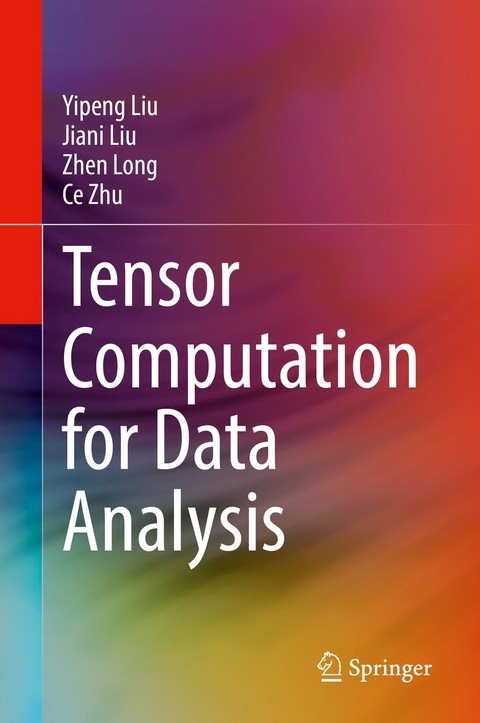
Tensor Computation for Data Analysis (eBook)
XX, 338 Seiten
Springer International Publishing (Verlag)
978-3-030-74386-4 (ISBN)
Tensor is a natural representation for multi-dimensional data, and tensor computation can avoid possible multi-linear data structure loss in classical matrix computation-based data analysis.
This book is intended to provide non-specialists an overall understanding of tensor computation and its applications in data analysis, and benefits researchers, engineers, and students with theoretical, computational, technical and experimental details. It presents a systematic and up-to-date overview of tensor decompositions from the engineer's point of view, and comprehensive coverage of tensor computation based data analysis techniques. In addition, some practical examples in machine learning, signal processing, data mining, computer vision, remote sensing, and biomedical engineering are also presented for easy understanding and implementation. These data analysis techniques may be further applied in other applications on neuroscience, communication, psychometrics, chemometrics, biometrics, quantum physics, quantum chemistry, etc.
The discussion begins with basic coverage of notations, preliminary operations in tensor computations, main tensor decompositions and their properties. Based on them, a series of tensor-based data analysis techniques are presented as the tensor extensions of their classical matrix counterparts, including tensor dictionary learning, low rank tensor recovery, tensor completion, coupled tensor analysis, robust principal tensor component analysis, tensor regression, logistical tensor regression, support tensor machine, multilinear discriminate analysis, tensor subspace clustering, tensor-based deep learning, tensor graphical model and tensor sketch. The discussion also includes a number of typical applications with experimental results, such as image reconstruction, image enhancement, data fusion, signal recovery, recommendation system, knowledge graph acquisition, traffic flow prediction, link prediction, environmental prediction, weather forecasting, background extraction, human pose estimation, cognitive state classification from fMRI, infrared small target detection, heterogeneous information networks clustering, multi-view image clustering, and deep neural network compression.
Yipeng Liu received the BSc degree and the PhD degree from University of Electronic Science and Technology of China (UESTC), Chengdu, in 2006 and 2011, respectively. In 2011, he was a research engineer at Huawei Technologies, Chengdu, China. From 2011 to 2014, he was a postdoctoral research fellow at University of Leuven, Leuven, Belgium. Since 2014, he has been an associate professor with UESTC, Chengdu, China. His main research interest is tensor computation for data analysis. He has authored or co-authored over 70 publications, and held more than 10 patents. He has given tutorials on several international conferences, such as ICIP 2020, SSCI 2020, ISCAS 2019, SiPS 2019, and APSIPA ASC 2019. He has been an associate editor for IEEE Signal Processing Letters.
Zhen Long received the BSc degree in Electronic Information Engineering from the Southwest University of Science and Technology, Mianyang, China, in 2016. From 2016 to now, she is a PhD student with the University of Electronic Science and Technology of China (UESTC), Chengdu, China. Her research interest is tensor signal processing.
Jiani Liu received the BSc degree in Electronic Information Engineering from University of Electronic Science and Technology of China (UESTC), Chengdu, China, in 2016. From 2016 to now, she is a PhD student with the UESTC, Chengdu, China. Her research interest is tensor for machine learning.
Ce Zhu is currently a professor with the School of Information and Communication Engineering, University of Electronic Science and Technology of China, Chengdu, China. He had been with Nanyang Technological University, Singapore, for 14 years from 1998 to 2012. His research interests include image/video coding and communications, video analysis, and tensor signal processing. He has served on the editorial boards of a few journals, including as an Associate Editor of IEEE Transactions on Image Processing, IEEE Transactions on Circuits and Systems for Video Technology, IEEE Transactions on Broadcasting, IEEE Signal Processing Letters, IEEE Communications Surveys and Tutorials, and as a Guest Editor of IEEE Journal of Selected Topics in Signal Processing. He is a Fellow of the IEEE and a CASS Distinguished Lecturer (2019-2020). He currently serves on the ICME Steering Committee.
| Erscheint lt. Verlag | 31.8.2021 |
|---|---|
| Zusatzinfo | XX, 338 p. 132 illus., 119 illus. in color. |
| Sprache | englisch |
| Themenwelt | Technik ► Elektrotechnik / Energietechnik |
| Schlagworte | Matrix and Tensor Variate Data Analysis • Nonnegative Matrix and Tensor Factorizations • Tensor Component Analysis • Tensors in Computer Vision • Tensors in Image Processing |
| ISBN-10 | 3-030-74386-1 / 3030743861 |
| ISBN-13 | 978-3-030-74386-4 / 9783030743864 |
| Informationen gemäß Produktsicherheitsverordnung (GPSR) | |
| Haben Sie eine Frage zum Produkt? |
 PDF (Wasserzeichen)
DRM: Digitales Wasserzeichen
Dieses eBook enthält ein digitales Wasserzeichen und ist damit für Sie personalisiert. Bei einer missbräuchlichen Weitergabe des eBooks an Dritte ist eine Rückverfolgung an die Quelle möglich.
Dateiformat: PDF (Portable Document Format)
Mit einem festen Seitenlayout eignet sich die PDF besonders für Fachbücher mit Spalten, Tabellen und Abbildungen. Eine PDF kann auf fast allen Geräten angezeigt werden, ist aber für kleine Displays (Smartphone, eReader) nur eingeschränkt geeignet.
Systemvoraussetzungen:
PC/Mac: Mit einem PC oder Mac können Sie dieses eBook lesen. Sie benötigen dafür einen PDF-Viewer - z.B. den Adobe Reader oder Adobe Digital Editions.
eReader: Dieses eBook kann mit (fast) allen eBook-Readern gelesen werden. Mit dem amazon-Kindle ist es aber nicht kompatibel.
Smartphone/Tablet: Egal ob Apple oder Android, dieses eBook können Sie lesen. Sie benötigen dafür einen PDF-Viewer - z.B. die kostenlose Adobe Digital Editions-App.
Buying eBooks from abroad
For tax law reasons we can sell eBooks just within Germany and Switzerland. Regrettably we cannot fulfill eBook-orders from other countries.
aus dem Bereich