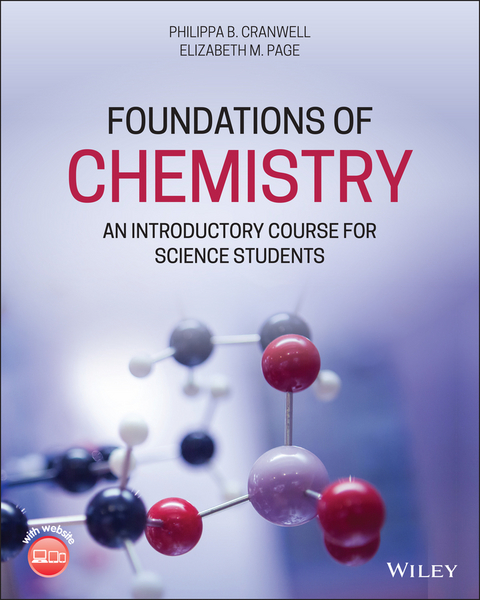
Foundations of Chemistry (eBook)
John Wiley & Sons (Verlag)
978-1-119-51390-2 (ISBN)
A foundation-level guide to chemistry for physical, life sciences and engineering students
Foundations of Chemistry: An Introductory Course for Science Students fills a gap in the literature to provide a basic chemistry text aimed at physical sciences, life sciences and engineering students. The authors, noted experts on the topic, offer concise explanations of chemistry theory and the principles that are typically reviewed in most one year foundation chemistry courses and first year degree-level chemistry courses for non-chemists.
The authors also include illustrative examples and information on the most recent applications in the field. Foundations of Chemistry is an important text that outlines the basic principles in each area of chemistry - physical, inorganic and organic - building on prior knowledge to quickly expand and develop a student's knowledge and understanding.
Key features include:
- Worked examples showcase core concepts and practice questions.
- Margin comments signpost students to knowledge covered elsewhere and are used to highlight key learning objectives.
- Chapter summaries list the main concepts and learning points.
Philippa B. Cranwell is Associate Professor of Organic Chemistry at the University of Reading. She has extensive experience of teaching students chemistry, ranging from A-level to Foundation level and higher. She has co-authored several texts relating to both practical and theoretical organic chemistry. She actively undertakes research in the field of chemistry education and regularly publishes her work. She was awarded a University of Reading Teaching Fellowship in 2016 for her contribution to teaching and learning.
Elizabeth M. Page is Emeritus Professor of Chemistry Education at the University of Reading. She has over 30 years experience of teaching chemistry at Foundation level and higher. She is author of several text books for life-sciences and chemistry students. Elizabeth has been an examiner for A level chemistry and helped in the design of the revised A level specifications in chemistry. During her time at Reading she established a strong network of chemistry teachers, providing a forum for discussions and guidance in teaching GCSE and A level chemistry. Elizabeth was awarded the Royal Society of Chemistry Education prize for her work with chemistry teachers and is a National and University of Reading Teaching Fellow.
FOUNDATIONS OF CHEMISTRY A foundation-level guide to chemistry for physical, life sciences and engineering students Foundations of Chemistry: An Introductory Course for Science Students fills a gap in the literature to provide a basic chemistry text aimed at physical sciences, life sciences and engineering students. The authors, noted experts on the topic, offer concise explanations of chemistry theory and the principles that are typically reviewed in most one year foundation chemistry courses and first year degree-level chemistry courses for non-chemists. The authors also include illustrative examples and information on the most recent applications in the field. Foundations of Chemistry is an important text that outlines the basic principles in each area of chemistry - physical, inorganic and organic - building on prior knowledge to quickly expand and develop a student's knowledge and understanding. Key features include: Worked examples showcase core concepts and practice questions. Margin comments signpost students to knowledge covered elsewhere and are used to highlight key learning objectives. Chapter summaries list the main concepts and learning points.
Philippa B. Cranwell is Associate Professor of Organic Chemistry at the University of Reading. She has extensive experience of teaching students chemistry, ranging from A-level to Foundation level and higher. She has co-authored several texts relating to both practical and theoretical organic chemistry. She actively undertakes research in the field of chemistry education and regularly publishes her work. She was awarded a University of Reading Teaching Fellowship in 2016 for her contribution to teaching and learning. Elizabeth M. Page is Emeritus Professor of Chemistry Education at the University of Reading. She has over 30 years experience of teaching chemistry at Foundation level and higher. She is author of several text books for life-sciences and chemistry students. Elizabeth has been an examiner for A level chemistry and helped in the design of the revised A level specifications in chemistry. During her time at Reading she established a strong network of chemistry teachers, providing a forum for discussions and guidance in teaching GCSE and A level chemistry. Elizabeth was awarded the Royal Society of Chemistry Education prize for her work with chemistry teachers and is a National and University of Reading Teaching Fellow.
0
Fundamentals
At the end of this chapter, students should be able to:
- Recognise the base SI quantities used in chemistry and state their symbols and units
- Convert between commonly used SI units
- Write numbers using scientific notation
- Recognise metric prefixes used in expressing large or small numbers.
- Understand the use of significant figures when expressing quantities and measurements and be able to round values to the correct number of significant figures
- Write chemical formulae and equations and balance equations
- Use the appropriate symbol to indicate the physical state of a substance in a chemical equation
0.1 Introduction to chemistry
Chemistry is a subject that underpins many other disciplines. At the heart of chemistry is the study of the elements that make up the periodic table, the reactions they undergo, and the new compounds that are formed.
Water is a compound that we are all familiar with, and most people know the formula for water is H2O even if they know nothing else about chemistry. The formula of water tells us that it is a molecule made up of two atoms of the element hydrogen and one atom of the element oxygen. In your course, you will learn that the elements in the periodic table are composed of atoms and that atoms are made up of smaller particles called protons, neutrons, and electrons. It is the specific combination of protons, neutrons, and electrons that gives each element its particular properties.
Hydrogen and oxygen are two of the smallest and lightest elements in the periodic table. Both hydrogen and oxygen are gases at room temperature, whereas water is a liquid. During your studies, you will learn why certain substances are gases or liquids, with low melting points and boiling points, and why other substances are solids that are very difficult to break down or melt. These properties depend to a certain extent upon how the atoms are arranged in molecules of the substances. For example, a water molecule has a bent shape (Figure 0.1). The bent shape of the water molecule is one of the factors that determines the melting and boiling point of water and ensures that it is a liquid at ambient temperatures. If the atoms in water were arranged in a straight line, water would have a much lower boiling point and would likely be a gas at room temperature. Clearly, this would have a major impact on life on earth. In this course, you will learn how to predict the shapes of small molecules such as water and see how important shape is in chemistry.
Figure 0.1 The shape of a water molecule, H2O.
In this chapter, we will introduce some of the fundamental tools necessary for studying, understanding, and applying chemical principles. You may have met some of these rules before in other subject areas, and you will probably meet them again later in the book, but this chapter should act as a toolbox from which you can select the information and guidance you need for the rest of the course.
0.2 Measurement in chemistry and science – SI units
Chemistry is a practical subject, and our present knowledge of chemical properties and principles is based on experiments. Unfortunately, we don't have space in this book to describe many of the amazing experiments that early investigators carried out to enhance our understanding and knowledge of chemistry. The majority of experiments require making and recording measurements. The laws of science operate across the globe, so it's important that scientists make measurements that can be compared with each other. Therefore, measurements must be recorded in a universal and standard way. For this reason, the metric system was developed to establish a standardised set of units. The metric system has its origins in the eighteenth century. More recently, a revised metric system was introduced and adopted by scientists across the world. This system is known as the Système Internationale d'Unités, and the units in the system are known as SI units.
There are seven fundamental SI units. Six of these are commonly used in chemistry, and you will meet all of them in this course. The six base units used in chemistry are listed in Table 0.1 and are the units of mass, length, time, electrical current, temperature, and amount of substance. All other units for physical quantities can be reduced to these base units. For example, speed is defined as the distance or length travelled divided by the time taken, so:
Table 0.1 Base SI quantities used in chemistry with symbols and units.
| Physical quantity | Symbol | Base unit | Unit symbol |
|---|
| Mass | m | kilogram | kg |
| Length | l | metre | m |
| Time | t | second | s |
| Electrical current | I | ampere | A |
| Temperature | T | kelvin | K |
| Amount of substance | n | mole | mol |
This defines the unit of speed as metre per second or m/s. In chemistry, as in most other scientific subjects, this would be written as: m s−1, where the superscript ‘−1’ means ‘per second’.
There are many other units you will come across that can be reduced down to these base units. Units of this type are called derived units and usually have their own symbol. A list of derived units and their symbols is given in Table 0.2.
Dealing with exponents
Exponents tell us how many times a number should be multiplied by itself. For example:
A special case is a0 = 1
To multiply quantities with exponents just add the exponents together:
To divide quantities with exponents subtract the exponents:
Table 0.2 Commonly used derived units.
| Quantity | Unit name | Symbol and base units |
|---|
| Area | square metre | m2 |
| Volume | cubic metre | m3 |
| Velocity (speed) | metre per second | m s−1 |
| Acceleration | metre per second squared | m s−2 |
| Density | kilogram per cubic metre | kg m−3 |
| Concentration | mole per cubic metre | mol m−3 |
| Energy | joule | J = kg m2 s−2 |
| Force | newton | N = J m−1 = kg m s−2 |
| Pressure | pascal | Pa = N m−2 = kg m−1 s−2 |
| Frequency | hertz | Hz = s−1 |
It is very important when carrying out calculations to keep track of the units, as you will be expected to quote the units of your answers. Units of each value in a calculation multiply or cancel with each other, as shown in the example here:
- Acceleration is defined as the change in velocity (speed) divided by the time taken and can be represented by this equation: acceleration = .
- Replacing the quantities with their units, we obtain: acceleration = .
- The unit can also be written as s−1, so the units for acceleration are m s−1 × s−1.
- To multiply s−1 by s−1, we simply add the −1 superscripts: acceleration = m s−1 × s−1 = m s−2.
- If we know the speed of an object and wish to determine how far it travels in a certain time, we multiply the speed by the time: distance = speed × time.
- Inserting the units for speed and time gives us the unit for distance = m s−1 × s.
- To multiply s−1 by s, again we add the superscripts: distance = m s−1 × s = m. This gives us the answer for distance in the correct units of metres. You should always check your answer when doing calculations to make sure that the value you obtain and the units are sensible.
Worked Example 0.1
Determine the derived units for the following quantities using the definitions given:
- density =
- entropy =
- pressure =
- power =
Solution
- density = = kg m−3
- entropy = = = kg m2 s−2 K−1
- pressure = = = = kg m s−2 × m−2 = kg m−1 s−2
- power = = = = kg m2 s−2 × s−1 = kg m2 s−3
0.3 Expressing large and small numbers using scientific notation
When studying science, you will likely come across numbers that are either extremely large or very small. It often isn't convenient (or practical) to write out the numbers ‘longhand’. An example of this is in using the constant for the speed of light in vacuum. The value of...
| Erscheint lt. Verlag | 30.7.2021 |
|---|---|
| Sprache | englisch |
| Themenwelt | Naturwissenschaften ► Biologie |
| Naturwissenschaften ► Chemie ► Technische Chemie | |
| Technik ► Umwelttechnik / Biotechnologie | |
| Schlagworte | biomedical engineering • Biomedizinische Technik • Biomedizintechnik • chemical engineering • Chemie • Chemische Verfahrenstechnik • Chemistry • Einführung in die Chemie • Preparatory / Introductory Chemistry |
| ISBN-10 | 1-119-51390-1 / 1119513901 |
| ISBN-13 | 978-1-119-51390-2 / 9781119513902 |
| Informationen gemäß Produktsicherheitsverordnung (GPSR) | |
| Haben Sie eine Frage zum Produkt? |
 EPUB (Adobe DRM)
Kopierschutz: Adobe-DRM
Adobe-DRM ist ein Kopierschutz, der das eBook vor Mißbrauch schützen soll. Dabei wird das eBook bereits beim Download auf Ihre persönliche Adobe-ID autorisiert. Lesen können Sie das eBook dann nur auf den Geräten, welche ebenfalls auf Ihre Adobe-ID registriert sind.
Details zum Adobe-DRM
Dateiformat: EPUB (Electronic Publication)
EPUB ist ein offener Standard für eBooks und eignet sich besonders zur Darstellung von Belletristik und Sachbüchern. Der Fließtext wird dynamisch an die Display- und Schriftgröße angepasst. Auch für mobile Lesegeräte ist EPUB daher gut geeignet.
Systemvoraussetzungen:
PC/Mac: Mit einem PC oder Mac können Sie dieses eBook lesen. Sie benötigen eine
eReader: Dieses eBook kann mit (fast) allen eBook-Readern gelesen werden. Mit dem amazon-Kindle ist es aber nicht kompatibel.
Smartphone/Tablet: Egal ob Apple oder Android, dieses eBook können Sie lesen. Sie benötigen eine
Geräteliste und zusätzliche Hinweise
Buying eBooks from abroad
For tax law reasons we can sell eBooks just within Germany and Switzerland. Regrettably we cannot fulfill eBook-orders from other countries.
aus dem Bereich