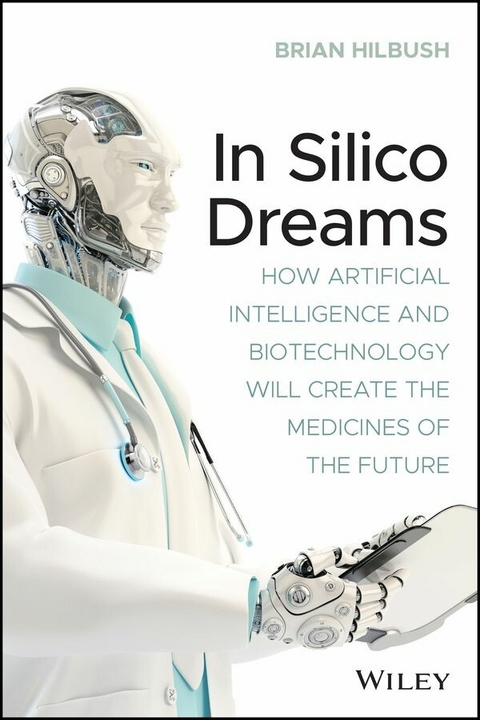
In Silico Dreams (eBook)
John Wiley & Sons (Verlag)
978-1-119-74563-1 (ISBN)
Learn how AI and data science are upending the worlds of biology and medicine
In Silico Dreams: How Artificial Intelligence and Biotechnology Will Create the Medicines of the Future delivers an illuminating and fresh perspective on the convergence of two powerful technologies: AI and biotech. Accomplished genomics expert, executive, and author Brian Hilbush offers readers a brilliant exploration of the most current work of pioneering tech giants and biotechnology startups who have already started disrupting healthcare. The book provides an in-depth understanding of the sources of innovation that are driving the shift in the pharmaceutical industry away from serendipitous therapeutic discovery and toward engineered medicines and curative therapies.
In this fascinating book, you'll discover:
- An overview of the rise of data science methods and the paradigm shift in biology that led to the in silico revolution
- An outline of the fundamental breakthroughs in AI and deep learning and their applications across medicine
- A compelling argument for the notion that AI and biotechnology tools will rapidly accelerate the development of therapeutics
- A summary of innovative breakthroughs in biotechnology with a focus on gene editing and cell reprogramming technologies for therapeutic development
- A guide to the startup landscape in AI in medicine, revealing where investments are poised to shape the innovation base for the pharmaceutical industry
Perfect for anyone with an interest in scientific topics and technology, In Silico Dreams also belongs on the bookshelves of decision-makers in a wide range of industries, including healthcare, technology, venture capital, and government.
BRIAN HILBUSH, PhD, is Director, IT Advanced Analytics and Data Solutions at Veranome Biosystems. He received his doctorate in Neuroscience from Stony Brook University and has over three decades of experience in computational biology, genomics, drug discovery, data science, and artificial intelligence.
Learn how AI and data science are upending the worlds of biology and medicine In Silico Dreams: How Artificial Intelligence and Biotechnology Will Create the Medicines of the Future delivers an illuminating and fresh perspective on the convergence of two powerful technologies: AI and biotech. Accomplished genomics expert, executive, and author Brian Hilbush offers readers a brilliant exploration of the most current work of pioneering tech giants and biotechnology startups who have already started disrupting healthcare. The book provides an in-depth understanding of the sources of innovation that are driving the shift in the pharmaceutical industry away from serendipitous therapeutic discovery and toward engineered medicines and curative therapies. In this fascinating book, you'll discover: An overview of the rise of data science methods and the paradigm shift in biology that led to the in silico revolution An outline of the fundamental breakthroughs in AI and deep learning and their applications across medicine A compelling argument for the notion that AI and biotechnology tools will rapidly accelerate the development of therapeutics A summary of innovative breakthroughs in biotechnology with a focus on gene editing and cell reprogramming technologies for therapeutic development A guide to the startup landscape in AI in medicine, revealing where investments are poised to shape the innovation base for the pharmaceutical industry Perfect for anyone with an interest in scientific topics and technology, In Silico Dreams also belongs on the bookshelves of decision-makers in a wide range of industries, including healthcare, technology, venture capital, and government.
BRIAN HILBUSH, PhD, is Director, IT Advanced Analytics and Data Solutions at Veranome Biosystems. He received his doctorate in Neuroscience from Stony Brook University and has over three decades of experience in computational biology, genomics, drug discovery, data science, and artificial intelligence.
Introduction
We have entered an unprecedented era of rapid technological change where developments in fields such as computer science, artificial intelligence (AI), genetic engineering, neuroscience, and robotics will direct the future of medicine. In the past decade, research organizations around the globe have made spectacular advances in AI, particularly for computer vision, natural language processing and speech recognition. The adoption of AI across business is being driven by the world's largest technology companies. Amazon, Google, and Microsoft offer vast, scalable cloud computing resources to train AI systems and platforms on which to build businesses. They also possess the talent, resources, and financial incentives to accelerate AI breakthroughs into medicine. These tech giants, including Apple, are executing on corporate strategies and product roadmaps that take them directly to the heart of healthcare. Every few weeks, a new AI tool is announced that performs a medical diagnostic procedure at human levels of performance. The pace of innovation in the tech sector is exponential, made possible by continual improvements and widespread availability of computing power, algorithmic design, and billions of lines of software programming code. Technology's influence on the sciences has been profound. Traditional disciplines such as biology and chemistry are being transformed by AI and data science to such an extent that new experimental paradigms have emerged for research and the pharmaceutical industry.
Biotechnology's growth and innovation cycles are equally impressive. Startling advances have been made to move the field from simple gene cloning experiments using viral and bacterial genetic material in test tubes to performing gene editing at precise locations in the human genome. A new generation of gene therapy and T-cell engineering companies are building tools to equip the immune systems of patients to destroy cancer. Explosive growth in data-generating capabilities from DNA sequencing instruments, medical imaging, and high-resolution microscopy has created a perfect storm of opportunities for AI and machine learning to analyze the data and produce biological insights. Out of this milieu, the first generation of tech-inspired startups has emerged, initiating the convergence of AI and biotechnology. These young companies are taking aim at the conventional path of drug development, with the brightest minds and freshest ideas from both fields providing a new base of innovation for the pharmaceutical industry.
This book tells the story of the impact of innovations in biology and computer science on the future of medicine. The creation of a new industry based on therapeutic engineering has begun. Nearly 200 years ago, Emmanuel Merck saw a commercial opportunity to produce the painkilling substance from the opium poppy, which was in widespread use across Europe and beyond. He was inspired by Fredrich Sertürner's innovative process for the extraction of the opiate alkaloid. Sertürner gave the newly purified narcotic substance the name morphium, after the Greek god of dreams. For thousands of years before these Germans helped to launch the pharmaceutical industry, medicinal compounds derived from nature had been concocted into noxious mixtures of uncertain potency by alchemists, physicians, or shamans in all cultures. With the elucidation of the rules of organic chemistry, the preparation and manufacturing of small molecule drugs and the practice of medicine would be forever changed.
The pharmaceutical industry began during the Industrial Revolution, drawing on a series of innovations in chemistry from the coal tar-based dye industry, along with other technological developments. This same rhythm of explosive innovation occurred again 100 years later in post–World War II laboratories in the United States and Britain. In the epochal years of 1952 and 1953, the foundations of computing, molecular biology, neuroscience, AI, and modern medicine arose almost at once, appearing in juxtaposition against the afterglow of the first thermonuclear bomb detonated in the Pacific. Science was literally blazing on all fronts.
Medicine has benefited enormously from the scientific discoveries and technologies born in the atomic age. Biotechnology has its roots in the principles and successes of molecular biology. The historic beginning was the discovery of the double helical structure of DNA in 1953, followed a generation later by the development of recombinant DNA technology in the 1970s. Therapeutics originating from biotechnology innovations now account for 7 of the top 10 drugs sold in the world.
Cancer chemotherapy treatments entered into clinical practice in the early 1950s, landmarked by the FDA's approval of methotrexate in 1953. These therapies provided a rational basis for attacking cancer cells selectively and sparked a decades-long search for new chemotherapeutics. As importantly, clinicians became critical in the evaluation of these and other new drugs in clinical trials, taking a seat at the table alongside medicinal chemists and pharmacologists as decision-makers in industry.
In neuroscience, Alan Hodgkin and Andrew Huxley's unifying theory of how neurons fire action potentials was published in 1952. The Hodgkin-Huxley model stands as one of biology's most successful quantitative models, elegantly tying together experimental and theoretical work. The framework led to the search for the ion channels, receptors, and transporters that control ionic conductance and synaptic activity, which together formed the basis of 50 years' worth of neuroscience drug discovery.
Modern computing and AI began with the work of its seminal figures starting in the 1930s and was anchored by successful operation of the first stored program, electronic digital computer—the MANIAC I—in 1952. Historian George Dyson framed the significance of this moment well in his 2012 book, Turing's Cathedral: The Origins of the Digital Universe, (Vintage, 2012), stating that “The stored-program computer conceived by Alan Turing and delivered by John von Neumann broke the distinction between numbers that mean things and numbers that do things. The universe would never be the same.” AI pioneers who had hopes for machine intelligence based on neural networks would need another 60 years and a trillion-fold increase in computing performance to have their dreams realized.
The science and technologies sparking the biotech and digital revolutions developed in parallel over the past 50 years and within the past decade have acquired powerful capabilities with widespread applications. The convergence of these technologies into a new science will have a profound impact on the development of diagnostics and medicines and nonpharmaceutical interventions for chronic diseases and mental health. The recent advances in AI and biotechnology together will be capable of disrupting the long-standing pharmaceutical industry model via superiority in prediction, precision, theory testing, and efficiency across critical phases of drug development. Not too far into the future, with any luck, the in silico dreams of scientists and its impact on medicine will be realized.
What Does This Book Cover?
The book ties together historical background with the latest cutting-edge research from the fields of biotechnology and AI, focusing on important innovations affecting medicine. Several chapters also contain highlights of the crop of new businesses engaged in the latest gene and cell therapy, along with those founded on AI-based therapeutic discovery and engineering. An in-depth look at the history of medicines sets the stage for understanding the pharmaceutical industry today and the evolution of therapeutic discovery for tomorrow.
Chapter 1, “The Information Revolution's Impact on Biology,” begins with an overview of milestones in technology innovation that are central to modern biology and biomedical applications. The first section covers the success of genomics in tackling the deluge of genome sequencing information during the COVID-19 pandemic and biotech's utilization of the data for creating a vaccine against SARS-CoV-2. The next section details the recent paradigm shift in biology, describing how the field is moving toward a more quantitative discipline. Another major thrust of the chapter is the role of computational biology in human genome sequencing, and its potential for medicine in the 21st century.
Chapter 2, “A New Era of Artificial Intelligence,” covers the history of AI's development and the major milestones leading up to the stunning advances in deep learning. The role of neuroscience in formulating some of the ideas around artificial neural networks and the neurobiological basis of vision are discussed. An introduction to various approaches in machine learning is presented along with current deep learning breakthroughs. A first look at AI applications in medicine is also given. The chapter ends with a brief look at current limitations of AI.
Chapter 3, “The Long Road to New Medicines,” travels all the way back to the Stone Age to reveal humanity's first random experimentations to find nature's medicines. The first section outlines the progression of therapeutic discovery through four eras: botanicals, chemical therapeutics, biotherapeutics, and therapeutic engineering. The next section delves into the industrial manufacturing of medicines and the rise of the modern pharmaceutical industry. The chapter describes the birth of chemotherapeutic drugs and antibiotics and the impact of war on their...
| Erscheint lt. Verlag | 28.7.2021 |
|---|---|
| Sprache | englisch |
| Themenwelt | Informatik ► Theorie / Studium ► Künstliche Intelligenz / Robotik |
| Medizin / Pharmazie ► Allgemeines / Lexika | |
| Technik ► Umwelttechnik / Biotechnologie | |
| Schlagworte | AI • ai in biotech • AI in medicine • biological ai • biomedical engineering • Biomedizintechnik • Biotech • biotech ai • Biotechnologie • Chemie • Chemistry • Data Science • Data Science in Medicine • Drug Discovery & Development • Gesundheits- u. Sozialwesen • Gesundheitswesen • Health & Health Care Special Topics • Health & Social Care • KI • Künstliche Intelligenz • Medical AI • Medical data science • Medical Informatics & Biomedical Information Technology • Medicine • Medizininformatik u. biomedizinische Informationstechnologie • pharmaceutical ai • pharmaceutical data science • Pharmaceutical development • Spezialthemen Gesundheitswesen • therapeutics • Wirkstoffforschung • Wirkstoffforschung u. -entwicklung |
| ISBN-10 | 1-119-74563-2 / 1119745632 |
| ISBN-13 | 978-1-119-74563-1 / 9781119745631 |
| Informationen gemäß Produktsicherheitsverordnung (GPSR) | |
| Haben Sie eine Frage zum Produkt? |
 EPUB (Adobe DRM)
Kopierschutz: Adobe-DRM
Adobe-DRM ist ein Kopierschutz, der das eBook vor Mißbrauch schützen soll. Dabei wird das eBook bereits beim Download auf Ihre persönliche Adobe-ID autorisiert. Lesen können Sie das eBook dann nur auf den Geräten, welche ebenfalls auf Ihre Adobe-ID registriert sind.
Details zum Adobe-DRM
Dateiformat: EPUB (Electronic Publication)
EPUB ist ein offener Standard für eBooks und eignet sich besonders zur Darstellung von Belletristik und Sachbüchern. Der Fließtext wird dynamisch an die Display- und Schriftgröße angepasst. Auch für mobile Lesegeräte ist EPUB daher gut geeignet.
Systemvoraussetzungen:
PC/Mac: Mit einem PC oder Mac können Sie dieses eBook lesen. Sie benötigen eine
eReader: Dieses eBook kann mit (fast) allen eBook-Readern gelesen werden. Mit dem amazon-Kindle ist es aber nicht kompatibel.
Smartphone/Tablet: Egal ob Apple oder Android, dieses eBook können Sie lesen. Sie benötigen eine
Geräteliste und zusätzliche Hinweise
Buying eBooks from abroad
For tax law reasons we can sell eBooks just within Germany and Switzerland. Regrettably we cannot fulfill eBook-orders from other countries.
aus dem Bereich