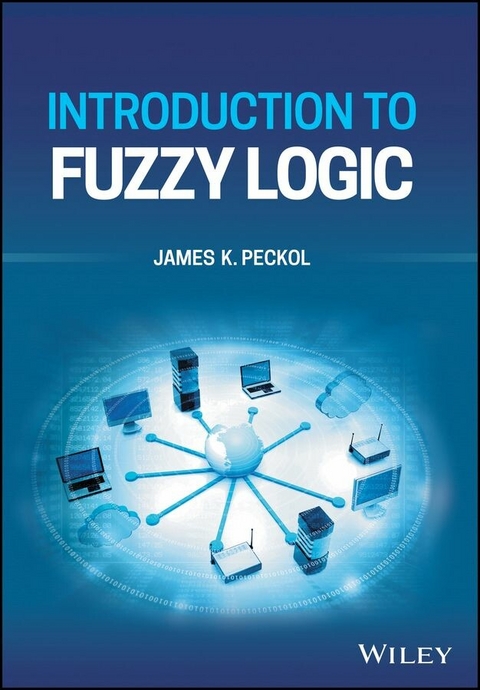
Introduction to Fuzzy Logic (eBook)
John Wiley & Sons (Verlag)
978-1-119-77263-7 (ISBN)
Learn more about the history, foundations, and applications of fuzzy logic in this comprehensive resource by an academic leader
Introduction to Fuzzy Logic delivers a high-level but accessible introduction to the rapidly growing and evolving field of fuzzy logic and its applications. Distinguished engineer, academic, and author James K. Peckol covers a wide variety of practical topics, including the differences between crisp and fuzzy logic, the people and professionals who find fuzzy logic useful, and the advantages of using fuzzy logic.
While the book assumes a solid foundation in embedded systems, including basic logic design, and C/C++ programming, it is written in a practical and easy-to-read style that engages the reader and assists in learning and retention. The author includes introductions of threshold and perceptron logic to further enhance the applicability of the material contained within.
After introducing readers to the topic with a brief description of the history and development of the field, Introduction to Fuzzy Logic goes on to discuss a wide variety of foundational and advanced topics, like:
- A review of Boolean algebra, including logic minimization with algebraic means and Karnaugh maps
- A discussion of crisp sets, including classic set membership, set theory and operations, and basic classical crisp set properties
- A discussion of fuzzy sets, including the foundations of fuzzy set logic, set membership functions, and fuzzy set properties
- An analysis of fuzzy inference and approximate reasoning, along with the concepts of containment and entailment and relations between fuzzy subsets
Perfect for mid-level and upper-level undergraduate and graduate students in electrical, mechanical, and computer engineering courses, Introduction to Fuzzy Logic covers topics included in many artificial intelligence, computational intelligence, and soft computing courses. Math students and professionals in a wide variety of fields will also significantly benefit from the material covered in this book.
James K. Peckol, PhD, is Principal Lecturer Emeritus in the Department of Electrical and Computer Engineering at the University of Washington in Seattle. He has over 50 years of experience in engineering and education in the fields of software, digital, medical, and embedded systems design and development.
Learn more about the history, foundations, and applications of fuzzy logic in this comprehensive resource by an academic leader Introduction to Fuzzy Logic delivers a high-level but accessible introduction to the rapidly growing and evolving field of fuzzy logic and its applications. Distinguished engineer, academic, and author James K. Peckol covers a wide variety of practical topics, including the differences between crisp and fuzzy logic, the people and professions who find fuzzy logic useful, and the advantages of using fuzzy logic. While the book assumes a solid foundation in embedded systems, including basic logic design, and C/C++ programming, it is written in a practical and easy-to-read style that engages the reader and assists in learning and retention. The author includes introductions of threshold and perceptron logic to further enhance the applicability of the material contained within. After introducing readers to the topic with a brief description of the history and development of the field, Introduction to Fuzzy Logic goes on to discuss a wide variety of foundational and advanced topics, like: A review of Boolean algebra, including logic minimization with algebraic means and Karnaugh maps A discussion of crisp sets, including classic set membership, set theory and operations, and basic classical crisp set properties A discussion of fuzzy sets, including the foundations of fuzzy sets logic, set membership functions, and fuzzy set properties An analysis of fuzzy inference and approximate reasoning, along with the concepts of containment and entailment and relations between fuzzy subsetsPerfect for mid-level and upper-level undergraduate and graduate students in electrical, mechanical, and computer engineering courses, Introduction to Fuzzy Logic covers topics included in many artificial intelligence, computational intelligence, and soft computing courses. Math students and professionals in a wide variety of fields will also significantly benefit from the material covered in this book.
James K. Peckol, PhD, is Principal Lecturer Emeritus in the Department of Electrical and Computer Engineering at the University of Washington in Seattle. He has over 50 years of experience in engineering and education in the fields of software, digital, medical, and embedded systems design and development.
Preface
Starting to Think Fuzzy and Beyond
Let's begin with these questions: “Exactly what is fuzzy logic?” “Why is the logic called fuzzy?” “Who might use fuzzy logic?” These are very good questions. People may have heard something about fuzzy logic and other kinds of logic but may not be quite sure what these terms mean or quite understand the applications.
Does fuzzy logic mean that someone's comment in a discussion is very confused? Let's try to answer that question and several of the other more common ones over the course of this text by starting with some simple fuzzy examples.
Our daily language is often routinely fuzzy; yet most of the time we easily understand it. Let's start by looking at some familiar expressions from our everyday exchanges.
Where did you park the car?
I parked up close to the front door of the building.
Please put the box in the trunk of the car.
I can't lift it. It's very heavy.
Are we close to the city yet?
We're roughly about thirty minutes away.
Is that shower warm?
It's very, very hot.
Is he tall?
Yes, he's very, very tall.
Is she smart?
Trust me, she's incredibly smart.
Each of the responses to the questions above is somewhat vague and imprecise yet, for the most part, each provides a reasonable answer that is probably well understood. Each expression in italics is called a fuzzy
linguistic variable rather than a crisp real number or a simple “yes” or “no.” The expressions give a high‐level view of fuzzy logic or fuzzy reasoning. Accompanying such reasoning we also find threshold logic and perceptrons, which model the brain.
In daily life, we find that there are two kinds of imprecision: statistical and nonstatistical. Statistical imprecision is that which arises from such events as the outcome of a coin toss or card game. Nonstatistical imprecision, on the other hand, is that which we find in expressions such as “We're roughly about thirty minutes away.” This latter type of imprecision is what we call fuzzy.
Children learn to understand and to manipulate such instructions at an early age. They quite easily understand phrases such as “Be home by around 5:00.” Perhaps children understand too well. They are adept at turning such a fuzzy expression into one that is also fuzzy. When they arrive home shortly after 6:00, they argue that 6:00 is about 5:00.
As we note, humans are quite facile at understanding fuzzy expressions and linguistic variables. For a computer, however, the opposite is true. With fuzzy logic, threshold logic, and perceptrons, increasingly both computer hardware and software are evolving to more challenging and interesting areas of logic such as neural networks, machine learning, and artificial intelligence.
Despite its amusing and seemingly contradictory name, fuzzy logic is not a logic that is fuzzy. On the contrary, fuzzy logic is a way of capturing the vagueness and imprecision that are so common in everyday human language. This capturing of vagueness and imprecision is also found in threshold logic and has significant application in artificial neurons called perceptrons. Capturing and representing the vagueness and imprecision of everyday language in terms that a computer can understand and work with is one of the objectives of fuzzy logic.
The computers we are all so familiar with operate using classical or crisp logic. Classical logic, around since Aristotle, divides the world into precise, nonoverlapping groups such as: yes–no, up–down, true–false, black–white, etc. Like a light bulb that can only be on or off, a classical logic statement can only be true or false. Those of you who have just said, “Wait a minute, what if the light's on a dimmer?” have just taken the first step to understanding fuzzy logic, threshold logic, and perceptrons. Like the light on a dimmer, a fuzzy logic statement can also be completely true or completely false, but it can also be partially true or partially false.
Fuzzy logic is simply a flexible variation and extension of classical logic. Fuzzy logic can represent statements that are completely true or false, and it can also represent those that are partially true. Classical logic lives in a black‐and‐white world. Fuzzy logic, threshold logic, and perceptrons, like humans, admit shades of gray. This ability to represent degrees of truth makes such tools very powerful for representing vague or imprecise ideas. We can now say, for example, that the tolerance on one capacitor is tighter than that on another or one program runs faster than another and not be concerned about specific values.
Organizing the Book
It is often all too easy to hack together a one‐off crisp logic application that appears to work. Trying to replicate a million or more copies of such a design (with elastic timing constraints, variable path impedance, or flexible data values) very quickly runs into the real‐world gremlins that are waiting for us. A solid, secure, robust, reliable design must always be based on the proven underlying theory, a thorough problem analysis, and a disciplined development approach. Such methods are growing increasingly important as we continue to push the envelope of designs that are impacting the daily lives of an ever‐increasing number of people.
This book takes a developer's perspective to first refreshing the basics of classic or crisp logic, teaching the concept of fuzzy logic, then applying such concepts to approximate reasoning systems such as threshold logic and perceptrons. This book examines, in detail, each of the important theoretical and practical aspects that one must consider when designing today's applications.
These applications must include the following:
- The formal hardware and software development process (stressing safety, security, and reliability)
- The digital and software architecture of the system
- The physical world interface to external analog and digital signals
- The debug and test throughout the development cycle and finally
- Improving the system performance
The Chapters
Introduction and Background
The Introduction gives an overview of the topics covered in the book. These topics include some of the vocabulary that is part of the fuzzy logic, threshold logic, and perceptron worlds. The Introduction also includes a bit of background and history, applications where such tools can be used, and a few contemporary examples.
History and Infrastructure
With the preliminary background set, the next two chapters introduce some of the early work that provided the foundation for fuzzy logic, the reasoning process for solving problems, and a brief review of the essentials of classic or crisp logic.
Chapter 1 presents some of the early views on reality, learning, logic, and reasoning that founded the first classic laws of thought that ultimately laid the foundations for fuzzy logic. Working from these fundamentals, the chapter introduces and discusses the basic mathematics and set theory underlying crisp and fuzzy logic and examines the similarities and differences between the two forms of logic. The chapter concludes with the introduction and study of fuzzy membership functions.
Chapter 2 opens with an introduction of the fundamental concepts of crisp logic underlying a classic algebra or algebraic system. The study follows with a review of the basics of Boolean algebra. We then introduce the concept and purpose of a truth table and demonstrate algebraic proofs using such tables. We then learn that the entries in such a table are called minterms and that a minterm is a binary aggregate of logical 0s and 1s that sets the logical value, true or false, of single cell entries in truth tables.
Next the K‐Map is introduced and reviewed as a pictorial tool for grouping logical expressions with shared or common factors. Such sharing enables the elimination of unwanted variables thereby simplifying a logical expression. These studies introduce and teach the groundwork for relaxing the precision of classic logic and the concepts and tools similar to those that we'll apply and work with in the worlds of fuzzy logic, threshold logic, and perceptrons.
Sets, Sets, and More Sets
Building on the work of those who opened the path and set the trail for us, the next two chapters introduce and study the fundamental concepts, properties, and operations of sets and set membership first for classic sets and then for fuzzy sets.
Chapter 3 introduces the fundamental concept of sets, focusing on what are known as classical or crisp sets. The chapter begins with an introduction of some of the elementary vocabulary and terminology and then reviews the principle definitions and concepts of the theory of ordinary or classical sets. The concepts of subsets and set membership are then presented and explored. Set membership naturally leads to the concept of membership functions.
With the fundamentals of sets and set membership established, we study the basic theory of classic or crisp logic. We then move to the details of the properties and logical operations of using crisp sets and of developing crisp membership applications. Crisp sets...
| Erscheint lt. Verlag | 27.7.2021 |
|---|---|
| Sprache | englisch |
| Themenwelt | Technik ► Elektrotechnik / Energietechnik |
| Schlagworte | Approximate Reasoning • basic fuzzy logic • crisp sets • Electrical & Electronics Engineering • Elektrotechnik u. Elektronik • Embedded • Embedded Systems & Smart Cards • Embedded Systems u. Smart Cards • fuzzification • Fuzzy Inference • fuzzy logic guide • fuzzy logic handbook • fuzzy logic intro • fuzzy logic manual • Fuzzy Logic Textbook • Fuzzy-Logik • Fuzzy Sets • Fuzzy-Systeme • Fuzzy Systems • Mathematical Modeling • Mathematics • Mathematik • Mathematische Modellierung • perceptron logic • threshold logic • UML |
| ISBN-10 | 1-119-77263-X / 111977263X |
| ISBN-13 | 978-1-119-77263-7 / 9781119772637 |
| Informationen gemäß Produktsicherheitsverordnung (GPSR) | |
| Haben Sie eine Frage zum Produkt? |
 EPUB (Adobe DRM)
Kopierschutz: Adobe-DRM
Adobe-DRM ist ein Kopierschutz, der das eBook vor Mißbrauch schützen soll. Dabei wird das eBook bereits beim Download auf Ihre persönliche Adobe-ID autorisiert. Lesen können Sie das eBook dann nur auf den Geräten, welche ebenfalls auf Ihre Adobe-ID registriert sind.
Details zum Adobe-DRM
Dateiformat: EPUB (Electronic Publication)
EPUB ist ein offener Standard für eBooks und eignet sich besonders zur Darstellung von Belletristik und Sachbüchern. Der Fließtext wird dynamisch an die Display- und Schriftgröße angepasst. Auch für mobile Lesegeräte ist EPUB daher gut geeignet.
Systemvoraussetzungen:
PC/Mac: Mit einem PC oder Mac können Sie dieses eBook lesen. Sie benötigen eine
eReader: Dieses eBook kann mit (fast) allen eBook-Readern gelesen werden. Mit dem amazon-Kindle ist es aber nicht kompatibel.
Smartphone/Tablet: Egal ob Apple oder Android, dieses eBook können Sie lesen. Sie benötigen eine
Geräteliste und zusätzliche Hinweise
Buying eBooks from abroad
For tax law reasons we can sell eBooks just within Germany and Switzerland. Regrettably we cannot fulfill eBook-orders from other countries.
aus dem Bereich