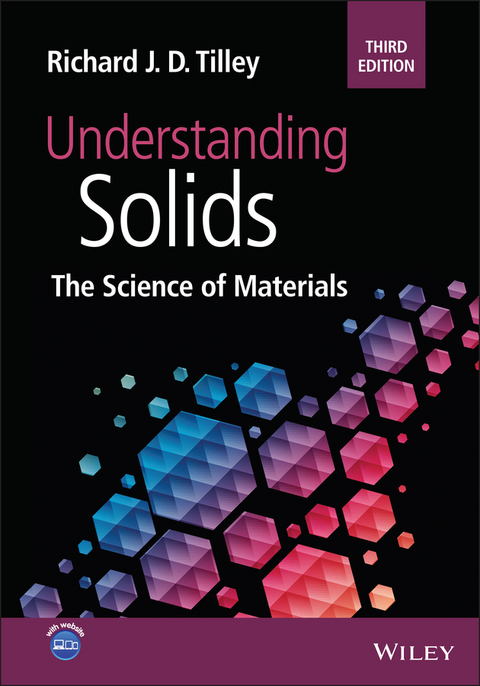
Understanding Solids (eBook)
John Wiley & Sons (Verlag)
978-1-119-71655-6 (ISBN)

Explore a comprehensive and illuminating introductory text to the science of solid materials from a leading voice in the field
The newly revised Third Edition of Understanding Solids: The Science of Materials delivers a complete yet concise treatment of the basic properties and chemical and physical behaviors of solid materials. Following a completely revised opening set of chapters in which the basic properties of solids-including atomic structure, chemical bonding, crystallography, and phase relationships-are discussed, the book goes on to describe new developments in the areas of batteries and fuel cells, perovskite solar cells, lighting and displays, nanoparticles, whiskers, and sheets.
The distinguished author has also added sections about organic framework structures, superionic conductors, mechanochemistry, bi-layer graphene, hologram formation and recording, and the optics of nanoparticle arrays and thermochromic materials. Each chapter includes a Further Reading section to help students accumulate additional knowledge on the topic within and new problems have been added throughout the book. Readers will also enjoy the inclusion of:
- A thorough introduction to the states of aggregation, including atoms and bonding, microstructures and phase relationships, and crystal structures and defects
- A comprehensive overview of different categories of solids, including metals, crystalline silicates, inorganic ceramics, and silicate glasses
- An exploration of reactions and transformations, including diffusion and ionic conductivity, phase transformations, and phase reactions
- A treatment of oxidation and reduction, including galvanic cells and chemical analysis
Perfect for undergraduate students in sciences, engineering, and technology, Understanding Solids: The Science of Materials will also earn a place in the libraries of anyone seeking a thoroughly up to date, one-stop reference to the science of solid materials.
Richard J.D. Tilley [INFO NOT INCLUDED]
Explore a comprehensive and illuminating introductory text to the science of solid materials from a leading voice in the field The newly revised Third Edition of Understanding Solids: The Science of Materials delivers a complete yet concise treatment of the basic properties and chemical and physical behaviors of solid materials. Following a completely revised opening set of chapters in which the basic properties of solids including atomic structure, chemical bonding, crystallography, and phase relationships are discussed, the book goes on to describe new developments in the areas of batteries and fuel cells, perovskite solar cells, lighting and displays, nanoparticles, whiskers, and sheets. The distinguished author has also added sections about organic framework structures, superionic conductors, mechanochemistry, bi-layer graphene, hologram formation and recording, and the optics of nanoparticle arrays and thermochromic materials. Each chapter includes a Further Reading section to help students accumulate additional knowledge on the topic within and new problems have been added throughout the book. Readers will also enjoy the inclusion of: A thorough introduction to the states of aggregation, including atoms and bonding, microstructures and phase relationships, and crystal structures and defects A comprehensive overview of different categories of solids, including metals, crystalline silicates, inorganic ceramics, and silicate glasses An exploration of reactions and transformations, including diffusion and ionic conductivity, phase transformations, and phase reactions A treatment of oxidation and reduction, including galvanic cells and chemical analysis Perfect for undergraduate students in sciences, engineering, and technology, Understanding Solids: The Science of Materials will also earn a place in the libraries of anyone seeking a thoroughly up to date, one-stop reference to the science of solid materials.
1
Atoms and Bonding
- What is an atomic term symbol?
- How are ionic radii determined?
- What are energy bands?
1.1 The Electron Structure of Atoms
An atom is made up of a small massive nucleus, in which almost all of the mass resides, surrounded by an electron cloud. Each element is differentiated from all others by the amount of positive charge on the nucleus, called the proton number or atomic number, Z. In a neutral atom, the nuclear charge is exactly balanced by Z electrons in the outer electron cloud, each of which carries one unit of negative charge. Variants of atoms that have slightly more or less electrons than are required for charge neutrality are called ions; those that have lost electrons have an overall positive charge and are called cations, while those that have gained electrons have an overall negative charge and are called anions. Many of the physical and chemical properties of solids described in later chapters are controlled by the outer electron structure of the component atoms.
1.1.1 Hydrogen
Hydrogen is the simplest atom and consists of a nucleus consisting of a single proton carrying one unit of positive charge together with a single bound electron carrying one unit of negative charge. The quantum mechanics of the hydrogen atom allows the probability of the location of the electron and its energy, defined in terms of wavefunctions, to be completely specified. The region of space defining the most probable location of the electron is termed an orbital. The wavefunctions are described by three quantum numbers: n, the principal quantum number; l, the orbital angular momentum quantum number; and ml, the magnetic quantum number. The principal quantum number, n, defines the energy of the electron. It can take integral values 1, 2, 3, … to infinity. The energy of the electron is lowest for n = 1 and this represents the most stable or ground state of the hydrogen atom. The next lowest energy is given by n = 2, then by n = 3, and so on.
The energy of each state is given by the formula:
where A is a constant equal to 2.179 × 10⁻¹⁸ J (13.6 eV)1 and E is the energy of the level with principal quantum number n. The negative sign in the equation indicates that the energy of the electron is chosen as zero when n is infinite, that is to say, when the electron is no longer bound to the nucleus.
There is only one wavefunction and orbital associated with the lowest energy, n = 1, state. The states of higher energy each have n2 different wavefunctions, corresponding to n2 different orbitals, all of which have the same energy. There are four different wavefunctions and orbitals corresponding to n = 2, nine different wavefunctions and orbitals for n = 3, and so on. These are differentiated from each other by different values of the quantum numbers l and ml, as explained in the following text. Wavefunctions with the same energy are said to be degenerate.
It is often convenient to represent the energy associated with each value of the principal quantum number, n, as a series of steps or energy levels (Figure 1.1). When an electron gains energy, it jumps from an energy level with a lower value of n to a level with a higher value of n. When an electron loses energy, it drops from an energy level with a higher value of n to an energy level with a lower value. The discrete packets of energy given out or taken up in this way are photons of electromagnetic radiation. The energy of a photon needed to excite an electron from energy E1, corresponding to an energy level n1 to energy E2, corresponding to an energy level n2 is given by:
Figure 1.1 Electron energy levels of the H atom.
The energy of the photon emitted when the electron falls back from E2 to E1 is the same as that required for the excitation. The frequency ν (or the equivalent wavelength, λ) of the photons that are either emitted or absorbed during these energy changes is given by the equation:
where h is the Planck constant. (Note that this equation applies to the transition between any two energy levels on any atom, not just between energy levels on hydrogen.) The energy needed to free the electron completely from the proton, which is called the ionisation energy of the hydrogen atom, is given by putting n1 = 1 and n2 = ∞ in the equation. The ionisation energy is 13.6 eV (2.179 × 10⁻¹⁸ J).
In the case of a single electron attracted to a nucleus of charge +Ze, the energy levels are given by:
This shows that the energy levels are much lower in energy than in hydrogen, and that the ionisation energy of such atoms is considerably higher.
1.1.2 Many Electron Atoms
The simplest description of an atom with a nuclear charge of +Z surrounded by Z electrons, called the orbital approximation, supposes that a single electron moves in a potential due to the nucleus and the average field of all the other electrons present in the atom, that is, it mirrors the hydrogen atom. The electron experiences an effective nuclear charge, Zeff, which is considered to be located as a point charge at the nucleus of the atom. The energy levels of all of the orbitals drop sharply as Zeff increases. When one reaches lithium, Z = 3, the 1s orbital energy has already decreased so much that it forms a chemically unreactive shell. This is translated into the concept of an atom as consisting of unreactive core electrons, surrounded by a small number of outermost valence electrons, which are of chemical and physical significance. Moreover, the change of energy as Z increases justifies the approximation that the valence electrons of all atoms are at similar energies.
The orbitals are specified by two interdependent quantum numbers, l and ml, where:
- l takes values of 0, 1, 2, …, (n − 1)
- ml takes values of 0, ±1, ±2, …, ±l
Each set of quantum numbers defines the state of the system. For a value of n = 1, there is only one state, corresponding to n = 1, l = 0, and ml = 0. For n = 2, l can take values of 0 and 1, and ml can then take values of 0, associated with l = 0, and −1, 0, and +1, associated with l = 1. For n = 3, l can take values of 0, 1, and 2, and ml then can take values of 0, associated with l = 0, −1, 0, and +1, associated with l = 1 and −2, −1, 0, +1, +2, associated with l = 2. The same procedure applies to higher values of n. The various orbitals are given letter symbols. Orbitals with l = 0 are called s orbitals, those with l = 1 are called p orbitals, those with l = 2 are called d orbitals, those with l = 3 are called f orbitals, and those with l = 4 are called g orbitals (Table 1.1).
Table 1.1 Orbitals of hydrogen‐like atoms.
| n | l | ml | Orbital | Number of electrons | Shell | Capacity |
|---|
| 1 | 0 | 0 | 1s (1) | 2 | K | 2 |
| 2 | 0 | 0 | 2s (1) | 2 | L | 8 |
| 1 | 0, ±1 | 2p (3) | 6 |
| 3 | 0 | 0 | 3s (1) | 2 | M | 18 |
| 1 | 0, ±1 | 3p (3) | 6 |
| 2 | 0, ±1, ±2 | 3d (5) | 10 |
| 4 | 0 | 0 | 4s (1) | 2 | N | 32 |
| 1 | 0, ±1 | 4p (3) | 6 |
| 2 | 0, ±1, ±2 | 4d (5) | 10 |
| 3 | 0, ±1, ±2, ±3 | 4f (7) | 14 |
| 5 | 0 | 0 | 5s (1) | 2 | O | 50 |
| Erscheint lt. Verlag | 11.6.2021 |
|---|---|
| Sprache | englisch |
| Themenwelt | Naturwissenschaften ► Chemie |
| Technik ► Maschinenbau | |
| Schlagworte | atomic structure of solids • batteries • chemical bonding of solids • chemical properties of solids • Chemie • Chemistry • crystallography • Festkörperchemie • Festkörperphysik • Fuel cells • Materials Science • Materialwissenschaften • nanoparticles • Perovskite solar cells • phase relationships of solids • Physical properties of solids • Physics • Physik • small dimension solids • solid state chemistry • Solid state physics |
| ISBN-10 | 1-119-71655-1 / 1119716551 |
| ISBN-13 | 978-1-119-71655-6 / 9781119716556 |
| Informationen gemäß Produktsicherheitsverordnung (GPSR) | |
| Haben Sie eine Frage zum Produkt? |
 EPUB (Adobe DRM)
Kopierschutz: Adobe-DRM
Adobe-DRM ist ein Kopierschutz, der das eBook vor Mißbrauch schützen soll. Dabei wird das eBook bereits beim Download auf Ihre persönliche Adobe-ID autorisiert. Lesen können Sie das eBook dann nur auf den Geräten, welche ebenfalls auf Ihre Adobe-ID registriert sind.
Details zum Adobe-DRM
Dateiformat: EPUB (Electronic Publication)
EPUB ist ein offener Standard für eBooks und eignet sich besonders zur Darstellung von Belletristik und Sachbüchern. Der Fließtext wird dynamisch an die Display- und Schriftgröße angepasst. Auch für mobile Lesegeräte ist EPUB daher gut geeignet.
Systemvoraussetzungen:
PC/Mac: Mit einem PC oder Mac können Sie dieses eBook lesen. Sie benötigen eine
eReader: Dieses eBook kann mit (fast) allen eBook-Readern gelesen werden. Mit dem amazon-Kindle ist es aber nicht kompatibel.
Smartphone/Tablet: Egal ob Apple oder Android, dieses eBook können Sie lesen. Sie benötigen eine
Geräteliste und zusätzliche Hinweise
Buying eBooks from abroad
For tax law reasons we can sell eBooks just within Germany and Switzerland. Regrettably we cannot fulfill eBook-orders from other countries.
aus dem Bereich