


Wine Faults and Flaws (eBook)
John Wiley & Sons (Verlag)
978-1-118-97907-5 (ISBN)
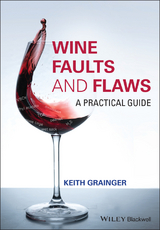
Wine Faults and Flaws: A Practical Guide
An essential guide to the faults and flaws that can affect wine
Written by the award-winning wine expert, Keith Grainger, this book provides a detailed examination and explanation of the causes and impact of the faults, flaws and taints that may affect wine. Each fault is discussed using the following criteria: what it is; how it can be detected by sensory or laboratory analysis; what the cause is; how it might be prevented; whether an affected wine is treatable, and if so, how; and the science applicable to the fault.
The incidences of faulty wines reaching the consumer are greater than would be regarded as acceptable in most other industries. It is claimed that occurrences are less common today than in recent recorded history, and it is true that the frequency of some faults and taints being encountered in bottle has declined in the last decade or two. However, incidences of certain faults and taints have increased, and issues that were once unheard of now affect many wines offered for sale. These include 'reduced' aromas, premature oxidation, atypical ageing and, very much on the rise, smoke taint.
This book will prove invaluable to winemakers, wine technologists and quality control professionals. Wine critics, writers, educators and sommeliers will also find the topics highly relevant. The wine-loving consumer, including wine collectors will also find the book a great resource and the basis for discussion at tastings with like-minded associates.
ABOUT THE AUTHOR
Keith Grainger is a wine writer, educator and consultant in wines and wine technology. His last book Wine Production and Quality, 2nd Edition (with co-author Hazel Tattersall) won the Gourmand Award for the Best Wine Book for Professionals in 25 Years.
2022 Winner of the OIV Award in the Oenology categoryAn essential guide to the faults and flaws that can affect wine Written by the award-winning wine expert, Keith Grainger, this book provides a detailed examination and explanation of the causes and impact of the faults, flaws and taints that may affect wine. Each fault is discussed using the following criteria: what it is; how it can be detected by sensory or laboratory analysis; what the cause is; how it might be prevented; whether an affected wine is treatable, and if so, how; and the science applicable to the fault. The incidences of faulty wines reaching the consumer are greater than would be regarded as acceptable in most other industries. It is claimed that occurrences are less common today than in recent recorded history, and it is true that the frequency of some faults and taints being encountered in bottle has declined in the last decade or two. However, incidences of certain faults and taints have increased, and issues that were once unheard of now affect many wines offered for sale. These include reduced aromas, premature oxidation, atypical ageing and, very much on the rise, smoke taint. This book will prove invaluable to winemakers, wine technologists and quality control professionals. Wine critics, writers, educators and sommeliers will also find the topics highly relevant. The wine-loving consumer, including wine collectors will also find the book a great resource and the basis for discussion at tastings with like-minded associates.ReviewsI read this book avidly from cover to cover. I ll dip into it for future reference as required, which is how many will employ it. Meanwhile, I learned a great deal, and it now influences how I think about wine evaluation.I commend this excellent new book to you. Consider it an investment. Paul Howard, Wine Alchemy
ABOUT THE AUTHOR Keith Grainger is a wine writer, educator and consultant in wines and wine technology. His last book Wine Production and Quality, 2nd Edition (with co-author Hazel Tattersall) won the Gourmand Award for the Best Wine Book for Professionals in 25 Years.
Introduction
This book comprises a detailed examination of faults, flaws, and taints that can affect the quality and merchantability of wines. Technically, there is a distinction between a taint and fault that will be discussed in Chapter 1. However, wine consumers, merchants, and the press rarely observe such distinction, simply referring to the affected product as faulty. Some faults render affected wines unsaleable and undrinkable. Others that have a negative effect upon quality, enjoyment, or potential for ageing.
There are no reliable figures regarding the total global financial cost of faulty and tainted wines to producers, agents, distributors, and retailers. However, there can be no doubt that it runs into many £/€ billions annually. A recent estimate of the economic costs to EU wine producers of haloanisoles taint in wines (so‐called ‘cork taint’) is 700 million euros annually [1]. Product recalls due to matters other than incidences of physical contamination are relatively rare in the wine industry. When bottles of faulty wines do reach the consumer, the impact upon the producers' and suppliers' reputations is incalculable. Although the purchaser may not have the knowledge or skill to identify the fault in question, it is unlikely that they will repurchase any other bottles of the same wine, and may avoid the brand or producer in question. In other words, the consumer will believe the faulty wine to be very low quality. If they have no recourse to financial redress, as will most likely be the case for wines purchased many years previously and which they have been patiently nurturing in their ‘cellar’ in anticipation of the complex delights of full maturity, consumers may well feel somewhat cheated.
Wine is, without doubt, the most discussed food or drink in the world, and wine lovers readily communicate their experiences to friends, colleagues, and those who share a love for what can be the most exciting and individual of products. Today, such discussions are livelier and more influential than ever. With the proliferation of blogs and social media postings, the opinions of a consumer's peers are, for better or worse, as or even more important than those of professional critics and reviewers. Wine writers, authors, and journalists are generally hugely supportive of the wine industry, without which their profession would not exist. Most are ‘deeply in love’ with wine, or at least ‘fine wine’. However, it is the nature of writing that certain topics become ‘hot’ and are then developed and pursued for as long as the readership retains an interest. Amongst the wine faults that have received considerable coverage in specialist consumer media in the last decade or two are so‐called ‘cork taint’, ‘reduced’ aromas (often referred to as reduction or reductivity), premature oxidation (premox), and the aromas produced by Brettanomyces yeasts. When such topics are discussed in a global context, articles can be informative, but they can also weaken confidence and influence buying habits. However, if the coverage relates to individual producers, the damage inflicted can be both instant and ongoing. Reputational damage may be done simply by naming faulty wines submitted for assessment at comparative tastings conducted by specialist magazines, or for tasting competitions. By way of example, during the early years of this century, the influential USA published magazine Wine Spectator revealed the identity and details of several ‘high‐end’ Californian producers who had marketed wines tainted by 2,4,6‐trichloroanisole (TCA) and 2,4,6‐tribromoanisole (2,4,6‐TBA). These compounds are usually, and particularly in the case of 2,4,6‐TBA erroneously, referred to as ‘cork taint’. The negative impact upon the reputations of producers that had taken decades to build is apparent.
On the other hand, there are ‘under the radar’ faults that are seldom discussed in the popular wine media or amongst professionals. A prime example is ‘atypical ageing’, by which white wines very rapidly lose varietal character and develop undesirable aroma and palate characteristics. This fault, often confused with premature oxidation, has been described as ‘one of the most serious quality problems in white wine making in nearly all wine producing countries’ [2]. It has been estimated that up to 20% of USA wines might be affected [3].
The financial impact upon producers and distributors who have sold faulty product can be immediate and direct. Supermarkets and merchants impose chargebacks upon suppliers when customers return wines. On an individual basis, this may be the cost of the bottle in question, the cost of analysis of other bottles, the cost of replacement bottles and a ‘fine’, or service handling fee. On a volume basis, the trade customer may demand reimbursement for pallets or even containers of affected wine, shipping and warehouse costs, handling, and possibly also excise duties which, in some countries, can amount to several times the value of the wine in question. If there are problems with subsequent shipments, the merchant may well blacklist the producer or supplier. The longer‐term financial impact can be massive. For example, winery contamination with haloanisoles has, on occasions, necessitated the destruction and rebuilding of cuveries and chais, as discussed in Chapter 3.
In Chapters 3–14, I discuss in detail individual categories of wine faults. I do not claim the list of faults included to be exhaustive. The discussion of each fault generally includes:
- What it is, in basic terms;
- How it can be detected by:
sensory recognition, including sensory detection thresholds;
laboratory analysis; - What the cause is;
- At which stage/s of production, maturation, or storage it can occur;
- How it might be prevented;
- Whether an affected wine is treatable, and if so how;
- The detailed science applicable to the fault.
The ‘history’ of the individual faults is also covered. Throughout the book, particularly Chapter 18, there is a general discussion of the implementation of what constitutes good procedures and practices in the vineyard and winery to enhance quality and minimise the likelihood of faults from occurring. Carrying out audits of premises, equipment, and inventory to identify microbial or chemical contamination can be costly and taking steps to address issues identified even more so. The cost of being unaware of problems, or doing nothing to rectify them, is incalculable. I am acutely aware of budget constraints that are an everyday challenge, particularly to the small producer, and such implementation may be generally achieved at minimum expense. Information on the identification of faults by laboratory analysis, and how faults may be rectified is given in general terms. However, producers seeking to address specific issues are advised to seek advice from any of the laboratories, consultants, and companies specialising in the identification and treatment of oenological problems. It is the responsibility of producers to check the legality of any method suggested, or the addition of any oenological products, in the country/region of production and market.
There are several challenges posed in undertaking any discussion of wine faults and flaws. These include matters of definitions, boundaries, concentrations, and the matrices of individual wines. From a sensory perspective, determining when a microbial or chemical issue is a fault is not necessarily straightforward. In addition to the issue of a taster's sensory detection thresholds, there can often be a dispute whether a particular characteristic is perceived as beneficial, harmless, a flaw or a fault. These perceptions are even subject to the vagaries of fashion. In 1982, Master of Wine and Burgundy expert Anthony Hanson wrote in the first edition of his critically acclaimed book Burgundy: ‘great Burgundy smells of shit’ [4]. If there were any raised eyebrows at the time, these were only because of Hanson's choice of language.
Indeed many Burgundies exuded the odours of stables and farmyards. By 1995, Hanson was already finding such a nose objectionable and blamed microbial activity [5]. We now know that these odours have nothing to do with Pinot Noir (the variety from which pretty much all red Burgundy is made). Nor do they stem from any of the myriads of Burgundy terroirs, but result from volatile phenols and other compounds produced by the yeast Brettanomyces (or to be technically correct Dekkera although it is rarely so‐called in the wine industry). Today, Brettanomyces is generally regarded in the wine industry as a rogue yeast, and odours of farmyards, stables, or BAND‐AID® are generally considered to be undesirable and regarded by most winemakers, oenologists, and critics to be a fault. This means that aromas in 1982 regarded by an expert taster as a sign of quality are today usually seen as a fault. However, Brettanomyces (often referred to as ‘Brett’) remains a controversial topic. Many producers, critics, and wine lovers believe it can, at low levels, add complexity to a wine. This poses the question as to where the boundary should be drawn. Purists perceive Brett always to be a fault and define it as such. Some lovers of ‘natural’ wines consider it to be one of nature's...
| Erscheint lt. Verlag | 19.5.2021 |
|---|---|
| Sprache | englisch |
| Themenwelt | Sachbuch/Ratgeber ► Essen / Trinken ► Getränke |
| Technik ► Lebensmitteltechnologie | |
| Schlagworte | Food chemistry • Food Marketing & Product Development • Food Science & Technology • Lebensmittelchemie • Lebensmittelforschung u. -technologie • Lebensmittel-Vermarktung u. -Produktentwicklung • lifestyle • lifestyles • Wein • Wein u. Spirituosen • Wines & Spirits |
| ISBN-10 | 1-118-97907-9 / 1118979079 |
| ISBN-13 | 978-1-118-97907-5 / 9781118979075 |
| Informationen gemäß Produktsicherheitsverordnung (GPSR) | |
| Haben Sie eine Frage zum Produkt? |
 EPUB (Adobe DRM)
Kopierschutz: Adobe-DRM
Adobe-DRM ist ein Kopierschutz, der das eBook vor Mißbrauch schützen soll. Dabei wird das eBook bereits beim Download auf Ihre persönliche Adobe-ID autorisiert. Lesen können Sie das eBook dann nur auf den Geräten, welche ebenfalls auf Ihre Adobe-ID registriert sind.
Details zum Adobe-DRM
Dateiformat: EPUB (Electronic Publication)
EPUB ist ein offener Standard für eBooks und eignet sich besonders zur Darstellung von Belletristik und Sachbüchern. Der Fließtext wird dynamisch an die Display- und Schriftgröße angepasst. Auch für mobile Lesegeräte ist EPUB daher gut geeignet.
Systemvoraussetzungen:
PC/Mac: Mit einem PC oder Mac können Sie dieses eBook lesen. Sie benötigen eine
eReader: Dieses eBook kann mit (fast) allen eBook-Readern gelesen werden. Mit dem amazon-Kindle ist es aber nicht kompatibel.
Smartphone/Tablet: Egal ob Apple oder Android, dieses eBook können Sie lesen. Sie benötigen eine
Geräteliste und zusätzliche Hinweise
Buying eBooks from abroad
For tax law reasons we can sell eBooks just within Germany and Switzerland. Regrettably we cannot fulfill eBook-orders from other countries.
aus dem Bereich


