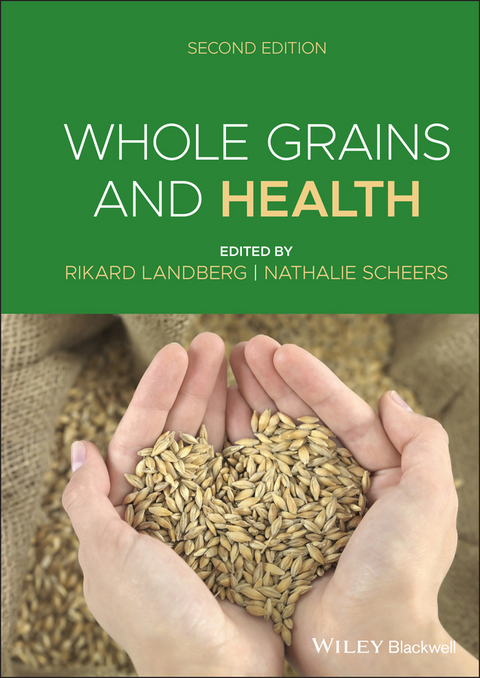
Whole Grains and Health (eBook)
John Wiley & Sons (Verlag)
978-1-118-93940-6 (ISBN)
The updated guide to whole grains and their integral role in nutritional health
In an increasingly health-conscious society, the potential benefits of whole grain products are of paramount importance to manufacturers, dieticians, and consumers alike. Whole Grains and Health covers all aspects of this crucial topic, presenting a data-driven study of whole grains' functional components, associated biomarkers and overall impact upon human health. Now in its second edition, the text has been revised and expanded to include six new chapters and groundbreaking new data. This essential guide features:
- Summaries of large research projects on the health effects of whole grain in Europe and the US
- New data on the associations between whole grain consumption and risk of developing chronic diseases
- Discussions of metabolomics and their use in addressing health effects and finding new biomarkers of both dietary exposure and health effects related to the diet
- Information on the use of genomics in studies of how gene-expression profiles change in response to whole grain intake
- Newly identified bioactive compounds in whole grains and whole grain fractions
- The new EU regulations on health claims that affect whole grain food products
Providing information that will be of interest to food scientists, healthcare specialists and food industry professionals alike, the second edition of Whole Grains and Health is an essential resource for anyone concerned with the impact whole grains may have upon health.
Rikard Landberg, Professor, Department of Biology and Biological Engineering, Food and Nutrition Science, Chalmers University of Technology, Gothenburg, Sweden
Nathalie Scheers, Associate Professor, Department of Biology and Biological Engineering, Food and Nutrition Science, Chalmers University of Technology, Gothenburg, Sweden
WHOLE GRAINS AND HEALTH The updated guide to whole grains and their integral role in nutritional healthIn an increasingly health-conscious society, the potential benefits of whole grain products are of paramount importance to manufacturers, dieticians, and consumers alike. Whole Grains and Health covers all aspects of this crucial topic, presenting a data-driven study of whole grains functional components, associated biomarkers and overall impact upon human health. Now in its second edition, the text has been revised and expanded to include six new chapters and groundbreaking new data. This essential guide features:Summaries of large research projects on the health effects of whole grain in Europe and the USNew data on the associations between whole grain consumption and risk of developing chronic diseases Discussions of metabolomics and their use in addressing health effects and finding new biomarkers of both dietary exposure and health effects related to the diet Information on the use of genomics in studies of how gene-expression profiles change in response to whole grain intake Newly identified bioactive compounds in whole grains and whole grain fractions The new EU regulations on health claims that affect whole grain food products Providing information that will be of interest to food scientists, healthcare specialists and food industry professionals alike, the second edition of Whole Grains and Health is an essential resource for anyone concerned with the impact whole grains may have upon health.
Rikard Landberg, Professor, Department of Biology and Biological Engineering, Food and Nutrition Science, Chalmers University of Technology, Gothenburg, Sweden Nathalie Scheers, Associate Professor, Department of Biology and Biological Engineering, Food and Nutrition Science, Chalmers University of Technology, Gothenburg, Sweden
Preface
Chapter 1: The structure of cereal grains and their products
Chapter 2: Definition of wholegrain and determination of content in cereal products
Chapter 3: Whole grain fractions and their utilisation in foods
Chapter 4: Whole Grain Carbohydrates
Chapter 5: Whole grain content of cereal products
Chapter 6: Factors associated with intake and consumption of whole grain
Chapter 7: Alkylresorcinols and their metabolites as biomarkers for wholegrain wheat and rye
Chapter 8: Body composition and weight management
Chapter 9: Whole Grains and type 2 diabetes
Chapter 10: Whole grains and cardiovascular disease
Chapter 11: Whole grains and cancer risk
Chapter 12: Whole grains and mortality
Chapter 13: Whole Grains and Appetite
Chapter 14: Modulating glycaemia with cereal products
Chapter 15: Whole grain, cereal fiber, and the gut function
Chapter 16: Bioactive compounds in whole grains and their implications for health
Chapter 17: Potential negative effects of whole grain consumption
Chapter 18: Application of metabolomics for the assessment of process induced changes in whole grain foods
Chapter 19: Application of metabolomics for the assessment of health effects of whole grain foods
Chapter 20: Using transcriptomics and RNA sequencing to assess health effects of whole grains
Chapter 21: Wholegrain from an industry perspective
Chapter 22: Global Regulation and Labelling, Claims, and Communication with Consumers
SUMMARY
Preface
Cereal foods constitute a backbone of the diet worldwide and are the major source of energy and nutrients in many populations. The most common way cereal foods are consumed have detrimental effects on human health. The largest proportion of the intake consists of refined‐cereal products, generally associated with high glycemic index, reduced nutritional density and central in a dietary pattern associated with increased risk for non‐communicable diseases (NCDs). However, shifting the intake towards whole grains is associated with a consistently reduced risk of developing NCDs, specifically cardiovascular disease, type 2 diabetes and certain cancers. In fact, a high whole grain intake is listed as one of the most important modifiable risk factors of NCDs (Global Burden of Disease). Whole grain cereals are rich sources of fibre, many minerals, vitamins and phytochemicals. Public health authorities in the European Union, United States and around the world encourage the increased intake of whole grain cereals based on the health benefits, but recently also for improved sustainability. Most of the evidence for their beneficial effects stem from observational studies, while dietary interventions have shown acute effects on glucose, hormonal and inflammatory responses, and long‐term effects on insulin sensitivity, blood pressure and dyslipidaemia. Such effects have been linked to specific bioactive compounds, fibre components, gut microbiota, processing‐induced changes and the structural features of whole grains and cereal‐grain fractions. The dietary fibre complex, that is, dietary fibre and associated compounds, is believed to have a central role for the health effects of whole grain foods, but the mechanisms are to be elucidated in detail. The development of whole grain cereal foods has a potentially huge positive impact on the health of the global population, but there are important barriers to be torn down to succeed increasing the intake.
Since the first edition of the current book, the number of studies on whole grains and health have increased dramatically. In total, 2093 new publications on the search words whole grain AND health appeared in a Scopus search for the period 1 January 2007 to 26 March 2020. There has been a tremendous development of the field during the past decade, including definition and communication of whole grains to consumers, application of techniques to produce whole grain foods and studies of whole grain health effects. Such advancements are covered and discussed in detail in the different chapters of this book. For example, a large number of epidemiological studies have been carried out in different populations on the associations between whole grain consumption and risk of developing chronic diseases such as CVD, type 2 diabetes, some cancers, but also more rare diseases have been studied. Compared to older studies, more recent observational studies have investigated different grains separately and have also managed to estimate the intakes in g/d. Several large controlled human intervention studies have been conducted to investigate different aspects of whole grains on human health, including effects on cardiovascular and diabetes risk factors such as blood pressure, blood lipids, insulin sensitivity, body weight, body fat and inflammation. During the past decade, new biomarkers of whole grain wheat and rye intake has been developed and validated (alkylresorcinols and their metabolites). These biomarkers have been adopted and shown useful to assess compliance in whole grain intervention studies and they have successfully been used as an independent measure of whole grain intake in observational studies in humans. Metabolomics has emerged as a new approach to address health effects and to find new biomarkers of both dietary exposures and health effects related to whole grain intake. Several metabolomics studies have been published recently to achieve better understanding of health effects underlying whole grain consumption. Such studies have recently shown a modest effect on microbial composition after whole grain/high‐fibre cereal intake, which suggested several new mechanisms on why whole grain rye may have particular effects on insulin metabolism. Genomics have been applied in several large‐scale intervention studies and have provided new knowledge on how gene expression profiles cause changes in response to whole grain intake. This will be of importance for the overall understanding of the physiological responses in relation to whole grain intake. Moreover, new bioactive compounds in whole grains and whole grain fractions have been identified and are currently studied. One example of such is the group of benzoxazinoids, which have recently been identified in whole wheat and rye grains and in bakery products of these cereals. These compounds, isolated from other sources or synthesized, have been studied for a number of bioactivities. Their uptake and elimination in animals and humans as well as their effects are currently extensively studied. Untargeted metabolomics approaches have facilitated the process of discovering new compounds. The role of gut microbiota for human health and disease has boomed the last 10 years, and important insights on the role of whole grains and dietary fibre and their interaction with gut microbiota for differential responses in human health outcomes have increased dramatically, although there is still much to improve concerning our understanding in this area. EU‐regulations on health claims have been adopted with consequences for whole grain consumption. No health claim is allowed for whole grains but several specific claims, including grain components (reflecting beneficial physiological effects and disease risk reduction claims related to certain fibres) are allowed. No current worldwide definition of whole grain intake exists, but new definitions of both whole grains and whole grain products have been suggested.
The structure, outline and style of this book is designed to provide a comprehensive treatise on the subject covering the topic from the grains themselves, their components and distribution in different botanical fractions and products to the effect of whole grains on health and the molecular mechanisms/effects on risk factors underlying their health effects. The book also highlights the interest from the food industry and governmental and non‐governmental authorities to develop new food products rich in whole grains as well as to educate consumers about the health benefits of consuming whole grain foods (the whole grain stamp is an example of this communication to the consumer and the whole grain campaigns launched in Denmark and The Netherlands are other examples). The chapters are comprehensive in their coverage with the aim to provide founded knowledge and information for researchers, research students, authority and industry personnel that gives them a multidisciplinary understanding of this important topic.
Recent advances will to a great extent be covered by the update of book chapters of the first edition. As in the previous edition, we divide the book into sections with a slight modification of the suggested sections. More emphasis will be put on the section “whole grains, cereal fibre and chronic disease” and “grain technology and health‐related outcomes,” whereas consumer aspects are given somewhat less attention compared with the first edition. We also provide comprehensive material on the whole grain morphology constituents, fractions and technology as well as products for readers coming from the medical or public‐health sectors. The book comprises 5 sections and concluding remarks and future perspectives. In total, 23 chapters are included (Table 1).
Table 1 Brief description of the content of the sections.
| Section | Content |
|---|
| Chemical composition and morphological structure of cereal grains and cereal fractions, such as bran, aleurone, germ and the endosperm, are described in detail as this is crucial for the understanding of physiological effects related to health. Differences and similarities among cereals are emphasized here. Important whole grain products are described with emphasis on traits and features that may be of importance for human health. This section also contains a chapter on the different definitions of whole grain and whole grain products. A chapter on consumption and description of lifestyle factors associated with whole grain intake as well as on tools for objective whole grain intake estimation through dietary biomarkers bridge this section to section two. |
| The current literature on evidence for disease prevention derived from epidemiological – as well as intervention studies in humans and model – and animal studies have been reviewed and the evidence are evaluated in a systematic way focusing on the outcome of largest importance. Hard endpoints such as type 2 diabetes, CVD, cancer and mortality are at main focus in this section. |
| This section bridges the section on whole grain basics and the section on chronic disease by discussing mechanisms and risk factors. This section contains chapters on whole grains and appetite, glycaemia, gut function as well as a chapter on bioactive compounds and effects that may be of relevance to human health. We have also... |
| Erscheint lt. Verlag | 19.5.2021 |
|---|---|
| Sprache | englisch |
| Themenwelt | Naturwissenschaften ► Biologie |
| Technik | |
| Weitere Fachgebiete ► Land- / Forstwirtschaft / Fischerei | |
| Schlagworte | Backwaren, Getreideerzeugnisse • Bakery & Cereals • Ernährung • Ernährung u. Diätetik • Food Science & Technology • Functional Food • Functional Food, Nutraceuticals • Functional Foods & Nutraceuticals • Gesundheits- u. Sozialwesen • Health & Social Care • Lebensmittelforschung u. -technologie • Nutrition & Dietetics General • Vollkorn |
| ISBN-10 | 1-118-93940-9 / 1118939409 |
| ISBN-13 | 978-1-118-93940-6 / 9781118939406 |
| Informationen gemäß Produktsicherheitsverordnung (GPSR) | |
| Haben Sie eine Frage zum Produkt? |
 EPUB (Adobe DRM)
Kopierschutz: Adobe-DRM
Adobe-DRM ist ein Kopierschutz, der das eBook vor Mißbrauch schützen soll. Dabei wird das eBook bereits beim Download auf Ihre persönliche Adobe-ID autorisiert. Lesen können Sie das eBook dann nur auf den Geräten, welche ebenfalls auf Ihre Adobe-ID registriert sind.
Details zum Adobe-DRM
Dateiformat: EPUB (Electronic Publication)
EPUB ist ein offener Standard für eBooks und eignet sich besonders zur Darstellung von Belletristik und Sachbüchern. Der Fließtext wird dynamisch an die Display- und Schriftgröße angepasst. Auch für mobile Lesegeräte ist EPUB daher gut geeignet.
Systemvoraussetzungen:
PC/Mac: Mit einem PC oder Mac können Sie dieses eBook lesen. Sie benötigen eine
eReader: Dieses eBook kann mit (fast) allen eBook-Readern gelesen werden. Mit dem amazon-Kindle ist es aber nicht kompatibel.
Smartphone/Tablet: Egal ob Apple oder Android, dieses eBook können Sie lesen. Sie benötigen eine
Geräteliste und zusätzliche Hinweise
Buying eBooks from abroad
For tax law reasons we can sell eBooks just within Germany and Switzerland. Regrettably we cannot fulfill eBook-orders from other countries.
aus dem Bereich