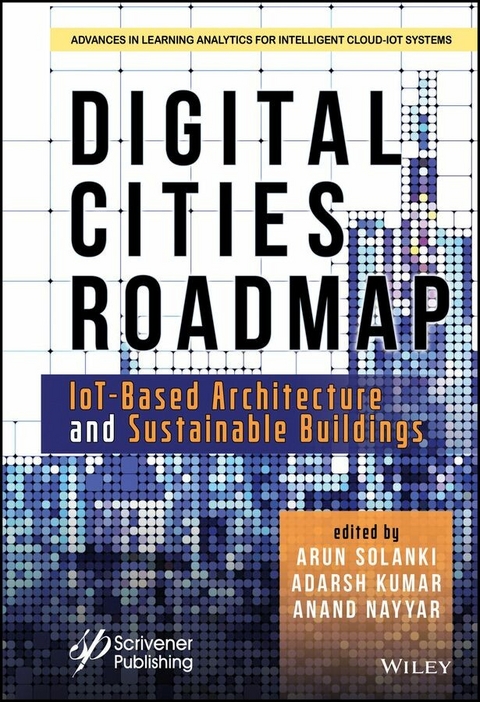
Digital Cities Roadmap (eBook)
John Wiley & Sons (Verlag)
978-1-119-79205-5 (ISBN)
This book details applications of technology to efficient digital city infrastructure and its planning, including smart buildings.
Rapid urbanization, demographic changes, environmental changes, and new technologies are changing the views of urban leaders on sustainability, as well as creating and providing public services to tackle these new dynamics. Sustainable development is an objective by which the processes of planning, implementing projects, and development is aimed at meeting the needs of modern communities without compromising the potential of future generations. The advent of Smart Cities is the answer to these problems.
Digital Cities Roadmap provides an in-depth analysis of design technologies that lay a solid foundation for sustainable buildings. The book also highlights smart automation technologies that help save energy, as well as various performance indicators needed to make construction easier. The book aims to create a strong research community, to have a deep understanding and the latest knowledge in the field of energy and comfort, to offer solid ideas in the nearby future for sustainable and resilient buildings. These buildings will help the city grow as a smart city. The smart city has also a focus on low energy consumption, renewable energy, and a small carbon footprint.
Audience
The information provided in this book will be of value to researchers, academicians and industry professionals interested in IoT-based architecture and sustainable buildings, energy efficiency and various tools and methods used to develop green technologies for construction in smart cities.
Arun Solanki PhD is an assistant professor in the Department of Computer Science and Engineering, Gautam Buddha University, Greater Noida, India, where he has been working since 2009. His research interests span expert systems, machine learning, and search engines. He has published many research articles in international journals/conferences.
Adarsh Kumar PhD is an associate professor at the University of Petroleum & Energy Studies, Dehradun, India. His main research interests are cybersecurity, cryptography, network security, and ad-hoc networks. He has published 60+ research papers in reputed journals, conferences and workshops.
Anand Nayyar PhD is currently working in the Graduate School, Duy Tan University, Da Nang, Vietnam. He is a certified professional with more than 75 Professional Certificates from CISCO, Microsoft, Oracle, Google, Beingcert, EXIN, GAQM, Cyberoam, and many more. He published more than 300 research articles in various national and international journals and conferences. He has authored, coauthored or edited about 30 books and has been granted two patents in the areas of Internet of Things and speech processing.
DIGITAL CITIES ROADMAP This book details applications of technology to efficient digital city infrastructure and its planning, including smart buildings.Rapid urbanization, demographic changes, environmental changes, and new technologies are changing the views of urban leaders on sustainability, as well as creating and providing public services to tackle these new dynamics. Sustainable development is an objective by which the processes of planning, implementing projects, and development is aimed at meeting the needs of modern communities without compromising the potential of future generations. The advent of Smart Cities is the answer to these problems.Digital Cities Roadmap provides an in-depth analysis of design technologies that lay a solid foundation for sustainable buildings. The book also highlights smart automation technologies that help save energy, as well as various performance indicators needed to make construction easier. The book aims to create a strong research community, to have a deep understanding and the latest knowledge in the field of energy and comfort, to offer solid ideas in the nearby future for sustainable and resilient buildings. These buildings will help the city grow as a smart city. The smart city has also a focus on low energy consumption, renewable energy, and a small carbon footprint.AudienceThe information provided in this book will be of value to researchers, academicians and industry professionals interested in IoT-based architecture and sustainable buildings, energy efficiency and various tools and methods used to develop green technologies for construction in smart cities.
Arun Solanki PhD is an assistant professor in the Department of Computer Science and Engineering, Gautam Buddha University, Greater Noida, India, where he has been working since 2009. His research interests span expert systems, machine learning, and search engines. He has published many research articles in international journals/conferences. Adarsh Kumar PhD is an associate professor at the University of Petroleum & Energy Studies, Dehradun, India. His main research interests are cybersecurity, cryptography, network security, and ad-hoc networks. He has published 60+ research papers in reputed journals, conferences and workshops. Anand Nayyar PhD is currently working in the Graduate School, Duy Tan University, Da Nang, Vietnam. He is a certified professional with more than 75 Professional Certificates from CISCO, Microsoft, Oracle, Google, Beingcert, EXIN, GAQM, Cyberoam, and many more. He published more than 300 research articles in various national and international journals and conferences. He has authored, coauthored or edited about 30 books and has been granted two patents in the areas of Internet of Things and speech processing.
Preface
Due to their continuously growing populations, cities are facing major challenges in providing conditions that will contribute to the development of a healthy sustainable environment. This population growth has increased resource requirements and the demand for large-scale waste management systems and other services. Therefore, the aim of sustainable development is to provide processes for the planning, implementation and development of projects to meet the needs of modern communities without compromising the potential of future generations. Sustainability always includes a balance of priorities in various areas, including economics, community needs and environmental quality, as well as justice, health and well-being, energy, water and material resources, and transportation needs. Also, since communication is of fundamental importance for both internet access and new digital services, an important starting point for smart cities is the introduction of public Wi-Fi.
Another point of significant concern that has contributed to the advent of sustainable smart cities is the energy crisis brought about by the global demand for limited natural resources, which are declining as demand grows. These natural resources are used by the industrial, transport, commercial, and residential sectors. Those living in residential areas use energy mostly for space heating, followed by electronics, lighting and other appliances, water heating, air conditioning, and cooling. Because the global residential sector consumes a significant amount of energy, which is equivalent to one-third of all available primary energy resources, it is necessary to reduce energy consumption by using sustainable buildings. A good management strategy must be expected to mitigate the dangerous consequences of rapid urbanization in modern society, the economy and the environment. Since sustainable smart cities include established structures, infrastructures, communities, institutions, and individuals, the proposed solution should be the result of real interdisciplinary discussions in a multicultural environment that encourages communication and has a real chance of succeeding.
This book provides readers with a platform through which they can simulate all of the requirements for the development of smart sustainable cities. It helps readers interact, brainstorm, and work on common problems or discuss proven solutions and models. Moreover, it also deals with energy consumption. Such energy consumption leads to a rapid depletion of energy resources, an increased need for building maintenance, an improvised comfortable lifestyle, and an increase in time spent on building construction. A sustainable building mainly refers to the renewable sources used for construction that help the structure withstand atmospheric changes. Currently, all countries are looking for ecological materials; that is, renewable plant materials such as straw and clay bricks, wood from forests certified for sustainable management, recycled materials, and other nontoxic, reusable and renewable products. For sustainable and durable construction, energy efficiency is an urgent problem, and researchers are currently actively involved in this area. This book provides an in-depth analysis of design technologies that lay a solid foundation for sustainable buildings. Smart automation technologies that help save energy are also highlighted, as well as various performance indicators needed to make construction easier. The aim of this book is to create a strong research community and to impart a deep understanding of the latest knowledge regarding the field of energy and comfort, along with offering solid ideas in the near future for sustainable buildings. These buildings will help cities grow into smart cities. Since the focus of smart cities is on low energy consumption, renewable energy, and a small carbon footprint, researchers must study optimization methods in order to find the optimal use of energy resources.
The book is organized as follows: Chapter 1, “The Use of Machine Learning for Sustainable and Resilient Buildings,” provides insights into intelligent resources, artificial learning and big data analytics. A detailed study of the field of intelligent architecture is presented, which focuses on the role of machine learning and large-scale data analytics technologies. Finally, some of the challenges and opportunities of applying machine learning in the built environment are discussed. Chapter 2, “Fire Hazard Detection and Prediction by Machine Learning Techniques in Smart Buildings (SBs) Using Sensors and Unmanned Aerial Vehicle (UAV),” discusses various time-series methods used to calculate the threshold value of the parameters in UAV-based data, including the Naive Bayes, simple average, moving average, simple exponential smoothing (SES), Holt’s linear, Holt-Winters, and autoregressive integrated moving average (ARIMA) methods. Since variation in the degree of value from the threshold range is helpful in predicting different actions, the vector autoregressive (VAR) method is also discussed, which is a multivariate time-series analysis used to calculate the threshold value that considers all the features at once along with their impact on each other.
Chapter 3, “Sustainable Infrastructure Theories and Models,” introduces the concepts of data fusion and data fusion approaches with respect to sustainable infrastructure. This work computes and explains various data fusion tools, techniques, and important methods of decentralized and distributed detection. Several smart city infrastructure approaches are highlighted along with the smart city components architecture. Chapter 4, “Blockchain for Sustainable Smart Cities,” explains how a sustainable smart city is a key solution for the large-scale urbanization of rural areas. However, urbanization poses a number of challenges for governments and city planners, including increased traffic congestion, reduction in quality health service provision, burden on civic facilities, and data management among others. Blockchain is integrated into smart city applications to improve the standard of living of citizens and overall management of the smart city. With the advantage of blockchain, a smart city can provide efficient and reliable services to people. Chapter 5, “Contextualizing Electronic Governance, Smart City Governance and Sustainable Infrastructure in India: A Study and Framework,” surveys and shows the research gaps in various E-governance services developed and implemented in India that are being initiated to achieve the Digital India program launched by the government of India with the help of information and communication technology (ICT). Furthermore, the architectural framework for smart governance-based services for smart cities in India based on transforming electronic governance to governance in a smart city is proposed.
Chapter 6, “Revolutionizing Geriatric Design in Developing Countries: IoT-Enabled Smart Home Design for the Elderly,” presents a study that emanated from concern for the growing population of the elderly in our cities who are forced to live alone without much assistance due to shrinking family size and intercity and international migration of their children in search of better job opportunities. The study looks at the middle-class to upper-middle-class elderly population aged 65 and above living in urban cities of India such as Bangalore. This group usually comes from a well-educated background with mid-level financial security. Chapter 7, “Sustainable E-Infrastructure for Blockchain-Based Voting System,” explores the block-chain technology used to implement an electronic voting system. E-voting can change the way in which we have voted for decades. The main feature of this system is that voters can cast their vote from anywhere in the world. As this voting process starts going digital and online, voters from outside the country can also vote from wherever they are, which can increase the total voting percentages tremendously. Chapter 8, “Impact of IoT Enabled for Smart Cities: A Systematic Review and Challenges,” discusses the way in which the IoT has influenced specific areas of our daily lives. Moreover, the reader will discover the fundamental options that come with smart cities and exactly why a contemporary community is given that name, along with some of its problems and solutions. Additionally, this particular chapter covers the role of 5G technologies in the IoT along with big data analysis. Finally, it includes the primary options that come with the Indian perspective of smart cities by 2030 to enhance the daily lives of humans, along with conceptual and block diagrams.
Chapter 9, “Indoor Air Quality (IAQ) in Green Buildings: A Prerequisite to Human Health and Well-Being,” examines why the IAQ inside buildings is one of the most important determining factors of human health as more than half of the air inhaled by a person during his/her lifetime is at home. Illnesses associated with environmental exposure often stem from indoor air exposure. Prominent air pollutants are found indoors, including volatile organic compounds (VOCs), particulate matter (PM), carbon monoxide (CO), lead (Pb), nitrogen oxides (NOx), and asbestos. Smart and sustainable approaches to green building construction should incorporate IAQ as a critical component of building design as the air quality is directly related to the inhabitants’ sound well-being. Chapter 10, “An Era of Internet of Things Leads to Smart Cities Initiatives towards Urbanization,” outlines the components of smart cities and IoT technologies used in...
| Erscheint lt. Verlag | 4.5.2021 |
|---|---|
| Reihe/Serie | Advances in Learning Analytics for Intelligent Cloud-IoT Systems | Advances in Learning Analytics for Intelligent Cloud-IoT Systems |
| Sprache | englisch |
| Themenwelt | Informatik ► Theorie / Studium ► Künstliche Intelligenz / Robotik |
| Technik ► Elektrotechnik / Energietechnik | |
| Schlagworte | Artificial Intelligence • Computer Science • Electrical & Electronics Engineering • Elektrotechnik u. Elektronik • Energie • Energieeffizienz • Energy • energy efficiency • Informatik • Künstliche Intelligenz • Robotics • Robotik |
| ISBN-10 | 1-119-79205-3 / 1119792053 |
| ISBN-13 | 978-1-119-79205-5 / 9781119792055 |
| Informationen gemäß Produktsicherheitsverordnung (GPSR) | |
| Haben Sie eine Frage zum Produkt? |
 EPUB (Adobe DRM)
Kopierschutz: Adobe-DRM
Adobe-DRM ist ein Kopierschutz, der das eBook vor Mißbrauch schützen soll. Dabei wird das eBook bereits beim Download auf Ihre persönliche Adobe-ID autorisiert. Lesen können Sie das eBook dann nur auf den Geräten, welche ebenfalls auf Ihre Adobe-ID registriert sind.
Details zum Adobe-DRM
Dateiformat: EPUB (Electronic Publication)
EPUB ist ein offener Standard für eBooks und eignet sich besonders zur Darstellung von Belletristik und Sachbüchern. Der Fließtext wird dynamisch an die Display- und Schriftgröße angepasst. Auch für mobile Lesegeräte ist EPUB daher gut geeignet.
Systemvoraussetzungen:
PC/Mac: Mit einem PC oder Mac können Sie dieses eBook lesen. Sie benötigen eine
eReader: Dieses eBook kann mit (fast) allen eBook-Readern gelesen werden. Mit dem amazon-Kindle ist es aber nicht kompatibel.
Smartphone/Tablet: Egal ob Apple oder Android, dieses eBook können Sie lesen. Sie benötigen eine
Geräteliste und zusätzliche Hinweise
Buying eBooks from abroad
For tax law reasons we can sell eBooks just within Germany and Switzerland. Regrettably we cannot fulfill eBook-orders from other countries.
aus dem Bereich