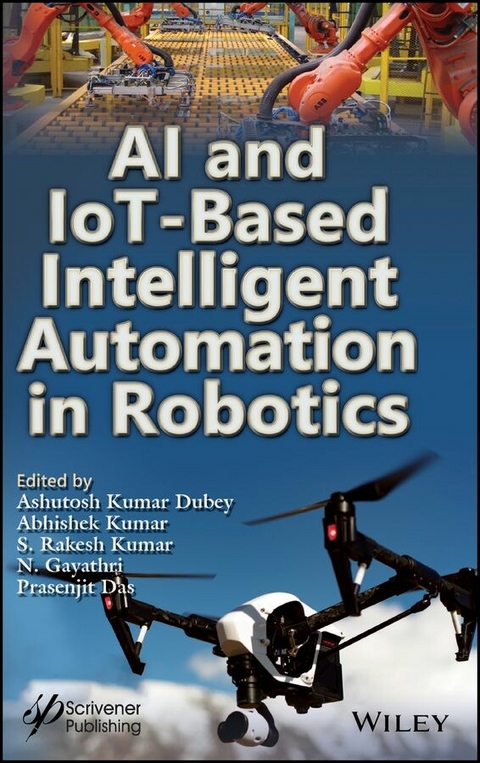
AI and IoT-Based Intelligent Automation in Robotics (eBook)
John Wiley & Sons (Verlag)
978-1-119-71122-3 (ISBN)
Ashutosh Kumar Dubey received his PhD degree in Computer Science and Engineering from JK Lakshmipat University, Jaipur, Rajasthan, India. He is currently in the Department of Computer Science and Engineering, Chitkara University Institute of Engineering and Technology, Chitkara University, Punjab, India. His research areas are data mining, optimization, machine learning, cloud computing, artificial intelligence, big data, IoT and object-oriented programming.
Abhishek Kumar is a Doctorate in computer science from the University of Madras and more than 50 publications in reputed peer reviewed national and international journals, books & conferences. His research interests include artificial intelligence, image processing, computer vision, data mining, machine learning.
S. Rakesh Kumar received his M.E. degree in Computer Science and Engineering from Anna University Chennai in 2016. His main research areas are big data analytics, network security and cloud computing.
N. Gayathri received her B. Tech as well as M. Tech. degree in Computer Science and Engineering from Thiagarajar College of Engineering, Madurai, India. Her research interests include cloud computing, big data analytics and network security.
Pasenjit Das PhD is an associate professor at Chitkara University, Himachal Pradesh, India. He has 15 + years' experience in industry and academia and his research areas are data mining, machine learning and image processing.
The 24 chapters in this book provides a deep overview of robotics and the application of AI and IoT in robotics. It contains the exploration of AI and IoT based intelligent automation in robotics. The various algorithms and frameworks for robotics based on AI and IoT are presented, analyzed, and discussed. This book also provides insights on application of robotics in education, healthcare, defense and many other fields which utilize IoT and AI. It also introduces the idea of smart cities using robotics.
Ashutosh Kumar Dubey received his PhD degree in Computer Science and Engineering from JK Lakshmipat University, Jaipur, Rajasthan, India. He is currently in the Department of Computer Science and Engineering, Chitkara University Institute of Engineering and Technology, Chitkara University, Punjab, India. His research areas are data mining, optimization, machine learning, cloud computing, artificial intelligence, big data, IoT and object-oriented programming. Abhishek Kumar is a Doctorate in computer science from the University of Madras and more than 50 publications in reputed peer reviewed national and international journals, books & conferences. His research interests include artificial intelligence, image processing, computer vision, data mining, machine learning. S. Rakesh Kumar received his M.E. degree in Computer Science and Engineering from Anna University Chennai in 2016. His main research areas are big data analytics, network security and cloud computing. N. Gayathri received her B. Tech as well as M. Tech. degree in Computer Science and Engineering from Thiagarajar College of Engineering, Madurai, India. Her research interests include cloud computing, big data analytics and network security. Pasenjit Das PhD is an associate professor at Chitkara University, Himachal Pradesh, India. He has 15 + years' experience in industry and academia and his research areas are data mining, machine learning and image processing.
1
Introduction to Robotics
Srinivas Kumar Palvadi1, Pooja Dixit2 and Vishal Dutt3*
1Department of Computer Science Engineering, University of Madras, Chennai, Tamil Nadu, India
2Sophia Girls’ College (Autonomous), Ajmer, Rajasthan, India
3Department of Computer Science, Aryabhatta College, Ajmer, Rajasthan, India
Abstract
These days, automation plays a major role in all sectors of society and the technology of robotic automation is very much in demand along with other significantly trending concepts such as the Internet of Things (IoT), Machine Learning (ML), Artificial Intelligence (AI) and Cloud Computing. Many people are showing interest in purchasing things which have process automation; for example, do not increase speed once they reach a certain point and automatically turn off the water tank when it is about to overfill. Robotics is also the technology where when an instruction is given to the device it acts accordingly based on the user instruction. When we want the robot to perform based on the user instruction, we first have to train the device or robot with the instructions for the particular task we want to do. For example, if we give a data set to the robot for creation of coffee and we give an instruction to the robot to “Prepare Tea,” the robot doesn’t respond to the request because the request doesn’t match the available datasets in the robot. In this chapter, I will focus on a basic introduction to robots, their architecture and the equipment needed for designing robots.
Keywords: Machine learning, IoT, AI, energy, drones, nano tubes, energy, actuation
1.1 Introduction
“Robotics” or “robots” is a very popular term which we are increasingly hearing day by day. The word “robotics” was derived from the word “robot,” which comes from the Slavic word “robota,” meaning slave/servant. Robots were introduced to society by George C. Devol, who generally referred to them as artificial people. Generally, robots consist of different components such as sensors, controlling devices, manipulators, power supply as well as software to perform the defined action. A combination of these characteristics forms the robot. For preparing the perfect robot we have to proceed with designing, building, programming as well as testing the robot using a combination of physics, mathematics, computational techniques, mechanical engineering, electrical engineering and structural engineering. In some of the particular scenarios the concepts of biology, chemistry and medicine are also involved based on the requirements. Generally, robot technology is used [1] in environments where a human cannot perform the action.
Many people treat robots as machines but in many of the real-time applications robots replace the person and also act as a person, such as the androids in the movies Star Wars, Terminator and Star Trek: The Next Generation. The robots capture human faces and activities and perform tasks as a person does. Even though developers are implementing many advancements in robots and using them in many applications, they are not able to develop enough common sense in them because robots perform the task based on the user’s instructions but can’t predict future actions by doing tasks in a dynamic manner. So, regarding this topic, many of the researchers are working in this domain under the research domain named “humanoid robots.”
Most of the robots which were created till now are very dangerous, boring, onerous and just plain nasty. We can find these types of robots in the medical, automobile, manufacturing, and industrial industries among others, as well as the space industry. Robots, such as the Mars rover Sojourner and the upcoming Mars Exploration rover or the underwater robotic vehicle Caribou, were designed and sent to places where humans cannot go, such as volcanoes, mars, etc., for the purpose of helping to conduct research in those particular places. On the other hand, other types of robots were designed for the purpose of entertaining small children and others. A few of them are Techno, Polly and AIBO ERS-220, which often arrive at the stores around Christmas time.
Robots are very efficient, fun and easy to design. In his book Being Digital, Nicholas Negroponte relates an excellent story that took place about eight years ago at the time of the televised premier of the Media Lab’s LEGO/Logo work at the Hennigan School. When the robot was first introduced to the children in school, they didn’t show interest in adopting it. However, in a third attempt, the children talked, played and had fun with the robot. The children asked the robot questions and the robot started giving responses to the children. The children in the class felt very excited and had fun with the robot.
Finally, what exactly does robot mean?
Many authors gave definitions based on their understanding. There is really no standard definition of robotics. When designing the robot, every designer needs to have the following properties and features, if not it is not considered a robot [2].
The robot should have following characteristics:
- Sensing
First, robots have to recognize the surroundings and respond according to them. The robots will not behave in all the environments. We have to imbue robots with sensitivity to light (eyes), touch, pressure (like hands), chemicals (nose), sound (ears) and taste (tongue) among others. By combining all these we will get the correct working robot for the environment.
- Movement
The robot should be capable of identifying surroundings/ environment in order to perform actions such as moving its body all around the surroundings.
- Energy
Robots should be capable of identifying the power in their battery and should charge by themselves.
- Intelligence
Robots need to become smarter than humans. Those who make robots smart are called programmers. Robots should require a minimum amount of knowledge to understand and perform the task that the user instructed.
So, the definition of the term robot encompasses a sensor, controlling device, physical device, manipulator, and a programming testing device, with mechanical engineering, electrical engineering, mathematics, and a small portion of chemistry also being involved.
1.2 History and Evolution of Robots
Table 1.1 shows the origins of robotics along with detailed information of when the robots came into existence, the developer’s name, etc. Presently, there are various types of robots which are used for various environments for various users. Moreover, the robots were classified into mechanical construction, electrical components and computer programming mechanism.
Table 1.1 History of the earliest robots.
| Date | Significance | Robot name | Inventor |
|---|
| 3rd century BC and earlier | First humanoid automata based on an earlier description | Yan Shi |
| 1st century AD and earlier | Descriptions of more than 100 machines and automata which include a fire engine, a wind organ, a coin-operated machine, and a steam-powered engine | Ctesibius, Philo of Byzantium, Heron of Alexandria, and others |
| c. 420 BC | Robot designed like a bird, which will fly | Flying Pigeon | Archytas of Tarentum |
| 1206 | First humanoid robot with automata mechanism | Robot band, hand-washing automaton [11], automated moving peacocks [12] | Al-Jazari |
| 1495 | Humanoid robot | Mechanical Knight | Leonardo da Vinci |
| 1738 | Mechanical duck which can eat, flap its wings, and excrete | Digesting Duck | Jacques de Vaucanson |
| 1898 | First radio-controlled device | Teleautomaton | Nikola Tesla |
| 1921 | First fictional automatons called robots | Rossum’s Universal Robots | Karel Čapek |
| 1930s | Humanoid robot exhibited at the 1939 and 1940 New York World’s Fair | Elektro | Westinghouse Electric Corporation |
| 1946 | First general-purpose digital computer | Whirlwind | Multiple people | 5 |
| 1948 | Simple robots exhibiting biological behaviors | Elsie and Elmer | William Grey Walter |
| 1956 | First commercial robot from the Unimation company | Unimate | George Devol |
| 1961 | First installed industrial robot | Unimate | George Devol |
| 1967 to 1972 | First full-scale humanoid intelligent robot | WABOT-1 | Waseda University |
| 1973 | First industrial robot with six electromechanically driven axes | Famulus | KUKA Robot Group |
| 1974 | First microcomputer controlled electric industrial robot, IRB 6 from ASEA, which was already patented in 1972. | IRB 6 | ABB... |
| Erscheint lt. Verlag | 30.4.2021 |
|---|---|
| Sprache | englisch |
| Themenwelt | Informatik ► Theorie / Studium ► Künstliche Intelligenz / Robotik |
| Technik ► Elektrotechnik / Energietechnik | |
| Schlagworte | actuation • ad hoc network • AI • Amazon Alexa • Artificial Intelligence • Artificial Intelligence (AI) • Audio Watermarking • Automation • autonomous parking services • Clipper • collision free navigation • Computer Science • Contactless temperature (CT) • CORDIC-based QR decomposition • DCO-OFDM • drones • Electrical & Electronics Engineering • Elektrotechnik u. Elektronik • emotion recognition • Encryption • Energy • Face Recognizer • facial recognition (FR) • facial temperature (FT) • fever location camera (FLC) • fever location framework (FLF) • FFT transformation • Health Monitoring • Hermitian symmetry • human activities • Industrial Engineering • Industrielle Verfahrenstechnik • Informatik • internet of robotic things • Internet of Things (IoT) • IOT • KI • Künstliche Intelligenz • local binary pattern histogram (LBPH) • machine learning • Multiplexing • multi-sensor systems (MSS) • nanotubes • Natural Language Processing • normalized cross-correlation (NCC) • Open CV • Optimal Path Planning • Orthogonal Frequency Division • path planning algorithms • peak signal-to-noise ratio (PSNR) • personalized attention network (PANet) • Quadrature Amplitude Modulation • radio frequency identification (RFID) sensors • RGB • robot • Robotics • Robotik • robots • Semantic Rules • smart wheelchair • Speech • strong noise • thermal sensor (TS) • transfer of skills • Unmanned Aerial Vehicles (UAVs) • vehicle locus • Visible Light Communication • WIFI sensor • Wireless Sensor Networks (WSNs) |
| ISBN-10 | 1-119-71122-3 / 1119711223 |
| ISBN-13 | 978-1-119-71122-3 / 9781119711223 |
| Informationen gemäß Produktsicherheitsverordnung (GPSR) | |
| Haben Sie eine Frage zum Produkt? |
 EPUB (Adobe DRM)
Kopierschutz: Adobe-DRM
Adobe-DRM ist ein Kopierschutz, der das eBook vor Mißbrauch schützen soll. Dabei wird das eBook bereits beim Download auf Ihre persönliche Adobe-ID autorisiert. Lesen können Sie das eBook dann nur auf den Geräten, welche ebenfalls auf Ihre Adobe-ID registriert sind.
Details zum Adobe-DRM
Dateiformat: EPUB (Electronic Publication)
EPUB ist ein offener Standard für eBooks und eignet sich besonders zur Darstellung von Belletristik und Sachbüchern. Der Fließtext wird dynamisch an die Display- und Schriftgröße angepasst. Auch für mobile Lesegeräte ist EPUB daher gut geeignet.
Systemvoraussetzungen:
PC/Mac: Mit einem PC oder Mac können Sie dieses eBook lesen. Sie benötigen eine
eReader: Dieses eBook kann mit (fast) allen eBook-Readern gelesen werden. Mit dem amazon-Kindle ist es aber nicht kompatibel.
Smartphone/Tablet: Egal ob Apple oder Android, dieses eBook können Sie lesen. Sie benötigen eine
Geräteliste und zusätzliche Hinweise
Buying eBooks from abroad
For tax law reasons we can sell eBooks just within Germany and Switzerland. Regrettably we cannot fulfill eBook-orders from other countries.
aus dem Bereich