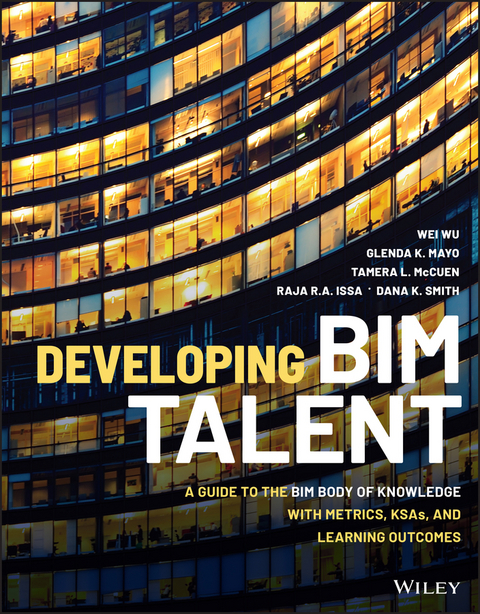
Developing BIM Talent (eBook)
John Wiley & Sons (Verlag)
978-1-119-68732-0 (ISBN)
A systematic Building Information Modeling (BIM) framework features cutting-edge use cases and competencies for students and professionals pursuing BIM careers.
Developing BIM Talent: A Guide to the BIM Body of Knowledge with Metrics, KSAs, and Learning Outcomes leads readers through the process of implementing a state-of-the-art BIM training and education program. Authored by a team of celebrated and highly qualified scholars and practitioners, this exciting new BIM education and workforce development guide offers a roadmap that navigates readers through the comprehensive BIM metrics and KSAs detailed in the BIM Body of Knowledge sponsored by the Academic Interoperability Coalition (AiC). Developing BIM Talent offers:
- A solid foundation and guidelines for educators and practitioners for starting or enhancing a BIM curriculum or training program
- Templates, expert interviews, and case studies that provide in-depth knowledge and lessons learned that can facilitate process changes and strategic action plans
- Strategies for standardizing emerging BIM job tasks, descriptions, and methods for benchmarking performance
This guide to contemporary and comprehensive metrics of BIM competency is an essential resource for corporate trainers and instructors teaching BIM, human resources professionals charged with recruiting BIM talent, as well as leadership interested in credentialing and BIM certification programs.
WEI WU, Ph.D., LEED AP, A.M.ASCE, CM-BIM is an Associate Professor and Department Chair of the Construction Management program in the Lyles College of Engineering at California State University, Fresno.
GLENDA K. MAYO, Ph.D., CSI, CDT, LEED AP, CFM is an Assistant Professor in the Engineering Technology and Construction Management program in the William States Lee College of Engineering at UNC Charlotte.
TAMERA L. MCCUEN, Ph.D., Assoc. DBIA, LEED AP is the Robert E. Busch Endowed Professor of Construction Science in the Gibbs College of Architecture at the University of Oklahoma.
R. RAYMOND ISSA, Ph.D., J.D., P.E., F.ASCE, API is the UF Distinguished Professor and Director of the Rinker School of Construction Management at the University of Florida and editor of Building Information Modeling: Applications and Practices in the AEC Industry (ASCE 2015).
DANA KENNISH SMITH, FAIA Emeritus is President of DKS Information Consulting, LLC and Co-author of Building Information Modeling (Wiley 2009) and Co-Chair of the APPA committee who developed a standard for Total Cost of Ownership (TCO).
WEI WU, Ph.D., LEED AP, A.M.ASCE, CM-BIM is an Associate Professor and Department Chair of the Construction Management program in the Lyles College of Engineering at California State University, Fresno. GLENDA K. MAYO, Ph.D., CSI, CDT, LEED AP, CFM is an Assistant Professor in the Engineering Technology and Construction Management program in the William States Lee College of Engineering at UNC Charlotte. TAMERA L. MCCUEN, Ph.D., A.M. ASCE, Assoc. DBIA, LEED AP is the Robert E. Busch Endowed Professor of Construction Science in the Gibbs College of Architecture at the University of Oklahoma. RAJA R.A. ISSA, Ph.D., J.D., P.E., F.ASCE, API is the UF Distinguished Professor and Director of the Rinker School of Construction Management at the University of Florida and editor of Building Information Modeling: Applications and Practices in the AEC Industry (ASCE 2015). DANA K. SMITH, FAIA Emeritus, FbSI is President of DKS Information Consulting, LLC and Co-author of Building Information Modeling (Wiley 2009) and Co-Chair of the APPA committee who developed a standard for Total Cost of Ownership (TCO).
Preface
The societal value of a quality-built environment is essential to life itself. Today, we can provide the bare necessities of potable water to everyone on the planet, along with food to feed everyone. Nevertheless, thousands die annually because of the lack of either or both. Why is that so? It appears that there is not the will to change how we as humans do business.
The providers of facilities and infrastructure deal with a similar scenario, albeit possibly not on the same catastrophic level. The architecture, engineering, construction, and operation (AECO) industry – and its broader ecosystem – erects buildings, industrial structures, and lays the infrastructure that is the foundation of our economies and is essential to our daily lives. It has successfully delivered ever more challenging projects – from undersea tunnels to what seem to be impossibly tall skyscrapers. However, the industry also has performed unsatisfactorily in many regards for an extended period. The AECO ecosystem represents 13% of global gross domestic product but has seen a mediocre productivity growth of 1% annually for the past 2 decades. Time and cost overruns are the norm, and overall earnings before interest and taxes are only around 5.5 percent despite the presence of significant risk in the industry. Even worse, the industry operates with as much as 50% waste, losing billions of dollars due to the lack of interoperability, meaning that we do have the capacity to accomplish much more, yet inadvertently choose to squander that opportunity. We waste building materials, time, energy, and natural resources and contribute more than one billion tons of waste to landfills.
While some action can take place sooner than later, this long-term issue will not be resolved quickly and requires systemic change. This change needs to begin with education. Education today, for the most part, rightly responds to the needs of the practitioner who responds to the requirements of the owner. The education change does not need to be in science, technology, engineering, and mathematics alone but applies to every aspect of the process.
We need to produce individuals who have elevated respect for the planet in general – not necessarily short-term-focused activists as much as better businesspeople. We must cultivate leaders who can see the big picture and understand the impact of what they do today related to the built environment on the occupants of the planet for the generations to come. While we cannot affect all aspects of the aforementioned issue, the serenity prayer may provide a guide to us to the things we can accomplish: God grant me the serenity to accept the things I cannot change, courage to change the things I can, and wisdom to know the difference. Hence, we plan to take on the built environment, the AECO industry, and AECO education specifically.
The need to change AECO education is the underlying goal of this book, specifically the education related to building information modeling (BIM). While this concept has many facets that will be explored in the book, it is the driving force. The past 2 decades have seen a paradigm shift from representation-based technologies known as computer-aided design (CAD) to information-rich database technologies known as BIM. This paradigm shift continues to change the way industry designs, builds, and operates buildings and infrastructure, which creates a rapidly and steadily growing market demand for BIM talent.
When looking at the workforce, the use of BIM and other digital tools bring with them new skill requirements and eventually could change AECO jobs. Traditionally, higher education has played pivotal roles in fostering the AECO industry in innovation-driven market transformation. While in some cases faculty research leads to practice change, most faculty who teach emerging technologies are challenged to keep up with all of the changing practices. Given the significant advancements achieved in BIM education during the last decade among the nation's top universities, a substantial number of institutions with limited resources are still struggling with developing robust BIM curricula and instilling BIM competency in students to meet industry employers' expectations.
Faculty across the country have developed BIM coursework and curriculum without a baseline or shared understanding about what knowledge, skills, and abilities constitute BIM competency. Furthermore, once classes are developed, faculty continue to be challenged to keep up with rapid changes in technologies and workflows as the industry continues to evolve, adopting new technologies and developing new BIM uses. Existing educational research on the integration of BIM into the college curriculum has focused on student learning and overlooks the need for faculty development. It results in a gap of knowledge on how faculty preparedness for BIM course design, instructional pedagogy, and learning assessment may impact the dissemination of technological advancement in higher education and the capability of AECO programs to keep up with transforming industry workplace competency requirements.
On the same boat are the corporate trainers, who are usually BIM champions and technology evangelists in AECO companies and organizations. They represent the state-of-the-art BIM practice in business processes that shape the companies' BIM uses. However, the highly specialized and fragmented business environment in the AECO industry could make corporation-based continuing education and on-the-job training of BIM inherently siloed. Individual companies may practice only a fraction of the continuously growing portfolio of all 50-plus BIM uses, whereas digital collaboration and integrated project delivery have arisen with strong momentum in the AECO industry.
This book is written for both higher education faculty and corporate trainers. It perceives BIM education to encompass any life cycle or a holistic view of the AECO industry. Thus, the BIM education transformation will need to affect all levels from entry-level to mid-career to full-performance practitioners. The foundational information provided in this book should be applied to all levels.
The first chapter provides some historical context and a big-picture view of how the implementation of BIM is progressing in the industry. It provides a few case studies documenting a baseline state of the art in the industry at the time the book was written so that over time we can see progress. It also describes how the Academic Interoperability Coalition arrived at the point of developing the body of knowledge (BOK) for BIM.
The second chapter walks through the development of the BOK and examines the very concept of a BOK and how it relates to existing norms in education, such as Bloom's taxonomy. The chapter discusses the journey required for students to prepare themselves for a meaningful role in the workforce. It then describes in detail the Delphi process the team conducted to develop the job task definitions and, ultimately, the BOK.
Chapter 3 presents an overview of current practices of BIM education and talent procurement. It looks in-depth at a series of survey studies that were conducted to explore the dynamics among college BIM education, industry talent needs and recruitment, and students' career development. This chapter also reviews the various tools available to assess BIM capacities and maturities of the practitioner, the project, and the organization. Despite the practical value of these individual tools, a unified framework seems to be missing. The BIM BOK, therefore, is expected to lead to a more meaningful and promising practice of BIM education, training, certification, and credentialing.
The next chapter, Chapter 4, delineates the principles of the BOK-informed BIM instruction. Readers will obtain a thorough understanding of the logical steps they need to apply the BIM BOK in developing specific BIM instruction. The chapter also helps the readers recall some of the foundational learning theories in instructional design. The BIM BOK job task definitions are the backbone of curriculum design, which are thoroughly discussed in this chapter with case studies. From this information, educators and corporate trainers can develop a more informed and outcome-based BIM learning and training curriculum. At the end of this chapter, the readers will find handy design templates to help them start with BIM learning and training module design.
Chapter 5 continues the workforce planning and development discussion by looking specifically at the four roles laid out for the BIM BOK: designer, contractor, facility manager, and consultant. For the consultant, it was discovered that they had subroles that would likely need more development in the future, as there could be expert consultants specific to a discipline, a consulting role that dealt with a broader life cycle scope, as well as a consultant that was in a supporting role, such as the role of cybersecurity for BIM. The knowledge, skills, and abilities (KSAs) for the designer, contractor, and facility manager roles are also included for each level of performance expected of practitioners.
The final chapter reinforces that this is but the first step in a rather long journey for the AECO industry to reinvent itself and to mature to the point where collaboration and interoperability are the way of doing business. As the industry matures and innovation occurs, education must keep pace. Hence, continuous improvement will be the norm. It is hoped that the BIM BOK–informed education and training developed to deliver this book will be the foundation as well as the guiding path on which progress will...
| Erscheint lt. Verlag | 29.4.2021 |
|---|---|
| Sprache | englisch |
| Themenwelt | Technik ► Architektur |
| Technik ► Bauwesen | |
| Schlagworte | Architecture • Architektur • Bauentwurf • Bauingenieur- u. Bauwesen • Berufspraxis i. d. Architektur • BIM benchmarking • BIM BOK • BIM careers • BIM certification • BIM competencies • BIM corporate training • BIM curriculum • BIM education accreditation • BIM instructors • BIM KSAs • BIM licensing • BIM metrics • BIM prerequisites • BIM standardization • BIM teaching • BIM training • Building Design • Building Information Modeling • Civil Engineering & Construction • Professional Practice • Structural & Building Engineering • Tief- u. Hochbau / Massivbau |
| ISBN-10 | 1-119-68732-2 / 1119687322 |
| ISBN-13 | 978-1-119-68732-0 / 9781119687320 |
| Informationen gemäß Produktsicherheitsverordnung (GPSR) | |
| Haben Sie eine Frage zum Produkt? |
 EPUB (Adobe DRM)
Kopierschutz: Adobe-DRM
Adobe-DRM ist ein Kopierschutz, der das eBook vor Mißbrauch schützen soll. Dabei wird das eBook bereits beim Download auf Ihre persönliche Adobe-ID autorisiert. Lesen können Sie das eBook dann nur auf den Geräten, welche ebenfalls auf Ihre Adobe-ID registriert sind.
Details zum Adobe-DRM
Dateiformat: EPUB (Electronic Publication)
EPUB ist ein offener Standard für eBooks und eignet sich besonders zur Darstellung von Belletristik und Sachbüchern. Der Fließtext wird dynamisch an die Display- und Schriftgröße angepasst. Auch für mobile Lesegeräte ist EPUB daher gut geeignet.
Systemvoraussetzungen:
PC/Mac: Mit einem PC oder Mac können Sie dieses eBook lesen. Sie benötigen eine
eReader: Dieses eBook kann mit (fast) allen eBook-Readern gelesen werden. Mit dem amazon-Kindle ist es aber nicht kompatibel.
Smartphone/Tablet: Egal ob Apple oder Android, dieses eBook können Sie lesen. Sie benötigen eine
Geräteliste und zusätzliche Hinweise
Buying eBooks from abroad
For tax law reasons we can sell eBooks just within Germany and Switzerland. Regrettably we cannot fulfill eBook-orders from other countries.
aus dem Bereich