Hydraulic Fluid Power (eBook)
John Wiley & Sons (Verlag)
978-1-119-56910-7 (ISBN)
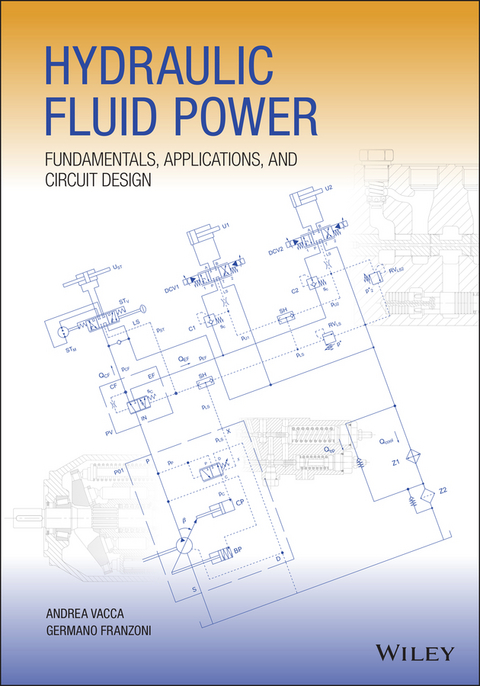
Learn more about hydraulic technology in hydraulic systems design with this comprehensive resource
Hydraulic Fluid Power provides readers with an original approach to hydraulic technology education that focuses on the design of complete hydraulic systems. Accomplished authors and researchers Andrea Vacca and Germano Franzoni begin by describing the foundational principles of hydraulics and the basic physical components of hydraulics systems. They go on to walk readers through the most practical and useful system concepts for controlling hydraulic functions in modern, state-of-the-art systems.
Written in an approachable and accessible style, the book's concepts are classified, analyzed, presented, and compared on a system level. The book also provides readers with the basic and advanced tools required to understand how hydraulic circuit design affects the operation of the equipment in which it's found, focusing on the energy performance and control features of each design architecture. Readers will also learn how to choose the best design solution for any application.
Readers of Hydraulic Fluid Power will benefit from:
- Approaching hydraulic fluid power concepts from an 'outside-in' perspective, emphasizing a problem-solving orientation
- Abundant numerical examples and end-of-chapter problems designed to aid the reader in learning and retaining the material
- A balance between academic and practical content derived from the authors' experience in both academia and industry
- Strong coverage of the fundamentals of hydraulic systems, including the equations and properties of hydraulic fluids
Fluid Power Fundamentals is perfect for undergraduate and graduate students of mechanical, agricultural, and aerospace engineering, as well as engineers designing hydraulic components, mobile machineries, or industrial systems.
Andrea Vacca is the Maha Chair for Fluid Power Systems at Purdue University, and he leads Purdue's Maha Fluid Power Research Center. He obtained his MSc at the University of Parma and his doctorate at the University of Florence in Energy Systems. He has written over 150 technical papers on fluid power technology and was awarded the 2019 Joseph Bramah Medal by the Institution of Mechanical Engineers for contributions to fluid power research.
Germano Franzoni obtained his mechanical engineering PhD in the field of fluid power in 2006 and has worked in the hydraulics industry in Europe and the USA. He is currently on the mobile systems engineering team at Parker Hannifin, where he specializes in systems design, business development, and research and development in new system concepts and works with major global OEMs in the construction, mining, military, and materials handling industries. He holds two patents and has several pending patent applications. He is the author of several scientific papers and has presented at various fluid power conferences and symposia.
ANDREA VACCA is the Maha Chair for Fluid Power Systems at Purdue University and he leads Purdue's Maha Fluid Power Research Center. He obtained his MSc at the University of Parma and his doctorate in Energy Systems at the University of Florence. He has written over 150 technical papers on fluid power technology and was awarded the 2019 Joseph Bramah Medal by the Institution of Mechanical Engineers for contributions to fluid power research. GERMANO FRANZONI obtained his Ph.D. in mechanical engineering in 2006 from the University of Parma, Italy. Since then, he has worked in the Hydraulics Industry, both in Europe and USA. He is currently part of the Mobile Systems Engineering team for North America at Parker Hannifin. He specializes in systems design, business development and R&D. He works side by side with the major OEMs in the construction, mining, vocational truck and military markets. He holds two patents and has several patent pending applications. He is author of several scientific papers and has presented at various fluid power conferences and symposia.
Preface
The idea for this textbook came to the mind in the summer of 2003. At that time, as junior researchers at the University of Parma in Italy, the authors were tasked to learn more about hydraulic technology and gather material for a new course to be added to the mechanical engineering program.
Emilia Romagna in northern Italy, where Parma is located, is home to many proficient hydraulics manufacturers. To better connect with the surrounding industries, the Engineering Department of the University of Parma began teaching and doing research on hydraulics, a topic that was missing in the course offering.
The authors were challenged with preparing a material suitable for a college‐level class and at the same time advertising the research capabilities of the university laboratory among the local fluid power companies.
After spending several hours online and in libraries searching for educational materials in fluid power, the authors immediately realized the absence of well‐structured textbooks explaining the state‐of‐the‐art of hydraulic technology. At the same time, by also interviewing hydraulic engineers in the workforce, they discovered how most knowledge on hydraulics seemed to belong to a restricted elite who learned through years of experience. This knowledge had been passed along within the same companies as a proprietary know‐how, a kind of tribal knowledge.
Thanks to the “freedom of learning” allowed to young scholars in Italy, the authors started researching through existing literature and contacting Italian and international academic professors. Each book they had the chance to read and every class they could attend seemed to be focused only on certain aspects of hydraulics. Therefore, the authors started putting together different bits and pieces of a large collage, spending countless hours researching and animatedly debating on how to connect the dots.
The more their work was expanding, the more passionate they had become about hydraulics or better yet, “hydraulic fluid power.” They quickly realized how this discipline has a huge technical implication and it often falls under the radar of many engineering departments. But it also is a very complex technology, which embraces bits and pieces of several other disciplines: structural mechanics, fluid mechanics, heat transfer, electrical engineering, control systems, product design, and others.
The authors also realized the difficulty to teach hydraulics, and the lack of structured teaching material was also probably the root cause for the decline in academic interest for fluid power. In fact, universities preferred to focus the attention on other technologies such as electronic controls and electric drives, which are more structured disciplines and benefit from the abundance of educational materials.
The idea for this textbook came to the mind in the summer of 2003. At that time, as junior researchers at the University of Parma in Italy, the authors were tasked to learn more about hydraulic technology and gather material for a new course to be added to the mechanical engineering program.
Emilia Romagna in northern Italy, where Parma is located, is home to many proficient hydraulics manufacturers. To better connect with the surrounding industries, the Engineering Department of the University of Parma began teaching and doing research on hydraulics, a topic that was missing in the course offering.
The authors were challenged with preparing a material suitable for a college‐level class and at the same time advertising the research capabilities of the university laboratory among the local fluid power companies.
After spending several hours online and in libraries searching for educational materials in fluid power, the authors immediately realized the absence of well‐structured textbooks explaining the state‐of‐the‐art of hydraulic technology. At the same time, by also interviewing hydraulic engineers in the workforce, they discovered how most knowledge on hydraulics seemed to belong to a restricted elite who learned through years of experience. This knowledge had been passed along within the same companies as a proprietary know‐how, a kind of tribal knowledge.
Thanks to the “freedom of learning” allowed to young scholars in Italy, the authors started researching through existing literature and contacting Italian and international academic professors. Each book they had the chance to read and every class they could attend seemed to be focused only on certain aspects of hydraulics. Therefore, the authors started putting together different bits and pieces of a large collage, spending countless hours researching and animatedly debating on how to connect the dots.
The more their work was expanding, the more passionate they had become about hydraulics or better yet, “hydraulic fluid power.” They quickly realized how this discipline has a huge technical implication and it often falls under the radar of many engineering departments. But it also is a very complex technology, which embraces bits and pieces of several other disciplines: structural mechanics, fluid mechanics, heat transfer, electrical engineering, control systems, product design, and others.
The authors also realized the difficulty to teach hydraulics, and the lack of structured teaching material was also probably the root cause for the decline in academic interest for fluid power. In fact, universities preferred to focus the attention on other technologies such as electronic controls and electric drives, which are more structured disciplines and benefit from the abundance of educational materials.
The idea for this textbook came to the mind in the summer of 2003. At that time, as junior researchers at the University of Parma in Italy, the authors were tasked to learn more about hydraulic technology and gather material for a new course to be added to the mechanical engineering program.
Emilia Romagna in northern Italy, where Parma is located, is home to many proficient hydraulics manufacturers. To better connect with the surrounding industries, the Engineering Department of the University of Parma began teaching and doing research on hydraulics, a topic that was missing in the course offering.
The authors were challenged with preparing a material suitable for a college‐level class and at the same time advertising the research capabilities of the university laboratory among the local fluid power companies.
After spending several hours online and in libraries searching for educational materials in fluid power, the authors immediately realized the absence of well‐structured textbooks explaining the state‐of‐the‐art of hydraulic technology. At the same time, by also interviewing hydraulic engineers in the workforce, they discovered how most knowledge on hydraulics seemed to belong to a restricted elite who learned through years of experience. This knowledge had been passed along within the same companies as a proprietary know‐how, a kind of tribal knowledge.
Thanks to the “freedom of learning” allowed to young scholars in Italy, the authors started researching through existing literature and contacting Italian and international academic professors. Each book they had the chance to read and every class they could attend seemed to be focused only on certain aspects of hydraulics. Therefore, the authors started putting together different bits and pieces of a large collage, spending countless hours researching and animatedly debating on how to connect the dots.
The more their work was expanding, the more passionate they had become about hydraulics or better yet, “hydraulic fluid power.” They quickly realized how this discipline has a huge technical implication and it often falls under the radar of many engineering departments. But it also is a very complex technology, which embraces bits and pieces of several other disciplines: structural mechanics, fluid mechanics, heat transfer, electrical engineering, control systems, product design, and others.
The authors also realized the difficulty to teach hydraulics, and the lack of structured teaching material was also probably the root cause for the decline in academic interest for fluid power. In fact, universities preferred to focus the attention on other technologies such as electronic controls and electric drives, which are more structured disciplines and benefit from the abundance of educational materials.
Also for this reason, the passion of the authors in their exciting hydraulics journey was fueled by a few individuals they had the good fortune to interact with. Prof. Nicola Nervegna, Prof. Gian Luca Zarotti, and Prof. Monika Ivantysynova are certainly among the pioneers of modern hydraulic education. Mr. Renato Casappa is an Italian entrepreneur who, like a modern‐era Maecenas, promoted and financially supported several educational programs and symposiums. All of them felt that renewed interest on fluid power is needed to regain its lost inclusion in university curriculum. The authors feel lucky and privileged for having the chance to meet, interact, and in many cases closely work with these outstanding individuals. The level of the educational materials they produced or supported is among the best available today. Unfortunately, most of the materials created was not in English language, while some were not structured to reach the broader audience.
These are significant motivations for writing this book, aimed at filling the lack of educational materials suitable to train engineers in the field of hydraulic fluid power. However, all journeys come to an...
| Erscheint lt. Verlag | 28.4.2021 |
|---|---|
| Sprache | englisch |
| Themenwelt | Technik ► Bauwesen |
| Technik ► Elektrotechnik / Energietechnik | |
| Technik ► Maschinenbau | |
| Schlagworte | Bauingenieur- u. Bauwesen • Civil Engineering & Construction • Elektrische Energietechnik • Energie • Energietechnik • Energy • Hydraulic/Water Engineering • Hydraulik • Hydraulik, Wasserbau • Maschinenbau • mechanical engineering • Power Technology & Power Engineering |
| ISBN-10 | 1-119-56910-9 / 1119569109 |
| ISBN-13 | 978-1-119-56910-7 / 9781119569107 |
| Informationen gemäß Produktsicherheitsverordnung (GPSR) | |
| Haben Sie eine Frage zum Produkt? |
 EPUB (Adobe DRM)
Kopierschutz: Adobe-DRM
Adobe-DRM ist ein Kopierschutz, der das eBook vor Mißbrauch schützen soll. Dabei wird das eBook bereits beim Download auf Ihre persönliche Adobe-ID autorisiert. Lesen können Sie das eBook dann nur auf den Geräten, welche ebenfalls auf Ihre Adobe-ID registriert sind.
Details zum Adobe-DRM
Dateiformat: EPUB (Electronic Publication)
EPUB ist ein offener Standard für eBooks und eignet sich besonders zur Darstellung von Belletristik und Sachbüchern. Der Fließtext wird dynamisch an die Display- und Schriftgröße angepasst. Auch für mobile Lesegeräte ist EPUB daher gut geeignet.
Systemvoraussetzungen:
PC/Mac: Mit einem PC oder Mac können Sie dieses eBook lesen. Sie benötigen eine
eReader: Dieses eBook kann mit (fast) allen eBook-Readern gelesen werden. Mit dem amazon-Kindle ist es aber nicht kompatibel.
Smartphone/Tablet: Egal ob Apple oder Android, dieses eBook können Sie lesen. Sie benötigen eine
Geräteliste und zusätzliche Hinweise
Buying eBooks from abroad
For tax law reasons we can sell eBooks just within Germany and Switzerland. Regrettably we cannot fulfill eBook-orders from other countries.
aus dem Bereich