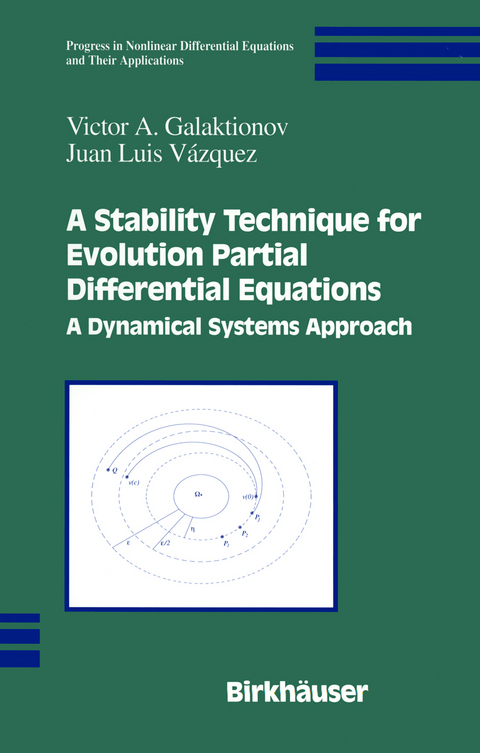
A Stability Technique for Evolution Partial Differential Equations
Birkhauser Boston Inc (Verlag)
978-0-8176-4146-7 (ISBN)
common feature is that these evolution problems can be formulated as asymptoti cally small perturbations of certain dynamical systems with better-known behaviour. Now, it usually happens that the perturbation is small in a very weak sense, hence the difficulty (or impossibility) of applying more classical techniques. Though the method originated with the analysis of critical behaviour for evolu tion PDEs, in its abstract formulation it deals with a nonautonomous abstract differ ential equation (NDE) (1) Ut = A(u) + C(u, t), t > 0, where u has values in a Banach space, like an LP space, A is an autonomous (time-independent) operator and C is an asymptotically small perturbation, so that C(u(t), t) ~ ° as t ~ 00 along orbits {u(t)} of the evolution in a sense to be made precise, which in practice can be quite weak. We work in a situation in which the autonomous (limit) differential equation (ADE) Ut = A(u) (2) has a well-known asymptotic behaviour, and we want to prove that for large times the orbits of the original evolution problem converge to a certain class of limits of the autonomous equation. More precisely, we want to prove that the orbits of (NDE) are attracted by a certain limit set [2* of (ADE), which may consist of equilibria of the autonomous equation, or it can be a more complicated object.
Introduction: A Stability Approach and Nonlinear Models.- Stability Theorem: A Dynamical Systems Approach.- Nonlinear Heat Equations: Basic Models and Mathematical Techniques.- Equation of Superslow Diffusion.- Quasilinear Heat Equations with Absorption. The Critical Exponent.- Porous Medium Equation with Critical Strong Absorption.- The Fast Diffusion Equation with Critical Exponent.- The Porous Medium Equation in an Exterior Domain.- Blow-up Free-Boundary Patterns for the Navier-Stokes Equations.- The Equation ut = uxx + uln2u: Regional Blow-up.- Blow-up in Quasilinear Heat Equations Described by Hamilton-Jacobi Equations.- A Fully Nonlinear Equation from Detonation Theory.- Further Applications to Second- and Higher-Order Equations.- References.- Index.
| Reihe/Serie | Progress in Nonlinear Differential Equations and Their Applications ; 56 |
|---|---|
| Zusatzinfo | XXI, 377 p. |
| Verlagsort | Secaucus |
| Sprache | englisch |
| Maße | 155 x 235 mm |
| Themenwelt | Mathematik / Informatik ► Mathematik ► Analysis |
| Technik ► Maschinenbau | |
| ISBN-10 | 0-8176-4146-7 / 0817641467 |
| ISBN-13 | 978-0-8176-4146-7 / 9780817641467 |
| Zustand | Neuware |
| Informationen gemäß Produktsicherheitsverordnung (GPSR) | |
| Haben Sie eine Frage zum Produkt? |
aus dem Bereich