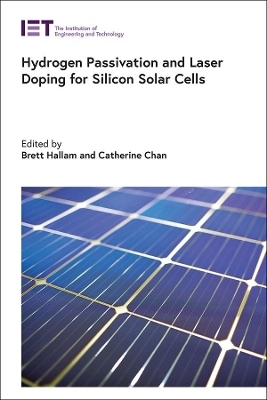
Hydrogen Passivation and Laser Doping for Silicon Solar Cells
Institution of Engineering and Technology (Verlag)
978-1-78561-623-5 (ISBN)
Photovoltaic electricity generation is a rapidly growing industry, and a key pillar of a decarbonised energy system. In modern solar cells, laser technology is used to form localised structures such as a selective emitter through doping or to locally ablate dielectric layers for contact definition. A critical factor is the ability to passivate the laser-induced defects to prevent premature charge carrier recombination reducing the cell efficiency. Hydrogenation is such a passivation technique. The exact mechanisms have until recently been poorly understood, so this timely reference covers the recent breakthroughs in the understanding of hydrogen passivation.
The book addresses key technologies for improving the efficiency of solar cells, including the industry-dominating PERC concept with an added rear passivation layer to reduce recombination. Coverage includes hydrogen passivation mechanisms, bulk and surface defect passivation, hydrogenation of light-induced defects, potential negative impacts of hydrogen, and laser doping for rapid diffusion and for selective emitter formation. This work also provides brand new results that enable low-quality silicon to be used for heterojunction applications and could pave the way for future low-cost, high-efficiency silicon solar cell technologies featuring passivated contacts to be fabricated on p-type wafers.
This work is indispensable for researchers in the field of photovoltaic energy, in academia as well as industry.
Brett Hallam is an associate professor and the research director for Advanced Hydrogenation at the University of New South Wales, Sydney, Australia, working on a large government funded project that is also supported by 15 key solar cell manufacturers. He has transferred patented hydrogen passivation and laser doping processes to several companies and research institutes. He received the 2020 IEEE PVSC Stuart Wenham Young Professional Award for his contributions to the photovoltaic industry. Catherine Chan is a senior researcher with the Australian Centre for Advanced Photovoltaics at the University of New South Wales, Sydney, Australia. She completed her PhD on laser doping and her research currently focuses on addressing the negative impacts of hydrogen with light- and elevated-temperature-induced degradation (LeTID) in PERC cells. She has demonstrated rapid approaches to eliminate such degradation and her work has led to the development of industrial tools to mitigate LeTID.
Chapter 1: Industrial silicon solar cells
Chapter 2: Hydrogen passivation mechanisms
Chapter 3: Hydrogen passivation of silicon surfaces
Chapter 4: Hydrogen passivation of bulk defects
Chapter 5: The boron-oxygen defect system
Chapter 6: Negative impacts of hydrogen in silicon
Chapter 7: Laser doping for rapid diffusion in silicon
Chapter 8: Laser-doped selective emitter formation and the passivation of laser-induced defects
Chapter 9: Applications of laser doping
Chapter 10: Conclusion and future outlook
| Erscheinungsdatum | 03.12.2021 |
|---|---|
| Reihe/Serie | Energy Engineering |
| Verlagsort | Stevenage |
| Sprache | englisch |
| Maße | 156 x 234 mm |
| Themenwelt | Technik ► Elektrotechnik / Energietechnik |
| ISBN-10 | 1-78561-623-4 / 1785616234 |
| ISBN-13 | 978-1-78561-623-5 / 9781785616235 |
| Zustand | Neuware |
| Informationen gemäß Produktsicherheitsverordnung (GPSR) | |
| Haben Sie eine Frage zum Produkt? |
aus dem Bereich