MRI Physics (eBook)
John Wiley & Sons (Verlag)
978-1-119-61504-0 (ISBN)
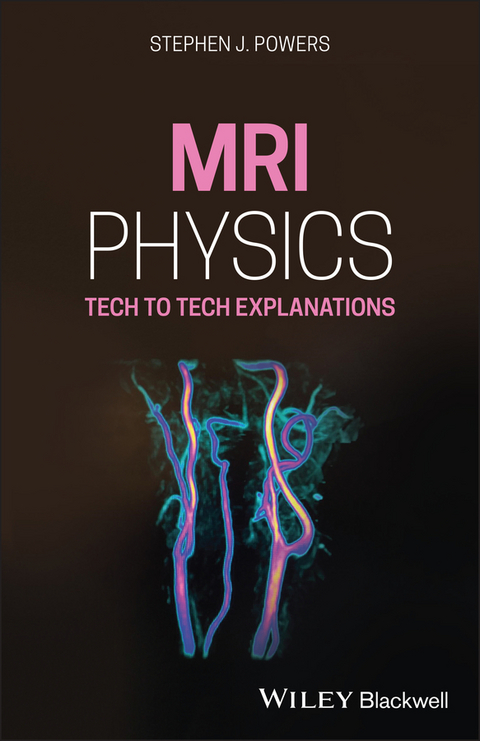
MRI PHYSICS
TECH TO TECH EXPLANATIONS
Technologists must have a solid understanding of the physics behind Magnetic Resonance Imaging (MRI), including safety, the hows and whys of the quantum physics of the MR phenomenon, and how to competently operate MRI scanners. Generating the highest quality images of the human body involves thorough knowledge of scanner hardware, pulse sequences, image contrast, geometric parameters, and tissue suppression techniques.
MRI Physics: Tech to Tech Explanations is designed to help student MRI technologists and radiotherapists preparing for Advanced MRI certification examinations to better understand difficult concepts and topics in a quick and easy manner.
Written by a highly experienced technologist, this useful guide provides clear and reader-friendly coverage of what every MR Technologist needs to know. Topics include safety considerations associated with the magnetic field and RF, pulse sequences, artifacts, MRI math, the much-feared gradients, and I.V. contrast.
- Provides basic guidance on safety considerations, protocols options, critical thinking, and image contrast optimization
- Simplifies the challenging topic of MRI physics using straightforward language and clear explanations
- Covers content for American Registry of Radiologic Technologists (ARRT) and Continuing Qualifications Requirements (CQR) exams
- Features numerous illustrations and photographs of various MRI concepts, pulse sequence design, artifacts, and the application of concepts in clinical settings
MRI Physics: Tech to Tech Explanations is a must-have resource for the experienced and training MRI technologist, medical students, and radiology residency rotations.
Stephen J. Powers, BSRT (R), (CT), (MR) is currently an MR Technologist for South Coast Hospital Systems in the USA, and former MRI Clinical Applications Specialist for General Electric Health Care. Stephen has over twenty years of classroom, lecture and clinical instructor experience.
MRI PHYSICS MRI PHYSICSTECH TO TECH EXPLANATIONSTechnologists must have a solid understanding of the physics behind Magnetic Resonance Imaging (MRI), including safety, the hows and whys of the quantum physics of the MR phenomenon, and how to competently operate MRI scanners. Generating the highest quality images of the human body involves thorough knowledge of scanner hardware, pulse sequences, image contrast, geometric parameters, and tissue suppression techniques.MRI Physics: Tech to Tech Explanations is designed to help student MRI technologists and radiotherapists preparing for Advanced MRI certification examinations to better understand difficult concepts and topics in a quick and easy manner.Written by a highly experienced technologist, this useful guide provides clear and reader-friendly coverage of what every MR Technologist needs to know. Topics include safety considerations associated with the magnetic field and RF, pulse sequences, artifacts, MRI math, the much-feared gradients, and I.V. contrast.Provides basic guidance on safety considerations, protocols options, critical thinking, and image contrast optimizationSimplifies the challenging topic of MRI physics using straightforward language and clear explanationsCovers content for American Registry of Radiologic Technologists (ARRT) and Continuing Qualifications Requirements (CQR) examsFeatures numerous illustrations and photographs of various MRI concepts, pulse sequence design, artifacts, and the application of concepts in clinical settingsMRI Physics: Tech to Tech Explanations is a must-have resource for the experienced and training MRI technologist, medical students, and radiology residency rotations.
Stephen J. Powers, BSRT (R), (CT), (MR) is currently an MR Technologist for South Coast Hospital Systems in the USA, and former MRI Clinical Applications Specialist for General Electric Health Care. Stephen has over twenty years of classroom, lecture and clinical instructor experience.
1: Hardware: Magnet Types and Coils.
2: The Basics: Hydrogen, Protons, NMV, FID, Relaxation Contrast, SNR, Free and Bound Protons.
3: Image Weighting: TR, TE, and the "Contrast (Weighting) Triangle".
4: Introduction to Basic Pulse Sequences: Spin Echo, Gradient Echo and Ernst Angle.
5: Image Weighting: Multi Echo SE Seq., Intro to k-Space M.A.R.S., DRIVE, 3D FSE, and Single Shot FSE.
6: Tissue suppression techniques: IR, ASPIR, SPAIR, SPIR, Fat Sat, Dixon Tech., Water Excitation, Sat. Pulses, Subs.
7: The Gradient Echo Sequence: Image Weighting,
8: Gradient Echo MRA.
9: k-Space Review: Filling schemes, Contrast MRA
10: EPI: DWI, DTI, SWAN/SWI, Perfusion, ASL, Spectroscopy.
11: Geometric Parameters: Tradeoffs and Effects on I.Q.
12: Artifacts.
13: Gradients: Physical, Logical, Cartesian Coordinate and Spatial Encoding.
14: MR Math: Equations, Pixel/Voxel + Scan time formula.
15: Parallel Imaging.
16: IV Gadolinium.
Introduction
Safety
What follows will be a generic safety offering. It is not meant to be all‐encompassing or empirical.
- When in doubt, don’t. You do not want to be “that guy.”
- Magnets are always hungry. They do not make mistakes so neither can we. The magnet is always hungry. A healthy dose of paranoia has worked pretty well for me, so far.
There are three different safety considerations in MR:
- The static magnetic field.
- The gradient magnetic field.
- Radiofrequency: Specific absorption rate (SAR).
The Static Magnetic Field
The static magnet field is 20 to 60 thousand or more times stronger at isocenter than the Earth’s magnetic field. If something is ferrous and it gets too close, it is going for a ride. You do not want to be in between it and the scanner.
Teaching Moment:
Magnetism is not governed by the inverse square law like x‐rays are. Magnetism has a cubic exponential relationship of attraction. Halve the distance and there is 8 times (23 or 2 × 2 × 2) the force of attraction. Things get drawn in very quickly. A ferrous object becomes magnetized (not just attracted but a magnet) in the presence of a strong field. Handheld and or wall‐mounted ferrous detectors are now pretty much standard, as well as a series of “zone” signs as warnings. A handheld magnet is a very good idea for checking ferrous vs. non‐ferrous.
We have all heard the stories and seen the pictures. From the MR point of view, there are two kinds of metals: Ferrous vs. non‐ferrous.
- Aluminum is non‐ferrous, i.e. it is not attracted to a magnet. It has little to no iron content.
- Ferrous metals include steel and alloys of iron with other metals. Manipulation of the atomic bonds between iron, carbon, and other alloys gives ferrous properties to a metal.
- Not all stretchers, IV poles or O₂ bottles are made the same. Do not be that guy. Be paranoid.
Figure I.1 Beware: Not all stretchers, IV poles, or O2 bottles are made of non‐ferrous materials.
Figure I.1 may not be an overly impressive photo of a hospital bed or respirator, but the scanner was still down for a day and a half.
The “5 Gauss line” (0.5 mT):
In Figures I.2 and I.3 these are the red lines on the Gauss diagram and on the floor of the scan room.) This line is considered the “safe zone” outside of which pacemakers, defibrillators, etc. are considered safe. Each scanner has a different “5 Gauss line.” Occasionally the lines are physically marked on the floor by colored tape.
Figure I.2 The 5 Gauss line. Diagram of a scan room.
Figure I.3 The 5 Gauss line. A scan room floor.
Some mechanical medical devices and their batteries do not do well in a strong magnetic field. Parts may become magnetized or battery life may be adversely affected.
The Gradient Magnetic Field
How many patients have asked you what causes the noise? The gradients make noise as they are turned on and off. There are actually three pairs of electromagnets that superimpose themselves onto the main magnet field. They are very rapidly turned on and off, causing the banging noise. Turn it on, bang, turn it off, bang. The stronger the gradient, the louder the noise. A 1.5 T, while noisy, is usually less noisy than a 3 T.
Gradients need to work harder the stronger the static field.
What is a gradient?:
A gradient is actually a hill or an incline. Have you ever seen a street or highway sign saying “Steep grade: Truckers use low gear” (Figure I.4)? It is a warning that a big downhill slope is near.
In MR’s case, it is a magnetic hill. One side is made briefly stronger than the other. Briefly is the key word here.
Figure I.4 Street sign warning of a steep gradient.
Gradient Magnetic Fields and Peripheral Nerve Stimulation
Gradients are turned on and off rapidly and repeatedly, so essentially what you have are moving magnetic fields. The peripheral nerves in our hands and /feet are really tiny wires.
Moving magnetic fields, tiny wires, Faraday’s Law of Induction – does this sound familiar? The oscillating magnetic fields cause tiny amounts of current to flow in the nerves, like pins and needles when you sleep on your arm.
PNS stops when the stimulus (the gradients) stops.
- You can also induce current in larger wires such as in bone growth stimulators, pacemakers, etc.
- PNS is not harmful. It is commonly caused by sequences with a lot of gradient applications. Some gradient‐intense sequences include: DWI, perfusion, functional, and FSEs like those with a long ETL. FSEs are both SAR and gradient intense as well.
- On DWIs, have the phase direction in the correct direction. Many scanners now will give you a pop‐up warning.
- Lower the ETL on FSEs. Each echo is caused by a 180° refocusing pulse, which also has a gradient associated with it.
- Thin slices and small FOVs cause steep gradients.
Radiofrequency and Specific Absorption Rate (SAR)
The RF energy used in MRI, circled in the electromagnetic spectrum in Figure I.5, is close to the microwave range. There will be some heating of the patient.
Some pulse sequences are more RF intense than others. Compare GRE’s to Spin Echo: A GRA has only one RF pulse and it is usually less then 90°, while a Spin Echo has a 90° and a 180° RF Pulse. There is less heating during a GRE sequence. Now consider a Fast Spin Echo sequence with several 180° RF pulses. As an FYI, a Saturation band or Sat Pulse is an RF pulse.
Figure I.5 The electromagnetic spectrum. Radiofrequencies used by MRI are circled.
Other considerations include:
- What body part are you scanning? Ankle or lumbar?
- What kind of coil are you using? Receive only or transmit/receive?
- Is the bore fan on? Are there lots of blankets on the patient?
- What about the patient’s ability to regulate body temperature? Are they febrile? On a water mattress?
All MR rooms have what is called RF shielding or a “Faraday cage.” The Faraday cage is made of copper sheets that completely cover all surfaces in the room. Like lead shielding in X‐ray, its job is to keep the MR RF in, and another people’s RF out.
There is a chance of RF leaks, which will of course cause artifacts in the images. Is security nearby on a walkie‐talkie? Is the door not closed fully? What about the integrity of the door seal? Are those little fingers missing or bent backwards? Is there a new or different piece of equipment in the room?
Teaching Moment:
Did a light bulb recently get replaced? If so, just hope it is not an LED. LEDs have a small transformer in them to convert A/C to D/C. The transformer can cause RF or data spikes (Figure I.6).
Figure I.6 Artifact caused by LED light bulb.
Your Point of View While You Are Scanning
This section is to orient you, or give you a point of view to visualize the MR physics of transverse (X/Y) and longitudinal (B0) planes.
What a piece of paper fails to get across is that imaging modalities are 3D, whereas a piece of paper is of course 2D. So, for this book, always assume that the patient is head first and supine in the scanner.
Your point of view (POV) is not always sitting at the console looking at the sole of the patient’s feet; rather you are looking down from the ceiling with the top of the magnet cut off (as if the patient is in a bath tub, the magnet being the tub).
Occasionally you will need to imagine yourself at the end of the bore looking at the patient’s feet to picture the coil and transverse plane.
Try to train your brain to think in 3D. You have two eyes, so see in 3D; try to think in it as well. The Cartesian coordinate system is the three cardinal directions in MR, much as North, South, East, and West are the four cardinal directions on Earth.
- The longitudinal plane (0° and 180°) is running head to foot.
- The transverse or X/Y (90°, 270°) is right/left and actually anterior/posterior (A/P) also (Figure I.7).
Why are these “degrees” important?:
They denote positions of the NMV before, during, or after the sequence as a result of the applied RF.
Note that the head coil and actually all coils are in the X/Y, also known as the transverse or 90°, 270°.
Protons pointing at the coil at the TE will be bright.
Figure I.7 The patient is head first and supine. Note that the coil is around the phantom in the X/Y, transverse or 90°/270° plane. Longitudinal, Z or B0 is running head to feet (0–180). When you are seated at the console and looking up the bore, you are looking up the Z direction.
Figure I.8 The net...
| Erscheint lt. Verlag | 12.3.2021 |
|---|---|
| Sprache | englisch |
| Themenwelt | Medizin / Pharmazie ► Allgemeines / Lexika |
| Medizin / Pharmazie ► Gesundheitsfachberufe | |
| Medizinische Fachgebiete ► Radiologie / Bildgebende Verfahren ► Radiologie | |
| Technik | |
| Schlagworte | Computertomographie • Computertomographie (MRI) • Gesundheits- u. Sozialwesen • Health & Social Care • Medical Science • Medizin • MRI • Radiographie • radiography • Radiologie • Radiologie u. Bildgebende Verfahren • Radiology & Imaging |
| ISBN-10 | 1-119-61504-6 / 1119615046 |
| ISBN-13 | 978-1-119-61504-0 / 9781119615040 |
| Informationen gemäß Produktsicherheitsverordnung (GPSR) | |
| Haben Sie eine Frage zum Produkt? |
 EPUB (Adobe DRM)
Kopierschutz: Adobe-DRM
Adobe-DRM ist ein Kopierschutz, der das eBook vor Mißbrauch schützen soll. Dabei wird das eBook bereits beim Download auf Ihre persönliche Adobe-ID autorisiert. Lesen können Sie das eBook dann nur auf den Geräten, welche ebenfalls auf Ihre Adobe-ID registriert sind.
Details zum Adobe-DRM
Dateiformat: EPUB (Electronic Publication)
EPUB ist ein offener Standard für eBooks und eignet sich besonders zur Darstellung von Belletristik und Sachbüchern. Der Fließtext wird dynamisch an die Display- und Schriftgröße angepasst. Auch für mobile Lesegeräte ist EPUB daher gut geeignet.
Systemvoraussetzungen:
PC/Mac: Mit einem PC oder Mac können Sie dieses eBook lesen. Sie benötigen eine
eReader: Dieses eBook kann mit (fast) allen eBook-Readern gelesen werden. Mit dem amazon-Kindle ist es aber nicht kompatibel.
Smartphone/Tablet: Egal ob Apple oder Android, dieses eBook können Sie lesen. Sie benötigen eine
Geräteliste und zusätzliche Hinweise
Buying eBooks from abroad
For tax law reasons we can sell eBooks just within Germany and Switzerland. Regrettably we cannot fulfill eBook-orders from other countries.
aus dem Bereich