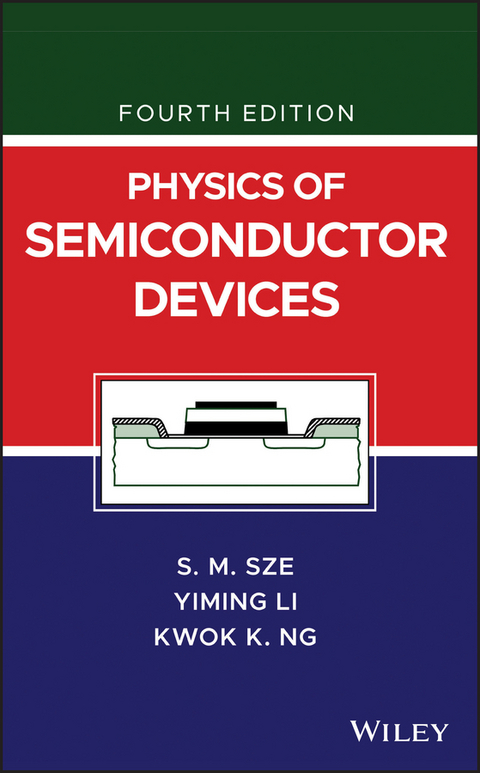
Physics of Semiconductor Devices (eBook)
John Wiley & Sons (Verlag)
978-1-119-61800-3 (ISBN)

The new edition of the most detailed and comprehensive single-volume reference on major semiconductor devices
The Fourth Edition of Physics of Semiconductor Devices remains the standard reference work on the fundamental physics and operational characteristics of all major bipolar, unipolar, special microwave, and optoelectronic devices. This fully updated and expanded edition includes approximately 1,000 references to original research papers and review articles, more than 650 high-quality technical illustrations, and over two dozen tables of material parameters.
Divided into five parts, the text first provides a summary of semiconductor properties, covering energy band, carrier concentration, and transport properties. The second part surveys the basic building blocks of semiconductor devices, including p-n junctions, metal-semiconductor contacts, and metal-insulator-semiconductor (MIS) capacitors. Part III examines bipolar transistors, MOSFETs (MOS field-effect transistors), and other field-effect transistors such as JFETs (junction field-effect-transistors) and MESFETs (metal-semiconductor field-effect transistors). Part IV focuses on negative-resistance and power devices. The book concludes with coverage of photonic devices and sensors, including light-emitting diodes (LEDs), solar cells, and various photodetectors and semiconductor sensors. This classic volume, the standard textbook and reference in the field of semiconductor devices:
- Provides the practical foundation necessary for understanding the devices currently in use and evaluating the performance and limitations of future devices
- Offers completely updated and revised information that reflects advances in device concepts, performance, and application
- Features discussions of topics of contemporary interest, such as applications of photonic devices that convert optical energy to electric energy
- Includes numerous problem sets, real-world examples, tables, figures, and illustrations; several useful appendices; and a detailed solutions manual for Instructor's only
- Explores new work on leading-edge technologies such as MODFETs, resonant-tunneling diodes, quantum-cascade lasers, single-electron transistors, real-space-transfer devices, and MOS-controlled thyristors
Physics of Semiconductor Devices, Fourth Edition is an indispensable resource for design engineers, research scientists, industrial and electronics engineering managers, and graduate students in the field.
S. M. SZE, PHD, is Honorary Chair Professor, College of Electrical and Computer Engineering, National Chiao Tung University, Taiwan. He has made fundamental and pioneering contributions to semiconductor devices, particularly his co-discovery of the floating-gate memory (FGM) effect that has ushered in the Fourth Industrial Revolution. Dr. Sze has authored, co-authored, and edited more than 400 papers and 16 books. He is a celebrated Member of IEEE, an Academician of Academia Simica, and a member of the US National Academy of Engineering.
YIMING LI, PHD, is Full Professor of Electrical and Computer Engineering at National Chiao Tung University, Taiwan. He has been a Visiting Professor in Stanford University, Grenoble INP, and Tohoku University. He has published more than 300 technical articles in journals, conferences, and book chapters. Dr. Li is an active member of IEEE and has served on technical committees for many international professional conferences including IEDM. He is the recipient of the Pan Wen-Yuan Foundation's Research Fellowship Award and the Chinese Institute of Electrical Engineering's Outstanding Young Electrical Engineer Award.
KWOK K. NG, PHD, is now serving on the Industry Advisory Board of the ECE Department of Wayne State University, USA, and as Adjunct Professor at National Chiao Tung University, Taiwan. He joined Bell Telephone Laboratories in 1980, and continued in its spin-offs Lucent Technologies and Agere Systems. He was with SRC (Semiconductor Research Corp.) from 2007 to 2019. Dr. Ng is an IEEE Life Fellow and former Editor of IEEE Electron Device Letters. He is author of numerous publications, including the book Complete Guide to Semiconductor Devices.
The new edition of the most detailed and comprehensive single-volume reference on major semiconductor devices The Fourth Edition of Physics of Semiconductor Devices remains the standard reference work on the fundamental physics and operational characteristics of all major bipolar, unipolar, special microwave, and optoelectronic devices. This fully updated and expanded edition includes approximately 1,000 references to original research papers and review articles, more than 650 high-quality technical illustrations, and over two dozen tables of material parameters. Divided into five parts, the text first provides a summary of semiconductor properties, covering energy band, carrier concentration, and transport properties. The second part surveys the basic building blocks of semiconductor devices, including p-n junctions, metal-semiconductor contacts, and metal-insulator-semiconductor (MIS) capacitors. Part III examines bipolar transistors, MOSFETs (MOS field-effect transistors), and other field-effect transistors such as JFETs (junction field-effect-transistors) and MESFETs (metal-semiconductor field-effect transistors). Part IV focuses on negative-resistance and power devices. The book concludes with coverage of photonic devices and sensors, including light-emitting diodes (LEDs), solar cells, and various photodetectors and semiconductor sensors. This classic volume, the standard textbook and reference in the field of semiconductor devices: Provides the practical foundation necessary for understanding the devices currently in use and evaluating the performance and limitations of future devices Offers completely updated and revised information that reflects advances in device concepts, performance, and application Features discussions of topics of contemporary interest, such as applications of photonic devices that convert optical energy to electric energy Includes numerous problem sets, real-world examples, tables, figures, and illustrations; several useful appendices; and a detailed solutions manual for Instructor's only Explores new work on leading-edge technologies such as MODFETs, resonant-tunneling diodes, quantum-cascade lasers, single-electron transistors, real-space-transfer devices, and MOS-controlled thyristors Physics of Semiconductor Devices, Fourth Edition is an indispensable resource for design engineers, research scientists, industrial and electronics engineering managers, and graduate students in the field.
S. M. SZE, PHD, is Honorary Chair Professor, College of Electrical and Computer Engineering, National Chiao Tung University, Taiwan. He has made fundamental and pioneering contributions to semiconductor devices, particularly his co-discovery of the floating-gate memory (FGM) effect that has ushered in the Fourth Industrial Revolution. Dr. Sze has authored, co-authored, and edited more than 400 papers and 16 books. He is a celebrated Member of IEEE, an Academician of Academia Simica, and a member of the US National Academy of Engineering. YIMING LI, PHD, is Full Professor of Electrical and Computer Engineering at National Chiao Tung University, Taiwan. He has been a Visiting Professor in Stanford University, Grenoble INP, and Tohoku University. He has published more than 300 technical articles in journals, conferences, and book chapters. Dr. Li is an active member of IEEE and has served on technical committees for many international professional conferences including IEDM. He is the recipient of the Pan Wen-Yuan Foundation's Research Fellowship Award and the Chinese Institute of Electrical Engineering's Outstanding Young Electrical Engineer Award. KWOK K. NG, PHD, is now serving on the Industry Advisory Board of the ECE Department of Wayne State University, USA, and as Adjunct Professor at National Chiao Tung University, Taiwan. He joined Bell Telephone Laboratories in 1980, and continued in its spin-offs Lucent Technologies and Agere Systems. He was with SRC (Semiconductor Research Corp.) from 2007 to 2019. Dr. Ng is an IEEE Life Fellow and former Editor of IEEE Electron Device Letters. He is author of numerous publications, including the book Complete Guide to Semiconductor Devices.
1
Physics and Properties of Semiconductors—A Review
- 1.1 INTRODUCTION
- 1.2 CRYSTAL STRUCTURE
- 1.3 ENERGY BANDS AND ENERGY GAP
- 1.4 CARRIER CONCENTRATION AT THERMAL EQUILIBRIUM
- 1.5 CARRIER‐TRANSPORT PHENOMENA
- 1.6 PHONON, OPTICAL, AND THERMAL PROPERTIES
- 1.7 HETEROJUNCTIONS AND NANOSTRUCTURES
- 1.8 BASIC EQUATIONS AND EXAMPLES
1.1 INTRODUCTION
The physics of semiconductor devices is naturally dependent on the physics of semiconductor materials themselves. This chapter summarizes and reviews the basic physics and properties of semiconductors. It represents only a small cross section of the vast literature on semiconductors; only those subjects pertinent to device operations are included here. For detailed consideration of semiconductor physics, the reader can consult textbooks or references by Moll,1 Smith,2 Moss,3 Böer,4 Seeger,5 Singh,6 Taur,7 Sze and Lee,8 and Hamaguchi,9 to name a few. To condense a large amount of information into a single chapter, over 30 tables (some in appendixes) and illustrations drawn from experimental data are compiled and presented here. This chapter emphasizes the two most‐important semiconductors: silicon (Si) and gallium arsenide (GaAs). Silicon has been studied extensively and widely used in commercial electronics products. Gallium arsenide has been intensively investigated in recent years. Particular properties studied are its direct bandgap for photonic applications and its intervalley‐carrier transport and higher mobility for generating microwaves.
1.2 CRYSTAL STRUCTURE
1.2.1 Primitive Cell and Crystal Plane
A crystal is characterized by having a well‐structured periodic placement of atoms. The smallest assembly of atoms that can be repeated to form the entire crystal is called a primitive cell, with a dimension of lattice constant a. Figure 1 shows some important primitive cells. Many important semiconductors have diamond or zincblende lattice structures which belong to the tetrahedral phases; that is, each atom is surrounded by four equidistant nearest neighbors which lie at the corners of a tetrahedron. The bond between two nearest neighbors is formed by two electrons with opposite spins. The diamond and the zincblende lattices can be considered as two interpenetrating face‐centered cubic (fcc) lattices. For the diamond lattice, such as Si (Fig. 1d), all the atoms are the same; whereas in a zincblende lattice, such as GaAs (Fig. 1e), one sublattice is Ga and the other is As. Gallium arsenide is a III–V compound because it is formed from elements of groups III and V of the periodic table.
Most III–V compounds crystallize in the zincblende structure6,9,10; however, many semiconductors (including some III–V compounds) crystallize in the rock‐salt or wurtzite structures. Figure 1f shows the rock‐salt lattice, which again can be considered as two interpenetrating fcc lattices. In this rock‐salt structure, each atom has six nearest neighbors. Figure 1g shows the wurtzite lattice, which can be considered as two interpenetrating hexagonal close‐packed lattices (e.g., the sublattices of cadmium and sulfur). In this picture, for each sublattice (Cd or S), the two planes of adjacent layers are displaced horizontally such that the distance between these two planes is at a minimum (for a fixed distance between centers of two atoms), hence the name close‐packed. The wurtzite structure has a tetrahedral arrangement of four equidistant nearest neighbors, similar to a zincblende structure. Appendix F gives a summary of the lattice constants of important semiconductors, together with their crystal structures.11,12 Some compounds, such as zinc sulfide and cadmium sulfide, can crystallize in either zincblende or wurtzite structures.
Devices are built on or near the semiconductor surface, so the orientations and properties of the surface crystal planes are important. A method of defining the various planes in a crystal is to use Miller indices. These indices are determined by first finding the intercepts of the plane with the three basis axes in terms of the lattice constants (or primitive cells), and then taking the reciprocals of these numbers and reducing them to the smallest three integers having the same ratio. The result is enclosed in parentheses (hkl) called the Miller indices for a single plane or a set of parallel planes {hkl}. Figure 2 shows the Miller indices of important planes in a cubic crystal. Some other conventions are given in Tab. 1. For Si, a single‐element semiconductor, the easiest breakage or cleavage planes are the {111} planes. In contrast, GaAs, which has a similar lattice structure but also has a slight ionic component in the bonds, cleaves on {110} planes. Three primitive basis vectors, a, b, and c of a primitive cell, describe a crystalline solid such that the crystal structure remains invariant under translation through any vector that is the sum of integer multiples of these basis vectors. In other words, the direct lattice sites can be defined by the set13
Fig. 1 Some important primitive cells (direct lattices) and their representative elements; a and c are the lattice constants. a1 − , a2 − a3−, and z‐axis are four axes of the wurtzite structure.
where m, n, and p are integers.
Fig. 2 Miller indices of some important planes in a cubic crystal.
Table 1 Miller Indices and Their Represented Plane or Direction of a Crystal Surface
| Miller Indices | Description of Plane or Direction |
|---|
| (hkl) | For a plane that intercepts 1/h, 1/k, 1/l on the x‐, y‐, and z‐axis, respectively |
| For a plane that intercepts the negative x‐axis |
| {hkl} | For a full set of planes of equivalent symmetry, such as {100} for (100), (010), (001), , and in cubic symmetry |
| [hkl] | For a direction of a crystal such as [100] for the x‐axis |
| 〈hkl〉 | For a full set of equivalent directions |
| [hklm] | For a plane in a hexagonal lattice (such as wurtzite) that intercepts 1/h, 1/k, 1/l, 1/m on the a1‐, a2‐, a3‐, and z‐axis, respectively ( Fig. 1g) |
1.2.2 Reciprocal Lattice
For a given set of the direct basis vectors, a set of reciprocal lattice basis vectors a*, b*, c* can be defined as
such that a · a* = 2π; a · b* = 0, and so on. The denominators are identical due to the equality that a · b × c = b · c × a = c · a × b, which is the volume enclosed by these vectors. The general reciprocal lattice vector is given by
where h, k, and 1 are integers. It follows that one important relationship between the direct lattice and the reciprocal lattice is
and therefore each vector of the reciprocal lattice is normal to a set of planes in the direct lattice. The volume of a primitive cell of the reciprocal lattice follows is of the direct lattice.
The primitive cell of a reciprocal lattice can be represented by a Wigner–Seitz cell. The Wigner–Seitz cell is constructed by drawing perpendicular bisector planes in the reciprocal lattice from the chosen center to the nearest equivalent reciprocal lattice sites. This technique can also be applied to a direct lattice. The Wigner–Seitz cell in the reciprocal lattice is called the first Brillouin zone. Figure 3a illustrates a body‐centered cubic (bcc) reciprocal lattice.14 If one first draws lines from the center point (Γ) to the eight corners of the cube, then forms the bisector planes, the result is the truncated octahedron within the cube—a Wigner–Seitz cell. A fcc direct lattice with lattice constant a has a bcc reciprocal lattice with spacing 4π/a.15 Thus, the Wigner–Seitz cell shown in Fig. 3a is the primitive cell of the reciprocal lattice for an fcc direct lattice. The Wigner–Seitz cells for bcc and...
| Erscheint lt. Verlag | 19.3.2021 |
|---|---|
| Sprache | englisch |
| Themenwelt | Technik ► Elektrotechnik / Energietechnik |
| Schlagworte | Electrical & Electronics Engineering • Elektrotechnik u. Elektronik • Halbleiter • Halbleiterbauelement • <p>semiconductor physics • Photonic devices • Photonic Sensors • Physics • Physics Special Topics • Physik • semiconductor devices • Semiconductor physics textbook • semiconductor properties • semiconductor reference • semiconductors • semiconductors characteristics </p> • semiconductor sensors • Spezialthemen Physik • Transistor Physics |
| ISBN-10 | 1-119-61800-2 / 1119618002 |
| ISBN-13 | 978-1-119-61800-3 / 9781119618003 |
| Informationen gemäß Produktsicherheitsverordnung (GPSR) | |
| Haben Sie eine Frage zum Produkt? |
 EPUB (Adobe DRM)
Größe: 54,7 MB
Kopierschutz: Adobe-DRM
Adobe-DRM ist ein Kopierschutz, der das eBook vor Mißbrauch schützen soll. Dabei wird das eBook bereits beim Download auf Ihre persönliche Adobe-ID autorisiert. Lesen können Sie das eBook dann nur auf den Geräten, welche ebenfalls auf Ihre Adobe-ID registriert sind.
Details zum Adobe-DRM
Dateiformat: EPUB (Electronic Publication)
EPUB ist ein offener Standard für eBooks und eignet sich besonders zur Darstellung von Belletristik und Sachbüchern. Der Fließtext wird dynamisch an die Display- und Schriftgröße angepasst. Auch für mobile Lesegeräte ist EPUB daher gut geeignet.
Systemvoraussetzungen:
PC/Mac: Mit einem PC oder Mac können Sie dieses eBook lesen. Sie benötigen eine
eReader: Dieses eBook kann mit (fast) allen eBook-Readern gelesen werden. Mit dem amazon-Kindle ist es aber nicht kompatibel.
Smartphone/Tablet: Egal ob Apple oder Android, dieses eBook können Sie lesen. Sie benötigen eine
Geräteliste und zusätzliche Hinweise
Buying eBooks from abroad
For tax law reasons we can sell eBooks just within Germany and Switzerland. Regrettably we cannot fulfill eBook-orders from other countries.
aus dem Bereich