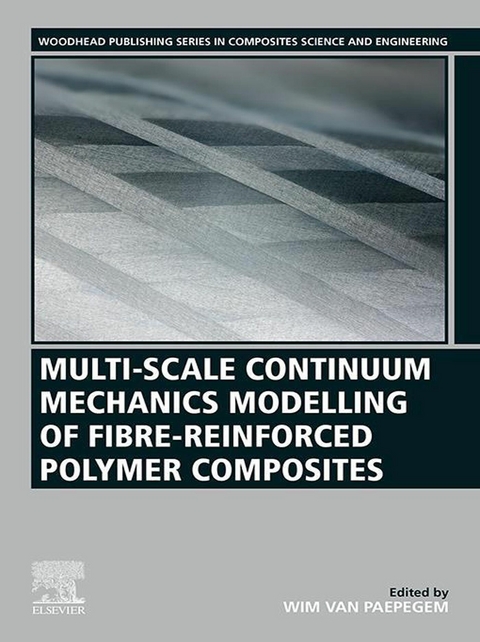
Multi-Scale Continuum Mechanics Modelling of Fibre-Reinforced Polymer Composites (eBook)
764 Seiten
Elsevier Science (Verlag)
978-0-12-818985-6 (ISBN)
Multi-scale modelling of composites is a very relevant topic in composites science. This is illustrated by the numerous sessions in the recent European and International Conferences on Composite Materials, but also by the fast developments in multi-scale modelling software tools, developed by large industrial players such as Siemens (Virtual Material Characterization toolkit and MultiMechanics virtual testing software), MSC/e-Xstream (Digimat software), Simulia (micromechanics plug-in in Abaqus), HyperSizer (Multi-scale design of composites), Altair (Altair Multiscale Designer)This book is intended to be an ideal reference on the latest advances in multi-scale modelling of fibre-reinforced polymer composites, that is accessible for both (young) researchers and end users of modelling software. We target three main groups:This book aims at a complete introduction and overview of the state-of-the-art in multi-scale modelling of composites in three axes: ranging from prediction of homogenized elastic properties to nonlinear material behaviour ranging from geometrical models for random packing of unidirectional fibres over meso-scale geometries for textile composites to orientation tensors for short fibre composites ranging from damage modelling of unidirectionally reinforced composites over textile composites to short fibre-reinforced compositesThe book covers the three most important scales in multi-scale modelling of composites: (i) micro-scale, (ii) meso-scale and (iii) macro-scale. The nano-scale and related atomistic and molecular modelling approaches are deliberately excluded, since the book wants to focus on continuum mechanics and there are already a lot of dedicated books about polymer nanocomposites. A strong focus is put on physics-based damage modelling, in the sense that the chapters devote attention to modelling the different damage mechanisms (matrix cracking, fibre/matrix debonding, delamination, fibre fracture, ) in such a way that the underlying physics of the initiation and growth of these damage modes is respected. The book also gives room to not only discuss the finite element based approaches for multi-scale modelling, but also much faster methods that are popular in industrial software, such as Mean Field Homogenization methods (based on Mori-Tanaka and Eshelby solutions) and variational methods (shear lag theory and more advanced theories). Since the book targets a wide audience, the focus is put on the most common numerical approaches that are used in multi-scale modelling. Very specialized numerical methods like peridynamics modelling, Material Point Method, eXtended Finite Element Method (XFEM), isogeometric analysis, SPH (Smoothed Particle Hydrodynamics), are excluded. Outline of the bookThe book is divided in three large parts, well balanced with each a similar number of chapters:
| Erscheint lt. Verlag | 25.11.2020 |
|---|---|
| Sprache | englisch |
| Themenwelt | Technik ► Maschinenbau |
| ISBN-10 | 0-12-818985-1 / 0128189851 |
| ISBN-13 | 978-0-12-818985-6 / 9780128189856 |
| Informationen gemäß Produktsicherheitsverordnung (GPSR) | |
| Haben Sie eine Frage zum Produkt? |
 EPUB (Adobe DRM)
Kopierschutz: Adobe-DRM
Adobe-DRM ist ein Kopierschutz, der das eBook vor Mißbrauch schützen soll. Dabei wird das eBook bereits beim Download auf Ihre persönliche Adobe-ID autorisiert. Lesen können Sie das eBook dann nur auf den Geräten, welche ebenfalls auf Ihre Adobe-ID registriert sind.
Details zum Adobe-DRM
Dateiformat: EPUB (Electronic Publication)
EPUB ist ein offener Standard für eBooks und eignet sich besonders zur Darstellung von Belletristik und Sachbüchern. Der Fließtext wird dynamisch an die Display- und Schriftgröße angepasst. Auch für mobile Lesegeräte ist EPUB daher gut geeignet.
Systemvoraussetzungen:
PC/Mac: Mit einem PC oder Mac können Sie dieses eBook lesen. Sie benötigen eine
eReader: Dieses eBook kann mit (fast) allen eBook-Readern gelesen werden. Mit dem amazon-Kindle ist es aber nicht kompatibel.
Smartphone/Tablet: Egal ob Apple oder Android, dieses eBook können Sie lesen. Sie benötigen eine
Geräteliste und zusätzliche Hinweise
Buying eBooks from abroad
For tax law reasons we can sell eBooks just within Germany and Switzerland. Regrettably we cannot fulfill eBook-orders from other countries.
aus dem Bereich