


Lagrangian-Lagrangian fluid-solid coupling in a generalized finite difference framework
Seiten
2021
Fraunhofer Verlag
9783839616741 (ISBN)
Fraunhofer Verlag
9783839616741 (ISBN)
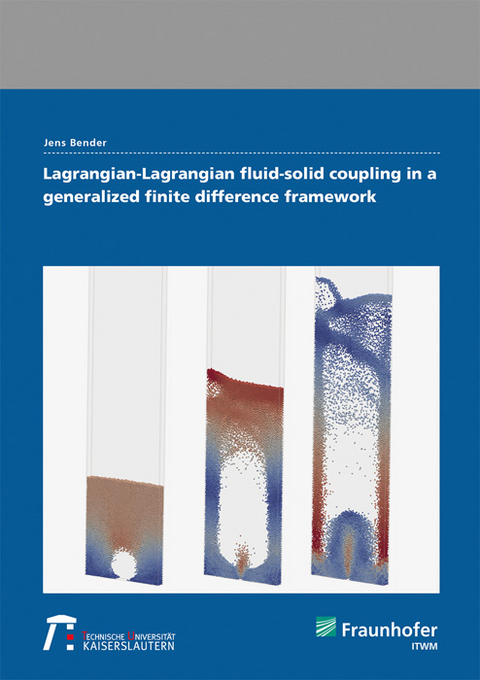
In this book, a two-way coupled CFD-DEM algorithm is presented and validated. This algorithm is embedded in a Lagrangian finite difference framework and does not depend on a mesh within the fluid phase. Thus, it is able to provide a unified framework for both phases in the coupled problem.
We consider the modeling and simulation of flows composed of a fluid with an immersed particulate solid phase within a two-way coupled scheme, which we embed into the generalized finite difference framework of the finite pointset method (FPM). Both phases are described in a Lagrangian formalism and are represented by point clouds. This allows us to treat all phases in a common framework and to take advantage of synergies in terms of data structures and algorithms. A key challenge, which the generalized finite difference setting introduces, is the calculation of averaged quantities. Due to the properties of our mesh-free approach, which is missing an inherent definition of cell volume, conventional averaging strategies from mesh-based schemes are not directly applicable. We employ an approach which circumvents these problems and takes the finite difference nature of the FPM into account. Additionally, we bring to light the required changes to a projection method for the fluid phase to incorporate the multi-phase setting. The solid phase solver, averaging scheme, and fluid solver are embedded into a coupled algorithm with a substepping procedure to improve efficiency.
We consider the modeling and simulation of flows composed of a fluid with an immersed particulate solid phase within a two-way coupled scheme, which we embed into the generalized finite difference framework of the finite pointset method (FPM). Both phases are described in a Lagrangian formalism and are represented by point clouds. This allows us to treat all phases in a common framework and to take advantage of synergies in terms of data structures and algorithms. A key challenge, which the generalized finite difference setting introduces, is the calculation of averaged quantities. Due to the properties of our mesh-free approach, which is missing an inherent definition of cell volume, conventional averaging strategies from mesh-based schemes are not directly applicable. We employ an approach which circumvents these problems and takes the finite difference nature of the FPM into account. Additionally, we bring to light the required changes to a projection method for the fluid phase to incorporate the multi-phase setting. The solid phase solver, averaging scheme, and fluid solver are embedded into a coupled algorithm with a substepping procedure to improve efficiency.
| Erscheinungsdatum | 01.03.2021 |
|---|---|
| Zusatzinfo | num., mostly col. illus. and tab. |
| Verlagsort | Stuttgart |
| Sprache | englisch |
| Maße | 148 x 210 mm |
| Themenwelt | Mathematik / Informatik ► Informatik |
| Mathematik / Informatik ► Mathematik ► Angewandte Mathematik | |
| Technik ► Maschinenbau | |
| Schlagworte | B • CFD-DEM • Discrete element method • Entwicklungsingenieur • Entwicklungsingenieure • Finite pointset method • Fraunhofer ITWM • generalized finite difference • Generalized finite differences • Mathematiker • Mechanics of Fluids • mechanics of solids • Meshfree • Wissenschaftliche Mitarbeiter • Wissenschaftlicher Mitarbeiter |
| ISBN-13 | 9783839616741 / 9783839616741 |
| Zustand | Neuware |
| Informationen gemäß Produktsicherheitsverordnung (GPSR) | |
| Haben Sie eine Frage zum Produkt? |
Mehr entdecken
aus dem Bereich



aus dem Bereich
für Ingenieure und Naturwissenschaftler
Buch | Softcover (2024)
Springer Vieweg (Verlag)
CHF 48,95
Buch | Softcover (2025)
Springer Vieweg (Verlag)
CHF 62,95
Buch | Softcover (2025)
Springer Fachmedien Wiesbaden (Verlag)
CHF 69,95


