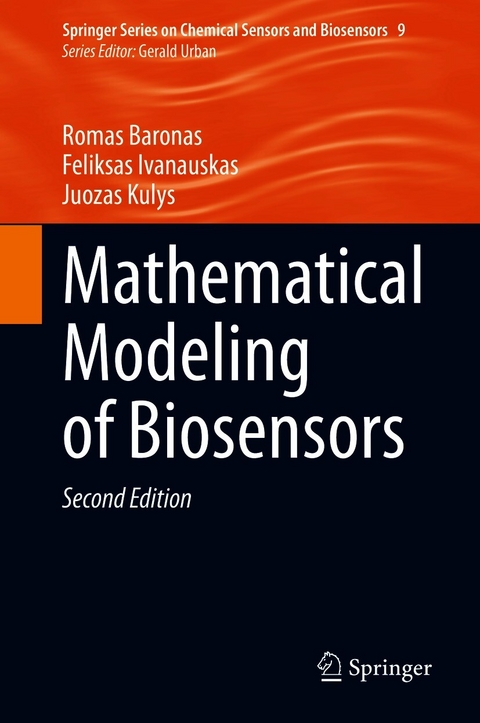
Mathematical Modeling of Biosensors (eBook)
456 Seiten
Springer International Publishing (Verlag)
978-3-030-65505-1 (ISBN)
This newly designed and enlarged edition offers an up-to-date presentation of biosensor development and modeling from both a chemical and a mathematical point of view. An entire new chapter in particular is dedicated to optimal design of biosensors. Two more new chapters discuss biosensors which utilize microbial cells and are based on carbon nanotubes respectively. All the other chapters have been revised and updated.
The book contains unique modeling methods for amperometric, potentiometric and optical biosensors based mainly on biocatalysts . It examines processes that occur in the sensors' layers and at their interface, and it provides analytical and numerical methods to solve equations of conjugated enzymatic (chemical) and diffusion processes. The action of single enzyme as well as polyenzyme biosensors and biosensors based on chemically modified electrodes is studied. The modeling of biosensors that contain perforated membranes and multipart mass transport profiles is critically investigated. Furthermore, it is fully described how signals can be biochemically amplified, how cascades of enzymatic substrate conversion are triggered, and how signals are processed via a chemometric approach and artificial neuronal networks. The results of digital modeling are compared with both proximal analytical solutions and experimental data.
| Erscheint lt. Verlag | 15.2.2021 |
|---|---|
| Reihe/Serie | Springer Series on Chemical Sensors and Biosensors | Springer Series on Chemical Sensors and Biosensors |
| Zusatzinfo | XVII, 456 p. 152 illus., 12 illus. in color. |
| Sprache | englisch |
| Themenwelt | Mathematik / Informatik ► Mathematik |
| Medizin / Pharmazie | |
| Naturwissenschaften ► Chemie | |
| Naturwissenschaften ► Physik / Astronomie | |
| Technik | |
| Schlagworte | allosteric enzyme layer • bi-enzyme biosensors • bioluminescent biosensor • BOD biosensor • carbon nanotube based biosensors • chemically modified electrodes • consecutive substrates conversion • cyclic substrates conversion • Enzymatic Kinetic • glucose dehydrogenase-based biosensor • heterogeneous microreactor • Metabolite biosensor • Microbial Cells • Nernst diffusion layer • Non Michaelis–Menten Enzyme • optimal design of biosensors • parallel substrates conversion • perforated membranes • synergistic substrates conversion |
| ISBN-10 | 3-030-65505-9 / 3030655059 |
| ISBN-13 | 978-3-030-65505-1 / 9783030655051 |
| Informationen gemäß Produktsicherheitsverordnung (GPSR) | |
| Haben Sie eine Frage zum Produkt? |
 PDF (Wasserzeichen)
DRM: Digitales Wasserzeichen
Dieses eBook enthält ein digitales Wasserzeichen und ist damit für Sie personalisiert. Bei einer missbräuchlichen Weitergabe des eBooks an Dritte ist eine Rückverfolgung an die Quelle möglich.
Dateiformat: PDF (Portable Document Format)
Mit einem festen Seitenlayout eignet sich die PDF besonders für Fachbücher mit Spalten, Tabellen und Abbildungen. Eine PDF kann auf fast allen Geräten angezeigt werden, ist aber für kleine Displays (Smartphone, eReader) nur eingeschränkt geeignet.
Systemvoraussetzungen:
PC/Mac: Mit einem PC oder Mac können Sie dieses eBook lesen. Sie benötigen dafür einen PDF-Viewer - z.B. den Adobe Reader oder Adobe Digital Editions.
eReader: Dieses eBook kann mit (fast) allen eBook-Readern gelesen werden. Mit dem amazon-Kindle ist es aber nicht kompatibel.
Smartphone/Tablet: Egal ob Apple oder Android, dieses eBook können Sie lesen. Sie benötigen dafür einen PDF-Viewer - z.B. die kostenlose Adobe Digital Editions-App.
Buying eBooks from abroad
For tax law reasons we can sell eBooks just within Germany and Switzerland. Regrettably we cannot fulfill eBook-orders from other countries.
aus dem Bereich