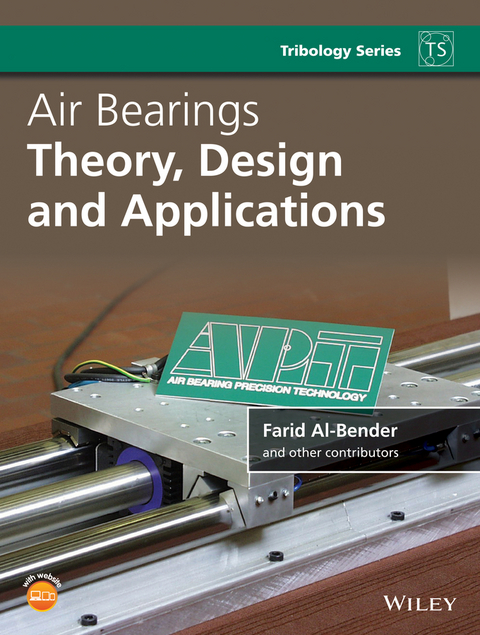

Comprehensive treatise on gas bearing theory, design and application
This book treats the fundamental aspects of gas bearings of different configurations (thrust, radial, circular, conical) and operating principles (externally pressurized, self-acting, hybrid, squeeze), guiding the reader throughout the design process from theoretical modelling, design parameters, numerical formulation, through experimental characterisation and practical design and fabrication.
The book devotes a substantial part to the dynamic stability issues (pneumatic hammering, sub-synchronous whirling, active dynamic compensation and control), treating them comprehensively from theoretical and experimental points of view.
Key features:
- Systematic and thorough treatment of the topic.
- Summarizes relevant previous knowledge with extensive references.
- Includes numerical modelling and solutions useful for practical application.
- Thorough treatment of the gas-film dynamics problem including active control.
- Discusses high-speed bearings and applications.
Air Bearings: Theory, Design and Applications is a useful reference for academics, researchers, instructors, and design engineers. The contents will help readers to formulate a gas-bearing problem correctly, set up the basic equations, solve them establishing the static and dynamic characteristics, utilise these to examine the scope of the design space of a given problem, and evaluate practical issues, be they in design, construction or testing.
Farid Al-Bender, Katholieke Universiteit Leuven, Belgium
Dr. Ir. Farid Al-Bender is Hon. Professor in the Department of Mechanical Engineering at KU Leuven, where his main areas of research included air bearing design and fabrication, tribology, friction modelling and non-linear system dynamics. He is the Director of the consultancy bureau Air Bearing Precision Technology and founder of Leuven Air Bearings company (now LAB Motion systems) where he is a board member.
Comprehensive treatise on gas bearing theory, design and applicationThis book treats the fundamental aspects of gas bearings of different configurations (thrust, radial, circular, conical) and operating principles (externally pressurized, self-acting, hybrid, squeeze), guiding the reader throughout the design process from theoretical modelling, design parameters, numerical formulation, through experimental characterisation and practical design and fabrication. The book devotes a substantial part to the dynamic stability issues (pneumatic hammering, sub-synchronous whirling, active dynamic compensation and control), treating them comprehensively from theoretical and experimental points of view. Key features: Systematic and thorough treatment of the topic. Summarizes relevant previous knowledge with extensive references. Includes numerical modelling and solutions useful for practical application. Thorough treatment of the gas-film dynamics problem including active control. Discusses high-speed bearings and applications. Air Bearings: Theory, Design and Applications is a useful reference for academics, researchers, instructors, and design engineers. The contents will help readers to formulate a gas-bearing problem correctly, set up the basic equations, solve them establishing the static and dynamic characteristics, utilise these to examine the scope of the design space of a given problem, and evaluate practical issues, be they in design, construction or testing.
Farid Al-Bender, Katholieke Universiteit Leuven, Belgium Dr. Ir. Farid Al-Bender is Hon. Professor in the Department of Mechanical Engineering at KU Leuven, where his main areas of research included air bearing design and fabrication, tribology, friction modelling and non-linear system dynamics. He is the Director of the consultancy bureau Air Bearing Precision Technology and founder of Leuven Air Bearings company (now LAB Motion systems) where he is a board member.
All chapters are written in an authoritative yet easy-to-read manner. The introduction of similarity parameters and scale effects in different chapters and a nice blend of experimental comparisons to theoretical analyses sprinkled throughout will appeal to graduate students and researchers. In summary, this comprehensive book on air bearings is a carefully written, methodical, insightful, and welcome contribution to the tribology literature. --Michael Khonsari, Journal of Tribology, November 2021.
Air bearings are a technology originally developed by the computer industry and which over time has been adopted by precision machining and by very high speed rotating machines. The monographs dedicated to this subject can be counted on the fingers of one hand and the work of Farid Al Bender is an important and welcome contribution. This book gives at the same time solid theoretical bases, presents physical models, details their mathematical formulations and describes a large variety of technical solutions. The reader is delighted by the wealth of information grouped into 17 carefully chosen chapters. --Mihai Arghir, Tribology International, November 2021.
List of Figures
| Figure 1.1 | Classification of air bearings according to pressure generation (dynamics) and morphology (kinematics). The bottom row depicts compliant‐surface bearings. |
| Figure 2.1 | General bearing configuration and notation ( and denote respectively the supply and atmospheric pressure). Source: Adapted from Al‐Bender F 1992. |
| Figure 2.2 | Schematic flow configuration of inlet flow to EP bearing. (Not to scale.) Source: Al‐Bender F 1992. |
| Figure 2.3 | (a) Feed flow and its transition to (b) film flow. |
| Figure 2.4 | Comparison between potential flow in the entrance region and ideal sink flow. Source: Al‐Bender F 1992. |
| Figure 2.5 | Entrance flow into a slider bearing: open shear flow transition to Couette–Poiseuille channel flow. |
| Figure 2.6 | Film flow configuration for EP case. (Not to scale.) Source: Al‐Bender F 1992. |
| Figure 2.7 | Film flow configuration for the slider‐bearing case. (Not to scale.) |
| Figure 2.8 | Circular centrally fed bearing geometry and notation. Source: Al‐Bender F 1992 |
| . |
| Figure 3.1 | Schematic and terminology of the entrance problem. (Not to scale.) |
| Figure 3.2 | A method of “separation of variables” for the solution of laminar boundary layer equations of narrow channel flows. Journal of Tribology 114, 630–636. 1992 by permission of ASME. |
| Figure 3.3 | Velocity profile functions in forward and reverse flow. Source: Al-Bender and Van Brussel, 1992 by permission of ASME. |
| Figure 3.4 | . Source: Al-Bender and Van Brussel, 1992 by permission of ASME. |
| Figure 3.5 | Velocity and pressure development in the entrance of a plane channel. Source: Al-Bender and Van Brussel, 1992 by permission of ASME. |
| Figure 3.6 | Radial channel flow: Notation. Source: Al-Bender and Van Brussel, 1992 by permission of ASME. |
| Figure 3.7 | Qualitative streamline field for (a) moderate taper (large flow rate) and (b) large taper (small flow rate) sliders and associated entrance velocity profiles. |
| Figure 3.8 | Development of the flow upstream of a slider bearing; Blasius BL (a) versus Skiadis BL (b). (Not to scale.) |
| Figure 3.9 | Normalised velocity profile of the Sakiadis boundary layer. |
| Figure 3.10 | Shear‐flow entrance into a plane uniform gap channel. Development of (a) velocity profile and (b) pressure (including head loss). (Not to scale) |
| Figure 3.11 | Velocity profile and its two components (a) just downstream of entrance and (b) Fully developed. |
| Figure 3.12 | Shear‐flow entrance parameters (a) head loss, (b) entrance length and (c) coefficient of discharge as a function of . |
| Figure 3.13 | Shear‐flow entrance parameters for small values of (a) head loss, (b) entrance length and (c) coefficient of discharge as a function of . Note that the pressure is expressed as to facilitate evaluation and comparison. |
| Figure 3.14 | Shear‐flow entrance into a plane uniform gap channel with reverse flow component. Development of (a) velocity profile and (b) pressure (including head gain). (Not to scale) |
| Figure 3.15 | Shear‐flow entrance parameters from left to right: head gain, entrance length and as a function of . Note that the pressure is expressed as to facilitate evaluation and comparison. |
| Figure 3.16 | Global pressure development, upstream and downstream the gap entrance. |
| Figure 4.1 | Control volume of the Reynolds Equation. |
| Figure 4.2 | Polar and spherical coordinates. |
| Figure 4.3 | Fixed inclined upper surface and moving flat lower one. |
| Figure 4.4 | Pure surface motion with various surface velocities. |
| Figure 4.5 | Inclined moving upper surface (with possible features). |
| Figure 4.6 | Moving and stationary grooves. |
| Figure 4.7 | Moving and stationary grooves with sliding surface. |
| Figure 4.8 | Moving and stationary grooves with sliding surface: the two situations are not equivalent. |
| Figure 4.9 | Probable flow pattern at the transition from land to groove. Source: Van der Stegen RHM 1997. |
| Figure 4.10 | Schematic of the 2‐D flow configuration. |
| Figure 4.11 | The boundary‐layer velocity profile. |
| Figure 4.12 | Profile function for different values of . |
| Figure 4.13 | Pressure distribution in an inclined slider with and without inertia effects; large . |
| Figure 4.14 | Schematic of squeeze film bearing configuration. |
| Figure 5.1 | Various restrictor types. |
| Figure 5.2 | Entrance region and notation. (Source: Al‐Bender and Van Brussel 1992 by permission of ASME.) |
| Figure 5.3 | Qualitative development of the velocity profile integral function in radial channel flow. Source: Al‐Bender and Van Brussel 1992 by permission of ASME. |
| Figure 5.4 | Comparison of pressure distributions for converging and diverging incompressible radial flow. Experimental data points adapted from McGinn (1955). Source: Al‐Bender F and Van Brussel H 1992 by permission of ASME. |
| Figure 5.5 | Comparison of pressure distributions for a bearing with large radius ratio. Experimental data points adapted from Lowe (1970). Source: Al‐Bender F and Van Brussel H 1992 by permission of ASME. |
| Figure 5.6 | Comparison of pressure distributions for a bearing with large radius ratio. Experimental data points adapted from Mori (1969). Source: Al‐Bender F and Van Brussel H 1992 by permission of ASME. |
| Figure 5.7 | Comparison of pressure distributions for a bearing with small radius ratio. Experimental data points adapted from Mori (1969). Source: Al‐Bender F and Van Brussel H 1992 by permission of ASME. |
| Figure 5.8 | Comparison of pressure distributions for a bearing with small radius ratio. Experimental data points adapted from Vohr (1966). Source: Al‐Bender F and Van Brussel H 1992 by permission of ASME. |
| Figure 5.9 | Comparison of pressure distributions for a convergent gap air bearing. Source: Al‐Bender F and Van Brussel H 1992 by permission of ASME. |
| Figure 5.10 | Comparison of pressure profile for an inherently restricted bearing (detail view provided in Figure 5.11). , for µm; , for µm. Experimental data from Belforte et al. (2007). Source: Waumans T, Al‐Bender F and Reynaerts D 2008 by permission of ASME. |
| Figure 5.11 | Detail view of Figure 5.10. Source: Waumans T, Al‐Bender F and Reynaerts D 2008 by permission of ASME. |
| Figure 5.12 | Comparison of pressure profile for an orifice restricted bearing with a shallow feeding pocket. Experimental data from Belforte et al. (2007). Source: Waumans T, Al‐Bender F and Reynaerts D 2008 by permission of ASME. |
| Figure 5.13 | Comparison of pressure profile for an orifice restricted bearing with a feeding pocket. Experimental data from Belforte et al. (2007). Source: Waumans T, Al‐Bender F and Reynaerts D 2008 by permission of ASME. |
| Figure 5.14 | Calculated values of the Coefficient of discharge . Source: Al-Bender F 1992. |
| Figure 6.1 | Geometry and notation. Source: Al‐Bender F 1992. |
| Figure 6.2 | Normalised pressure distribution corresponding to incompressible fluid flow for . |
| Figure 6.3 | Pressure distributions for and three values of , for compressible flow. |
| Figure 6.4 | Pressure distributions for and, from bottom to top, . |
| Figure 6.5 | Clearer presentation: the effect of higher . Curves from bottom to top are for . |
| Figure 6.6 | Pressure distribution for different... |
| Erscheint lt. Verlag | 15.1.2021 |
|---|---|
| Reihe/Serie | Tribology in Practice Series |
| Tribology in Practice Series (PEP) | Tribology in Practice Series (PEP) |
| Sprache | englisch |
| Themenwelt | Technik ► Maschinenbau |
| Schlagworte | Aerodynamic Bearings • Aerostatic bearings • Air bearings • Air Bearings: Theory, Design and Applications • compressibility • Farid Al-Bender • Festkörpermechanik • fluid mechanics • Gas bearings • Journal Bearings • Maschinenbau • Maschinenbau - Entwurf • mechanical engineering • Mechanical Engineering - Design • Pneumatic hammer • Self-acting gas bearings • solid mechanics • Strömungsmechanik • (subsynchronous) whirl • Tobias Waumans • (Ultra) high-speed bearings |
| ISBN-10 | 1-118-92656-0 / 1118926560 |
| ISBN-13 | 978-1-118-92656-7 / 9781118926567 |
| Informationen gemäß Produktsicherheitsverordnung (GPSR) | |
| Haben Sie eine Frage zum Produkt? |
 EPUB (Adobe DRM)
Kopierschutz: Adobe-DRM
Adobe-DRM ist ein Kopierschutz, der das eBook vor Mißbrauch schützen soll. Dabei wird das eBook bereits beim Download auf Ihre persönliche Adobe-ID autorisiert. Lesen können Sie das eBook dann nur auf den Geräten, welche ebenfalls auf Ihre Adobe-ID registriert sind.
Details zum Adobe-DRM
Dateiformat: EPUB (Electronic Publication)
EPUB ist ein offener Standard für eBooks und eignet sich besonders zur Darstellung von Belletristik und Sachbüchern. Der Fließtext wird dynamisch an die Display- und Schriftgröße angepasst. Auch für mobile Lesegeräte ist EPUB daher gut geeignet.
Systemvoraussetzungen:
PC/Mac: Mit einem PC oder Mac können Sie dieses eBook lesen. Sie benötigen eine
eReader: Dieses eBook kann mit (fast) allen eBook-Readern gelesen werden. Mit dem amazon-Kindle ist es aber nicht kompatibel.
Smartphone/Tablet: Egal ob Apple oder Android, dieses eBook können Sie lesen. Sie benötigen eine
Geräteliste und zusätzliche Hinweise
Buying eBooks from abroad
For tax law reasons we can sell eBooks just within Germany and Switzerland. Regrettably we cannot fulfill eBook-orders from other countries.
aus dem Bereich