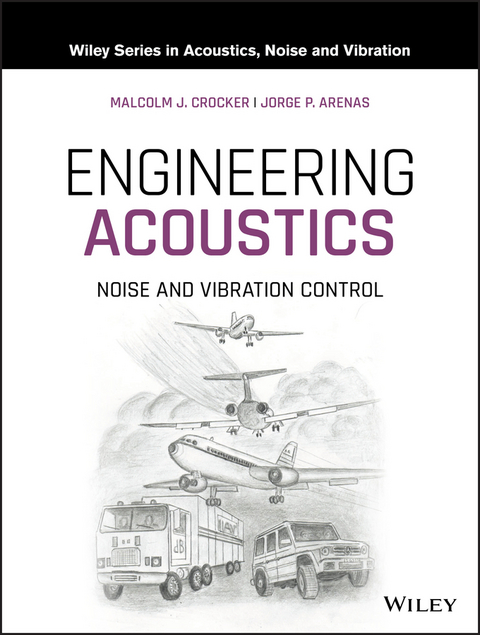
Engineering Acoustics (eBook)
John Wiley & Sons (Verlag)
978-1-118-69382-7 (ISBN)
ENGINEERING ACOUSTICS
NOISE AND VIBRATION CONTROL
A masterful introduction to the theory of acoustics along with methods for the control of noise and vibration
In Engineering Acoustics: Noise and Vibration Control, two experts in the field review the fundamentals of acoustics, noise, and vibration. The authors show how this theoretical work can be applied to real-world problems such as the control of noise and vibration in aircraft, automobiles and trucks, machinery, and road and rail vehicles.
Engineering Acoustics: Noise and Vibration Control covers a wide range of topics.
The sixteen chapters include the following:
- Human hearing and individual and community response to noise and vibration
- Noise and vibration instrumentation and measurements
- Interior and exterior noise of aircraft as well as road and rail vehicles
- Methods for the control of noise and vibration in industrial equipment and machinery
- Use of theoretical models in absorptive and reactive muffler and silencer designs
- Practical applications of finite element, boundary element and statistical energy analysis
- Sound intensity theory, measurements, and applications
- Noise and vibration control in buildings
- How to design air-conditioning systems to minimize noise and vibration
Readers, whether students, professional engineers, or community planners, will find numerous worked examples throughout the book, and useful references at the end of each chapter to support supplemental reading on specific topics. There is a detailed index and a glossary of terms in acoustics, noise, and vibration.
Malcolm J. Crocker obtained his Bachelors degree in Aeronautical Engineering and Masters degree in Noise and Vibration Studies from Southampton University and his PhD in Acoustics from Liverpool University. He worked at Supermarine and Vickers Armstrong Aircraft, UK, and at Wyle Labs, Huntsville, USA on the Lunar Saturn V launch noise. He has held full professor positions at Purdue, Sydney, and Auburn. At Auburn he served as Mechanical Engineering Department Head and Distinguished University Professor. He has published over 300 papers in refereed journals and conference proceedings and written eight books including the award-winning Encyclopedia of Acoustics, Handbook of Acoustics, and Handbook of Noise and Vibration Control for Wiley. Crocker served as one of the four founding directors of I-INCE and one of the four founding directors of IIAV. He was general chair of INTER-NOISE 72. He served for 40 years as Editor-in-Chief of the Noise Control Engineering Journal and the International Journal of Acoustics and Vibration. He has numerous awards including three honorary doctorates in Russia and Romania and is fellow and/or distinguished fellow of ASA, IIAV and ASME. He received the 2017 ASME Per Bruel Gold Medal for contributions to noise control and acoustics.
Jorge P. Arenas, Professor and former director of the Institute of Acoustics, University Austral of Chile, and Fellow of the International Institute of Acoustics and Vibration (IIAV). He received a degree in Acoustical Engineering in 1988 and his MSc in Physics in 1996 both from Univ. Austral, Chile. In 2001, he obtained a PhD in Mechanical Engineering from Auburn University in the USA. He also gained professional experience at the Institute of Acoustics in Madrid, Spain, and at the University of Southampton in the UK. He has served as the President of the IIAV (2016-2018) and he is currently the Editor-in-Chief of the International Journal of Acoustics and Vibration and a member of the editorial board of the journals Shock and Vibration and Applied Acoustics.
ENGINEERING ACOUSTICS NOISE AND VIBRATION CONTROL A masterful introduction to the theory of acoustics along with methods for the control of noise and vibration In Engineering Acoustics: Noise and Vibration Control, two experts in the field review the fundamentals of acoustics, noise, and vibration. The authors show how this theoretical work can be applied to real-world problems such as the control of noise and vibration in aircraft, automobiles and trucks, machinery, and road and rail vehicles. Engineering Acoustics: Noise and Vibration Control covers a wide range of topics. The sixteen chapters include the following: Human hearing and individual and community response to noise and vibration Noise and vibration instrumentation and measurements Interior and exterior noise of aircraft as well as road and rail vehicles Methods for the control of noise and vibration in industrial equipment and machinery Use of theoretical models in absorptive and reactive muffler and silencer designs Practical applications of finite element, boundary element and statistical energy analysis Sound intensity theory, measurements, and applications Noise and vibration control in buildings How to design air-conditioning systems to minimize noise and vibration Readers, whether students, professional engineers, or community planners, will find numerous worked examples throughout the book, and useful references at the end of each chapter to support supplemental reading on specific topics. There is a detailed index and a glossary of terms in acoustics, noise, and vibration.
Malcolm J. Crocker obtained his Bachelors degree in Aeronautical Engineering and Masters degree in Noise and Vibration Studies from Southampton University and his PhD in Acoustics from Liverpool University. He worked at Supermarine and Vickers Armstrong Aircraft, UK, and at Wyle Labs, Huntsville, USA on the Lunar Saturn V launch noise. He has held full professor positions at Purdue, Sydney, and Auburn. At Auburn he served as Mechanical Engineering Department Head and Distinguished University Professor. He has published over 300 papers in refereed journals and conference proceedings and written eight books including the award-winning Encyclopedia of Acoustics, Handbook of Acoustics, and Handbook of Noise and Vibration Control for Wiley. Crocker served as one of the four founding directors of I-INCE and one of the four founding directors of IIAV. He was general chair of INTER-NOISE 72. He served for 40 years as Editor-in-Chief of the Noise Control Engineering Journal and the International Journal of Acoustics and Vibration. He has numerous awards including three honorary doctorates in Russia and Romania and is fellow and/or distinguished fellow of ASA, IIAV and ASME. He received the 2017 ASME Per Bruel Gold Medal for contributions to noise control and acoustics. Jorge P. Arenas, Professor and former director of the Institute of Acoustics, University Austral of Chile, and Fellow of the International Institute of Acoustics and Vibration (IIAV). He received a degree in Acoustical Engineering in 1988 and his MSc in Physics in 1996 both from Univ. Austral, Chile. In 2001, he obtained a PhD in Mechanical Engineering from Auburn University in the USA. He also gained professional experience at the Institute of Acoustics in Madrid, Spain, and at the University of Southampton in the UK. He has served as the President of the IIAV (2016-2018) and he is currently the Editor-in-Chief of the International Journal of Acoustics and Vibration and a member of the editorial board of the journals Shock and Vibration and Applied Acoustics.
Preface
Chapter 1 Introduction
Chapter 2 Vibration of Simple and Continuous Systems
Chapter 3 Sound Generation and Propagation
Chapter 4 Human hearing, speech and psychoacoustics
Chapter 5 Effects of Noise, Vibration, and Shock on People
Chapter 6 Description, Criteria and Procedures Used to Determine Human Response to Noise and Vibration
Chapter 7 Noise and Vibration Transducers, Signal Processing, Analysis and Measurements
Chapter 8 Sound Intensity, Measurements and Determination of Sound Power, Noise Source Identification and Transmission Loss
Chapter 9 Principles of Noise and Vibration Control
Chapter 10 Mufflers and Silencers - Absorbent and Reactive Types
Chapter 11 Noise and Vibration Control of Machines
Chapter 12 Noise and Vibration Control in Buildings
Chapter 13 Design of Air-conditioning Systems for Noise and Vibration Control
Chapter 14 Surface Transportation Noise and Vibration Sources and Control
Chapter 15 Aircraft and Airport Transportation Noise Sources and Control
Chapter 16 Community Noise and Vibration Sources
1
Introduction
1.1 Introduction
Real‐world problems in the control of noise and vibration in aircraft, appliances, buildings, industry, and vehicles require the measurement of particular environmental parameters such as sound pressure, force, acceleration, velocity, displacement, etc. This process is often performed by using acoustical and vibration transducers. Vibration and acoustical sensors are transducers which convert a measured physical property (e.g. the vibration of a body or the propagation of a sound wave) into an electrical signal (voltage or charge). These electrical signals are often conditioned to provide signals suitable for the measurement devices. The signals are then amplified, attenuated, or transformed so that they can subsequently be analyzed and/or processed to provide the data of particular interest in the time domain and frequency domain. The information provided by these analyses is widely used to assess sources of noise and vibration, and design proper engineering control measures. For some cases, such as simple measurements of the A‐weighted sound pressure level, only limited amounts of processing are needed. In other cases with more sophisticated measurements, special analysis and processing is required. Such examples include modal analysis, sound intensity, wavelet analysis, machinery condition monitoring, beamforming, and acoustical holography, with which quite complicated signal analysis and processing may be needed. Some years ago, almost all measurements were made with analog equipment. Many analog instruments are still in use around the world. However, by using analog‐to‐digital conversion, increasing use is now made of digital signal processing to extract the required data. This is done either in dedicated instruments or by transferring measurement results onto computers for later processing by software.
Real‐time analysis in the frequency domain has many applications, including noise and vibration studies where the signal is nonstationary with time. Such applications include machinery vibration analysis, bearing noise, transient analysis, acoustic emission, speech analysis, music, and others. The goal of this chapter is to define the main types of signals used in noise, shock, and vibration control and also to serve as an introduction to signal analysis. The discussion in this chapter is kept mainly descriptive and those readers requiring a further mathematical discussion of signal analysis are referred to more detailed treatments available in several books [1–9].
1.2 Types of Noise and Vibration Signals
Depending on their time histories, noise and vibration signals can basically be divided into stationary and nonstationary. Examples of the various types of signals in the time and frequency domains are shown in Figure 1.1 [10].
Figure 1.1 Examples of different types of signals and their spectral content [10].
1.2.1 Stationary Signals
Stationary signals can be divided into deterministic and random signals. Stationary deterministic signals can be described by a mathematical function. They are made of a combination of sinusoidal signals (pure tones) with different amplitudes and frequencies. The spectrum of a stationary deterministic signal is characterized by content (power) at discrete frequencies (a line spectrum). The measured displacement signal of a simple mass‐spring system and the noise and vibration signals from machinery rotating at constant speeds are both examples of stationary deterministic signals.
Stationary random signals cannot be described by explicit mathematical functions but instead they must be described by their statistical properties (mean value, variance, standard deviation, crest factor, kurtosis, amplitude probability, etc.). In contrast to stationary deterministic signals, they have a continuous distribution of spectral content. If the random signal has constant statistical values which do not change with time, we refer to the random signal as stationary. The sound produced by rain or a waterfall, the noise produced by turbulent air coming out of a ventilation system, the noise produced by a passing vehicle, and the airborne noise of a circular saw during idle are examples of random signals. A random signal which has a flat (constant) spectral content over a wide frequency range is called white noise.
1.2.2 Nonstationary Signals
Nonstationary signals are divided into transient and continuous signals. Transient signals are signals which start and end at zero level and last a finite and relatively short amount of time. They are characterized by a certain amount of “energy” they contain in the same way that continuous signals are characterized by a “power” value. Examples of transient signals are the sound of a car door closing, a shock wave generated by an impact, the noise produced by a sheet metal stamping press, and the noise of an electric spark.
Nonstationary continuous signals are signals consisting of one or more of the following: sinusoidal components with variable amplitudes and/or frequencies, random signals with statistical properties which change with time, and transients which appear with varying intervals and with varying characteristics in time and frequency. Examples of nonstationary continuous signals are the acceleration on the chassis or frame of a truck driving on a rough road, the wind speed for wind‐induced vibrations, the vibrations or chatter induced in machine tools during machining, the vibration produced by a jackhammer, and speech.
1.3 Frequency Analysis
In noise and vibration control, signal analysis means determining from a measurement or a set of measurements certain descriptive characteristics of the environment that will help in identifying the sources of the noise and vibration. Frequency analysis is probably the most widely used method for studying noise and vibration problems. The frequency content of a noise or vibration signal is usually related to a specific component of a given system, such as a machine, so that frequency analysis is often the key to obtain a better understanding of the causes or sources of the noise and vibration.
1.3.1 Fourier Series
Sometimes in acoustics and vibration we encounter signals which are pure tones (or very nearly so), e.g. the 120 Hz hum from an electric motor. In the case of a pure tone, the time history of the signal is simple harmonic and could be represented by the waveform x(t) = A sin (2πf1 t) in Figure 1.2a. The pure tone can be represented in the frequency domain by a spike of height A at frequency f1, Hz (see Figure 1.2a).
Figure 1.2 Time and frequency domain representations of (a) pure tone; (b) complex tone; and (c) nonperiodic deterministic signal.
More often, sound signals are encountered which are periodic, but not simple harmonic. These are known as complex tones. Such sound signals are produced by most musical instruments (both wind and string). They can also be produced mechanically or electronically (a square wave is an example of a periodic signal or complex tone). The broken line plotted in Figure 1.2b is an example of a complex tone which is made up by the superposition (addition) of two simple harmonic signals, x(t) = A sin (2πf1 t) + B sin (2πf3 t). Note in this case we have chosen f3 = 3f1. The signal A sin (2πf1 t) is known as the fundamental (or first harmonic) and B sin (2πf3 t) is the third harmonic. In this particular case the second harmonic and the fourth and higher harmonics are completely absent from the complex tone x(t). The frequency domain representation of the complex tone is also given in Figure 1.2b.
In fact, Fourier [11] showed in 1822 that any periodic signal may be analyzed as a combination of sinusoids:
or in complex notation:
where ω = 2πf; f is the fundamental frequency; T = 1/f = 2π/ω, is the period of the signal; j = , and An and Bn are the Fourier coefficients calculated from [4, 6, 8]
The sine and cosine terms in Eq. (1.1) can have values of the subscript n equal to 1, 2, 3, …, ∞. Hence, the signal x(t) will be made up of a fundamental frequency ω and multiples, 2, 3, 4, …, ∞ times greater. The A0/2 term represents the D.C. (direct current) component (if present). The nth term of the Fourier series is called the nth harmonic of x(t). The amplitude of the nth harmonic is
and its square, , is sometimes called energy of the nth harmonic. Thus, the graph of the sequence is called the energy spectrum of x(t) and shows the amplitudes of the harmonics.
Example 1.1
Buzz‐saw noise is commonly generated by supersonic fans in modern turbofan aircraft engines. A buzzing sound can...
| Erscheint lt. Verlag | 31.12.2020 |
|---|---|
| Reihe/Serie | Wiley Series in Acoustics Noise and Vibration |
| Wiley Series in Acoustics Noise and Vibration | Wiley Series in Acoustics Noise and Vibration |
| Sprache | englisch |
| Themenwelt | Technik ► Maschinenbau |
| Schlagworte | Absorbent • Air-conditioning systems • Akustik • Control Process & Measurements • Determination • Human response • Maschinenbau • Maschinenbau - Entwurf • measurements • mechanical engineering • Mechanical Engineering - Design • Mess- u. Regeltechnik • Noise • noise source identification • Physics • Physics of Acoustics • Physik • Physik des Schalls • Procedures • Signal Processing • Silencers • Simple • sound power • Speech • Vibration Control • vibration sources • vibration transducers |
| ISBN-10 | 1-118-69382-5 / 1118693825 |
| ISBN-13 | 978-1-118-69382-7 / 9781118693827 |
| Informationen gemäß Produktsicherheitsverordnung (GPSR) | |
| Haben Sie eine Frage zum Produkt? |
 EPUB (Adobe DRM)
Kopierschutz: Adobe-DRM
Adobe-DRM ist ein Kopierschutz, der das eBook vor Mißbrauch schützen soll. Dabei wird das eBook bereits beim Download auf Ihre persönliche Adobe-ID autorisiert. Lesen können Sie das eBook dann nur auf den Geräten, welche ebenfalls auf Ihre Adobe-ID registriert sind.
Details zum Adobe-DRM
Dateiformat: EPUB (Electronic Publication)
EPUB ist ein offener Standard für eBooks und eignet sich besonders zur Darstellung von Belletristik und Sachbüchern. Der Fließtext wird dynamisch an die Display- und Schriftgröße angepasst. Auch für mobile Lesegeräte ist EPUB daher gut geeignet.
Systemvoraussetzungen:
PC/Mac: Mit einem PC oder Mac können Sie dieses eBook lesen. Sie benötigen eine
eReader: Dieses eBook kann mit (fast) allen eBook-Readern gelesen werden. Mit dem amazon-Kindle ist es aber nicht kompatibel.
Smartphone/Tablet: Egal ob Apple oder Android, dieses eBook können Sie lesen. Sie benötigen eine
Geräteliste und zusätzliche Hinweise
Buying eBooks from abroad
For tax law reasons we can sell eBooks just within Germany and Switzerland. Regrettably we cannot fulfill eBook-orders from other countries.
aus dem Bereich