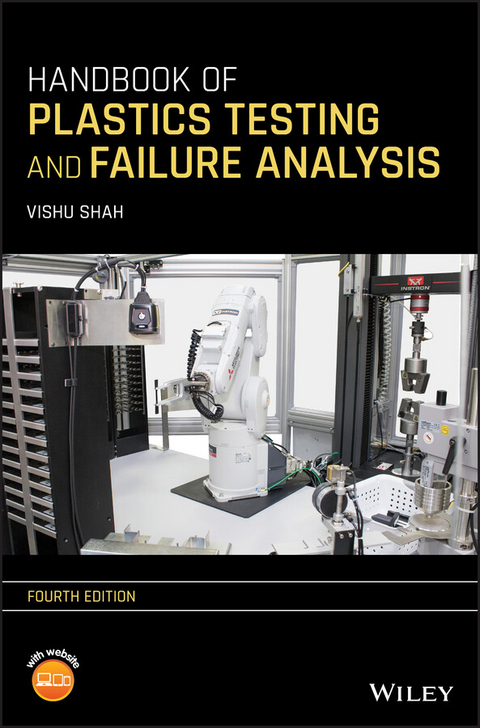
Handbook of Plastics Testing and Failure Analysis (eBook)
John Wiley & Sons (Verlag)
978-1-118-94363-2 (ISBN)
• Updates coverage of data analysis techniques and examples and expands coverage of failure analysis, key because of increased litigation related to product liability
• Overviews plastic testing methods and the framework to investigate causes of plastic part failure
• Provides a strong training resource and reference for product designers using plastics in their products
• Features a video tour of a plastics testing labroatory on a companion website and has a separate manual of problems and solutions that are appropriate for college professors using the book as a class textbook
VISHU SHAH is President of Consultek Consulting Group, a fully integrated management and technical consulting firm for the plastics and medical industry. His 45 years of extensive practical experience in plastics Industry includes positions as president and co-founder of Performance Engineered Products and Senior Plastics Engineer for Rain Bird Corporation and Nibco Inc. His areas of expertise include product design, processing, automation, materials, rapid prototyping, tooling, failure analysis and testing.
VISHU SHAH is President of Consultek Consulting Group, a fully integrated management and technical consulting firm for the plastics and medical industry. His 45 years of extensive practical experience in plastics Industry includes positions as president and co-founder of Performance Engineered Products and Senior Plastics Engineer for Rain Bird Corporation and Nibco Inc. His areas of expertise include product design, processing, automation, materials, rapid prototyping, tooling, failure analysis and testing.
Preface to the Fourth Edition vii
Preface to the Third Edition ix
Preface to the Second Edition xi
Preface to the First Edition xiii
Biography of Vishu Shah xv
About the Companion Website xvii
1 Basic Concepts and Advancement in Testing Technology 1
2 Mechanical Properties 17
3 Thermal Properties 93
4 Electrical Properties 117
5 Weathering Properties 139
6 Optical Properties 159
7 Material Characterization Tests 178
8 Flammability 220
9 Chemical Properties 252
10 Analytical Tests 260
11 Conditioning Procedures 270
12 Miscellaneous Tests 273
13 Identification Analysis of Plastic Materials 290
14 Testing of Cellular Plastics 308
15 Failure Analysis 328
16 Quality Control 397
17 Product Liabilities and Testing 432
18 Nondestructive Testing and Measurements 437
19 Professional and Testing Organizations 451
20 Uniform Global Testing Standards 458
Appendix A Index of Test Equipment Manufacturers 468
Appendix B Abbreviations: Polymeric Materials 475
Appendix C Glossary 477
Appendix D Trade Names 487
Appendix E Standards Organizations 491
Appendix F Links to Recommended Open Source for Quick Learning 496
Appendix G Web Resources 498
Appendix H Figure 15-5. New Application Checklist 500
Index 504
1
BASIC CONCEPTS AND ADVANCEMENT IN TESTING TECHNOLOGY
1.1. BASIC CONCEPTS
Not too long ago, the concept of testing was merely an afterthought of the procurement process. Now, however, with the advent of science and technology, the concept of testing is an integral part of research and development, product design, and manufacturing. The question that is often asked is, “why test?” The answer is simple. Times have changed. How we do things today is different. The emphasis is on automation, high production, and cost reduction. There is a growing demand for intricately shaped, high‐tolerance parts. Consumer awareness, a subject ignored by the manufacturers once upon a time, is now a major area of concern. Along with these requirements, our priorities have also changed. When designing a machine or a product, the priority in most cases is safety and health. Manufacturers and suppliers are now required to meet a variety of standards and specifications. Relying merely on experience and quality of workmanship is simply not enough. The following are some of the major reasons for testing:
- To prove design concepts
- To provide a basis for reliability
- Safety
- Protection against product liability lawsuits
- Quality control
- To meet standards and specifications
- To verify the manufacturing process
- To evaluate competitors’ products
- To establish a history for new materials
In the last three decades, just about every manufacturer has turned to plastics to achieve cost reduction, automation, and high yield. The lack of history, along with the explosive growth and diversity of polymeric materials, has forced the plastics industry into placing extra emphasis on testing and on developing a wide variety of testing procedures. Through the painstaking efforts of various standards organizations, material suppliers, and mainly the numerous committees of the ASTM International (ASTM), over 10,000 different test methods have been developed. Globalization has also dramatically influenced test method development, specifically through ISO TC61 on Plastics.
The need to develop standard test methods specifically designed for plastic materials originated for two main reasons. Initially, the properties of plastic materials were determined by duplicating the test methods developed for testing metals and other similar materials. The Izod impact test, for example, was derived from the manual for testing metals. Because of the drastically different nature of plastic materials, the test methods often had to be modified. As a result, a large number of nonstandard tests were written by various parties. As many as eight to ten distinct and separate test methods were written to determine the same property. Such a practice created chaos among developers of the raw materials, suppliers, design engineers, and ultimate end‐users. It became increasingly difficult to keep up with various test methods or to comprehend the real meaning of reported test values. The standardization of test methods acceptable to everyone solved the problem of communication between developers, designers, and end‐users, allowing them to speak a common language when comparing the test data and results. As plastic materials are introduced for use in more rigorous applications, such as structural components in automobiles in the form of high strength composites, the need for test methods that are applicable to these new applications will be important and lead to further development.
In spite of the standardization of various test methods, we still face the problem of comprehension and interpretation of test data by an average person in the plastics industry. This is due to the complex nature of the test procedures and the number of tests and testing organizations. The key to overcoming this problem is to develop a thorough understanding of what the various tests mean and the significance of the result to the application being considered (1). Unfortunately, the plastics industry has placed more emphasis on how and not enough on why, which is more important from the standpoint of comprehension of the test results and understanding the true meaning of the values. The lack of understanding of the real meaning of heat deflection temperature, which is often interpreted as the temperature at which plastic material will sustain static or dynamic load for a long period, is one such classic example of misinterpretation. In the chapters to follow, we concentrate on the significance, interpretation, and limitations of physical property data and test procedures. Finally, a word of caution: it is extremely important to understand that the majority of physical property tests are subject to rather large errors. As a general rule, the error of testing should be considered ±5 percent. Some tests are more precise than others. Such testing errors occur from three major areas: (1) material variation, (2) the basic test itself, (3) the operators conducting the tests, and (4) variations in the test specimens. While evaluating the test data and making decisions based on test data, one must consider the error factor to make certain that a valid difference in the test data exists (2).
1.2. SPECIFICATION AND STANDARDS
A specification is a detailed description of requirements, dimensions, materials, and so on. A standard is something established for use as a rule or a basis of comparison in measuring or judging capacity, quantity, content, extent, value, and quality.
A specification for a plastic material involves defining particular requirements in terms of density, tensile strength, thermal conductivity, and other related properties. The specification also relates standard test methods to be used to determine such properties. Thus, standard methods of test and evaluation commonly provide the bases of measurement required in the specification for needed or desired properties (3).
As discussed earlier, the ultimate purpose of a standard is to develop a common language, so that there can be no confusion or communication problems among developers, designers, fabricators, end‐users, and other concerned parties. The benefits of standards are innumerable. Standardization has provided the industry with such benefits as improved efficiency, mass production, superior quality goods through uniformity, and new challenges. Standardization has opened the door to international trade, technical exchanges, and the establishment of common markets. One can only imagine the confusion the industry would suffer without the specific definition of fundamental units of distance, mass, and time and without the standards of weights and measures fixed by the government (4).
Standards originate from a variety of sources. The majority of standards originate from the industry. The industry standards are generally established by voluntary organizations that make every effort to see that the standards are freely adopted and represent a general agreement. Some of the most common voluntary standards organizations are the ASTM International, the National Sanitation Foundation, the Underwriters Laboratories, the National Electrical Manufacturers Association, and the Society of Automotive Engineers. Quite often, the industry standards do not provide adequate information or are not suitable for certain applications, in which case private companies are forced to develop their standards. These company standards are generally adapted from modified industry standards.
The federal government is yet another major source of standardization activities. The standards and specifications related to plastics are developed by the U.S. Department of Defense and the General Services Administration under the common heading of Military Standards and Federal Standards, respectively.
After World War II, there was a tremendous increase in international trade. The International Standards Organization (ISO) was established for the sole purpose of international standardization. ISO consists of the national standards bodies of over 145 countries from around the world. The standardization work of ISO is conducted by technical committees established by the agreement of five or more countries. ISO’s Technical Committee 61 on plastics is among the most productive of all ISO committees.
1.3. PURPOSE OF SPECIFICATIONS
There are many reasons for writing specifications, but the major reason is to help the purchasing department purchase equipment, materials, and products on an equal basis. The specifications, generally written by the engineering department, allow the purchasing agent to meet requirements and ensure that the material received at different times is within the specified limits (5). The specifications are intended to ensure batch‐to‐batch uniformity, as well as remove confusion between the purchaser and supplier—we all know that more often than not, what is provided by the supplier is not what is expected by the purchaser.
1.4. BASIC SPECIFICATION FORMAT
Many guidelines and directives have been formulated for writing specifications. The specifications for materials should include the following:
- A descriptive title and designation
- A brief but all‐inclusive statement of scope
- Applicable documents
- A classification system
- Definitions of related terms
- Materials and manufacturing requirements
- Physical (property) requirements
- A sampling procedure
- Specimen preparation and...
| Erscheint lt. Verlag | 1.12.2020 |
|---|---|
| Sprache | englisch |
| Themenwelt | Naturwissenschaften ► Chemie ► Organische Chemie |
| Technik ► Maschinenbau | |
| Schlagworte | Industrial Engineering • Industrial Engineering / Manufacturing • Industrielle Verfahrenstechnik • Kunststoffverarbeitung • materials characterization • Materials Science • Materialwissenschaften • Plastics testing, product design, failure analysis, data analysis techniques, product liability, identification analysis • Polymer processing • Polymer Science & Technology • Polymertechnologie • Polymerverarbeitung • Polymerwissenschaft u. -technologie • Produktion i. d. Industriellen Verfahrenstechnik • Werkstoffprüfung |
| ISBN-10 | 1-118-94363-5 / 1118943635 |
| ISBN-13 | 978-1-118-94363-2 / 9781118943632 |
| Informationen gemäß Produktsicherheitsverordnung (GPSR) | |
| Haben Sie eine Frage zum Produkt? |
 EPUB (Adobe DRM)
Kopierschutz: Adobe-DRM
Adobe-DRM ist ein Kopierschutz, der das eBook vor Mißbrauch schützen soll. Dabei wird das eBook bereits beim Download auf Ihre persönliche Adobe-ID autorisiert. Lesen können Sie das eBook dann nur auf den Geräten, welche ebenfalls auf Ihre Adobe-ID registriert sind.
Details zum Adobe-DRM
Dateiformat: EPUB (Electronic Publication)
EPUB ist ein offener Standard für eBooks und eignet sich besonders zur Darstellung von Belletristik und Sachbüchern. Der Fließtext wird dynamisch an die Display- und Schriftgröße angepasst. Auch für mobile Lesegeräte ist EPUB daher gut geeignet.
Systemvoraussetzungen:
PC/Mac: Mit einem PC oder Mac können Sie dieses eBook lesen. Sie benötigen eine
eReader: Dieses eBook kann mit (fast) allen eBook-Readern gelesen werden. Mit dem amazon-Kindle ist es aber nicht kompatibel.
Smartphone/Tablet: Egal ob Apple oder Android, dieses eBook können Sie lesen. Sie benötigen eine
Geräteliste und zusätzliche Hinweise
Buying eBooks from abroad
For tax law reasons we can sell eBooks just within Germany and Switzerland. Regrettably we cannot fulfill eBook-orders from other countries.
aus dem Bereich