Bioplastics
Polymedia Publisher GmbH (Verlag)
978-3-9814981-4-1 (ISBN)
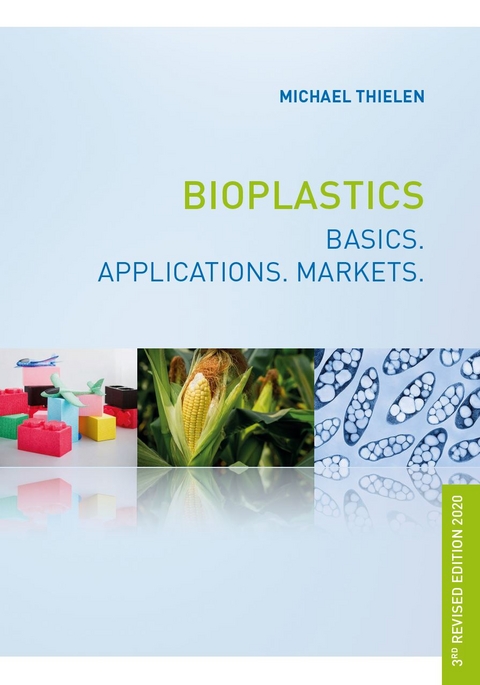
This book offers a short introduction into plastics and bioplastics, explaining which renewable resources can be used to produce bioplastics, what types of bioplastic exist, and which ones are currently on the market.
Chapters on applications, the market, end-of-life scenarios, political background and regulations, and the outlook for plastics round off the book.
1 Bioplastic - what is it exactly? 6
1.1 Fundamentals 6
1.2 Bioplastics 7
1.2.1 Biobased plastics 8
1.2.2 Biodegradable plastics 8
1.3 Biobased plastics - why? 10
2 Renewable resources 12
2.1 Introduction 12
2.2 Natural Polymers 12
2.2.1 Polysaccharides (carbohydrates) 12
2.2.2 Proteins 13
2.2.3 Lignin 13
2.2.4 Natural rubber 13
2.2.5 Other 13
2.3 Other biogenic materials 14
2.3.1 Plant oils 14
2.3.2 Monomers 14
3 Biobased plastics 16
3.1 Introduction 16
3.2 Biobased / partially biobased 19
3.3 Modified natural polymers 21
3.3.1 Thermoplastic starch 21
3.3.2 Cellulose-based plastics 22
3.3.3 Natural rubber and thermoplastic elastomers 24
3.3.4 Lignin-based plastics 26
3.3.5 Protein-based plastics 26
3.3.6 PHA 27
3.4 Synthesised biobased polymers from synthesised biobased monomers 30
3.4.1 Biobased polyesters 30
3.4.2 Biobased polyamides 36
3.4.3 Biobased polyurethane 38
3.4.4 Biobased polyacrylates 39
3.4.5 Biobased polyolefins 39
3.4.6 Biobased thermoset resins 41
3.4.7 Other biobased plastics 42
3.4.8 Bioplastics from waste 43
4 Methods of processing plastics 46
4.1 Introduction 46
4.2 Compounding 46
4.3 Further processing 47
4.3.1 Extrusion 47
4.3.2 Blown film extrusion 48
4.3.3 Injection moulding 49
4.3.4 Blow moulding 50
4.3.5 Thermoforming 52
4.3.6 Foams 52
4.3.7 Casting 54
4.3.8 Other plastic processing methods 54
4.3.9 Joining plastic together 55
5 Applications 56
5.1 Packaging 56
5.2 Catering 58
5.3 Horticulture and agriculture 59
5.4 Medicine and personal care 61
5.5 Consumer electronics 62
5.5 Automobile manufacture 63
5.6 Textiles 65
5.7 Other 66
6 End of Life / Disposal / Closed loops 68
6.1 Recycling 68
6.1.1 Material recycling 68
6.1.2 Chemical recycling 69
6.2 Composting 69
6.3 Energy recovery or thermal recycling 70
6.4 Land fill 71
6.5 Closed loops 72
7 The market 74
8 Potential and perspectives 78
8.1 Further developments 78
8.2 Do we in fact have enough agricultural land? 79
9 Legal and regulatory background 82
9.1 Standards and certification regarding “compostability” 82
9.2 The Packaging Ordinance 83
9.3 “Biobased” standards and certification 83
10 Suggested further reading 86
11 Sources of information on the Internet 88
12 List of references 90
Index 96
Preface Petroleum is not an inexhaustible resource, and it is becoming ever more expensive. Burning of petroleum products (including plastics) has an impact on climate change. Bioplastics can offer an alternative in this regard. Bioplastics are on the one hand biobased plastics (produced from renewable resources) and on the other hand may well be biodegradable plastics. Many bioplastics meet both of these criteria. This book is based on numerous articles in the bioplastics MAGAZINE trade publication as well as on various talks, presentations and university lectures that have been given by the author in recent years. It is intended to offer a rapid and uncomplicated introduction into the subject of bioplastics, and is aimed at all interested readers, in particular those who have not yet had the opportunity to dig deeply into the subject, such as students, those just joining this industry, and lay readers. It gives an introduction to plastics and bioplastics, explains which renewable resources can be used to produce bioplastics, what types of bioplastic exist, and which ones are already on the market. Further aspects, such as market development, the agricultural land required, and waste disposal, are also examined. An extensive index allows the reader to find specific aspects quickly, and is complemented by a comprehensive literature list and a guide to sources of additional information on the Internet. The author and the publishers express their thanks to all of the companies who have made it possible, through their advertisements, to publish this book at the lowest possible retail selling price. It should be made clear, however, that these companies have had no influence on the contents of the book. The author also expresses his thanks to the FNR (Agency for Renewable Resources) within then German Federal Ministry of Food, Agriculture and Consumer Protection for their support and excellent cooperation. Mönchengladbach, February 2012 Michael Thielen
1 Bioplastic - what is it exactly? 1.1 Fundamentals Plastics are organic polymers which can be processed in various different ways. Their technical properties, such as formability, hardness, elasticity, rigidity, heat resistance and chemical resistance, can be varied across a wide range by selecting the correct raw materials, manufacturing process, and additives. Plastics are lighter and more economic than many other materials. For these reasons, plus their extreme versatility and excellent processability, they are the material of choice in many industrial and commercial applications [1, 2]. Since the widespread availability of petroleum at the beginning of the 20th century most traditional plastics have been produced using petroleum. The statistics (2010 figures) are impressive: the plastics industry employs more than 1.6 million people in Western Europe and turns over some 300 billion Euros per annum. Out of the approximately 230 million tonnes of plastics produced annually worldwide about one quarter comes from Europe. Its applications are not only in packaging (40%), construction materials (20%), but plastic is also needed in automobile production (7%) and furniture manufacture, as well as in the electronics industry and in the manufacture of domestic equipment of all types [3]. Accordingly the demand for plastics continues to grow – for example demand in 1976 stood at 50 million tonnes worldwide, and by 2015 is expected to reach 330 million tonnes. But plastic isn‘t simply plastic. Whilst thermoset resins remain permanently in a rigid state after hardening, thermoplastics can be melted again, or reshaped by the application of heat. These thermoplastics are the most commonly used and hold an 80% share of the market. Another group of plastics covers the ductile plastics or thermoplastic elastomers [1]. 1.2 Bioplastics The widely used term “bioplastics” is not totally unambiguous and covers several groups of plastics. These on the one hand are biobased plastics (made from renewable resources) and on the other hand biodegradable plastics. Many bioplastics fall into both categories. (top right in Fig 1.1). The main focus in biobased plastics is the origin of the basic raw materials, i.e. renewable resources, in contrast to petroleum, which is a limited resource. Renewable resources are often referred to as RRs (or RRM for Renewable Raw Materials). Biodegradable plastics are classified according to the way in which they can be disposed of. These plastics are accessible to micro-organisms as a source of nutrition and energy, and the metabolic structure of the organisms means that they can break the material down into carbon dioxide (CO2), water and biomass (see also chapter1.2.2). Biobased plastics may or may not be biodegradable plastics. Biodegradable plastics may or may not be produced from renewable resources. In fact it is a general misconception that biobased plastics are automatically also biodegradable, and vice versa. Fig 1.1: Biobased und biodegradable plastics (according to [4]) 1.2.1 Biobased plastics Plastics basically consist of macromolecules that in general are made up of carbon (C), hydrogen (H) and other compounds such as oxygen, nitrogen etc. If the origin of the carbon/carbonates is from a fossil resource (petroleum, natural gas, coal) we talk about conventional, traditional or petroleum-based plastics. The carbon component in biobased plastics comes from current, rapidly renewable, resources. These may be fruits from various plants, or also so-called remnants such as stalks, leaves, etc. Even trash disposal routes such as communal waste water can be rich in current carbon substances so that they are basically suitable as a resource for biobased plastics. (cf. chapter. 3.3.6). The biobased plastics will be dealt with in detail more in this publication. 1.2.2 Biodegradable plastics A substance or a material is biodegradable if it is broken down by micro-organisms such as bacteria, protozoa, fungi, or enzymes. The micro-organisms use the substances as nutrients or a source of energy. The remainder of the broken down substance consists of carbon dioxide (CO2), water and mineral salts of other elements present (mineralisation), plus biomass [5]. A difference is made between aerobic degradation in the presence of oxygen, as is the case in a compost heap, and anaerobic degradation. In anaerobic degradation there is no oxygen present. In bio-gas plants for example, this type of degradation leads to the production of methane that can be captured in a controlled way and used for energy generation. The conversion of organic waste into bio-gas is also often referred to as anaerobic digestion (AD) [6].
| Erscheinungsdatum | 12.11.2020 |
|---|---|
| Verlagsort | Mönchengladbach |
| Sprache | englisch |
| Maße | 147 x 211 mm |
| Gewicht | 150 g |
| Einbandart | Paperback |
| Themenwelt | Sachbuch/Ratgeber ► Natur / Technik |
| Technik | |
| Schlagworte | biobased • biodegradable • Biokunststoff • Bioplastics • Climate • climate change • compost • compostable • crude oil • global warming • green house gas • Greenhouse Gas • green house gas effect • greenhouse gas effect • Kunststoff • mineral oil • Oil • Packaging • Petroleum • Plastic • renewable • renewable resources |
| ISBN-10 | 3-9814981-4-3 / 3981498143 |
| ISBN-13 | 978-3-9814981-4-1 / 9783981498141 |
| Zustand | Neuware |
| Informationen gemäß Produktsicherheitsverordnung (GPSR) | |
| Haben Sie eine Frage zum Produkt? |
aus dem Bereich