



Visible Words
A Study of Inscriptions In and As Books and Works of Art
Seiten
1969
Cambridge University Press (Verlag)
978-0-521-06534-4 (ISBN)
Cambridge University Press (Verlag)
978-0-521-06534-4 (ISBN)
- Titel erscheint in neuer Auflage
- Artikel merken
Zu diesem Artikel existiert eine Nachauflage
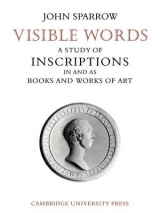
Mr Sparrow traces the development of the inscription as a literary form in Renaissance and post-Renaissance Europe. He attributes the Renaissance concern with the visual presentation of words to the profound interest in epigraphy aroused by the rediscovery of classical inscriptions.
Mr Sparrow traces the development of the inscription as a literary form in Renaissance and post-Renaissance Europe. He defines the 'literary' inscription as 'a text composed with a view to its being presented in lines of different lengths, the lineation contributing to or enhancing the meaning, so that someone who does not see it, actually or in the mind's eye, but only hears it read aloud, misses something of the intended effect'. Mr Sparrow attributes the Renaissance concern with the visual presentation of words to the profound interest in epigraphy aroused by the rediscovery of classical inscriptions. This interest was felt mainly by scholars and writers, but it extended to architects, painters, sculptors and designers of monuments - all of whom incorporated inscriptions in their work.
Mr Sparrow traces the development of the inscription as a literary form in Renaissance and post-Renaissance Europe. He defines the 'literary' inscription as 'a text composed with a view to its being presented in lines of different lengths, the lineation contributing to or enhancing the meaning, so that someone who does not see it, actually or in the mind's eye, but only hears it read aloud, misses something of the intended effect'. Mr Sparrow attributes the Renaissance concern with the visual presentation of words to the profound interest in epigraphy aroused by the rediscovery of classical inscriptions. This interest was felt mainly by scholars and writers, but it extended to architects, painters, sculptors and designers of monuments - all of whom incorporated inscriptions in their work.
Acknowledgements; List of illustrations; Preface; 1. The evolution of the inscription; 2. The inscription in Renaissance works of art; 3. The inscription as a literary form; 4. Conclusion; Index.
| Erscheint lt. Verlag | 2.11.1969 |
|---|---|
| Zusatzinfo | Worked examples or Exercises |
| Verlagsort | Cambridge |
| Sprache | englisch |
| Gewicht | 928 g |
| Themenwelt | Technik ► Architektur |
| ISBN-10 | 0-521-06534-8 / 0521065348 |
| ISBN-13 | 978-0-521-06534-4 / 9780521065344 |
| Zustand | Neuware |
| Informationen gemäß Produktsicherheitsverordnung (GPSR) | |
| Haben Sie eine Frage zum Produkt? |
Mehr entdecken
aus dem Bereich

aus dem Bereich
Grundlagen, Normen, Vorschriften
Buch | Hardcover (2024)
Springer Vieweg (Verlag)
CHF 219,95
Tragkonstruktion und Schichtaufbau
Buch | Hardcover (2024)
Birkhäuser (Verlag)
CHF 119,95
Arbeitsschritte - Fallbeispiele - Detailzeichnungen - Dokumente - …
Buch | Hardcover (2024)
DIN Media (Verlag)
CHF 92,40


