When Food Kills
Oxford University Press (Verlag)
978-0-19-852517-2 (ISBN)
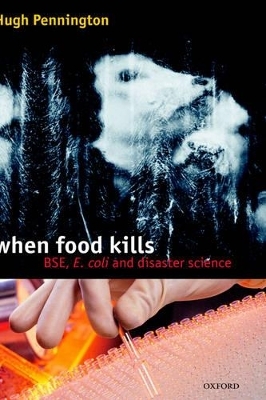
A unique feature of this book is its breadth since it covers history, politics and law as well as science. It also makes some fascinating connections, like those between 1930's nuclear physics, E.coli, and molecular biology, and the links between manslaughter in 19th century mental hospitals, syphilis, the Nobel Prize, and the prospects for successfully treating variant CJD. Royal murderers, vaccine research in Auschwitz and Buchenwald, and the race to develop the atom bomb appear as well.
For the general reader its non-technical but authoritative account of the science behind these tragedies, its critical appraisal of how the government responded to them, its coverage of public inquiries and its analysis of risk will be informative and stimulating. Scientists will find its approach to the prion theory and the origins of BSE challenging and controversial. Policy makers will find not only diagnoses of what went wrong in the past, but remedies ror the future.
Professor T.H. Pennington is Head of Department of Medical Microbiology, and a frequent commentator on radio and television where his opinion is sought on a wide range of infectious diseases ranging from necrotising fasciitis (the infamous and much-hyped flesh eating bacteria) to smallpox. His particular expertise lies in the science of food poisoning and the links between science, policy and the media. He is perhaps best known for the Pennington Group Report, on the circumstances leading to the 1996 outbreak of infection with E.coli O157 in Central Scotland. Pennington led the independent inquiry that was set up at the time, amidst a blaze of publicity.
1. E.coli O157, Central Scotland 1996 ; 2. Why disasters happen ; 3. Unlearned lessons ; 4. The inspectors fail ; 5. Inspectorates have limits ; 6. E.coli O157 ; 7. Other E.coli ; 8. CJD ; 9. The science of Transmissible Spongiform Encephalopathies (TSEs) ; 10. BSE ; 11. BSE - why things went wrong ; 12. Variant CJD - the future ; 13. The Precautionary Principle ; 14. BSE, vCJD and E.coli. The aftermath ; REFERENCES
| Erscheint lt. Verlag | 1.10.2003 |
|---|---|
| Zusatzinfo | numerous halftones and 6 line drawings |
| Verlagsort | Oxford |
| Sprache | englisch |
| Maße | 161 x 240 mm |
| Gewicht | 576 g |
| Themenwelt | Medizin / Pharmazie ► Medizinische Fachgebiete |
| Studium ► Querschnittsbereiche ► Epidemiologie / Med. Biometrie | |
| Studium ► Querschnittsbereiche ► Prävention / Gesundheitsförderung | |
| Technik ► Lebensmitteltechnologie | |
| ISBN-10 | 0-19-852517-6 / 0198525176 |
| ISBN-13 | 978-0-19-852517-2 / 9780198525172 |
| Zustand | Neuware |
| Informationen gemäß Produktsicherheitsverordnung (GPSR) | |
| Haben Sie eine Frage zum Produkt? |
aus dem Bereich