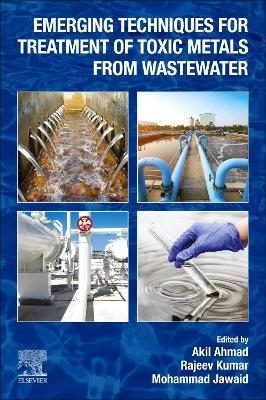
Emerging Techniques for Treatment of Toxic Metals from Wastewater
Elsevier Science Publishing Co Inc (Verlag)
978-0-12-822880-7 (ISBN)
Akil Ahmad is a Research Fellow at University of KwaZulu Natal, South Africa as Postdoctoral Fellow. He was previously Visiting Researcher of Chemical Engineering, Centre of Lipid Engineering and Applied Research, University Technology Malaysia (UTM), Malaysia. His research interest in the areas of environmental pollutants and their safe removal, synthesis of nanoparticles and Nano-sorbents (GO, CNT), photo-degradation and antimicrobial effects, preparation of various Chelating sorbents/adsorbent to prevent the environment, water and wastewater treatment, adsorption and ion-exchange, instrumental methods of analysis, thermodynamic and kinetic studies, and preconcentration and method validation with standard reference materials. Rajeev Kumar received a M.Sc. in Analytical Chemistry (2006), and M. Phil (2008) and Ph.D. degree in Applied Chemistry (2011) from Aligarh Muslim University, India. He is currently working as associate professor at the Environmental Science Department, King Abdulaziz University, Jeddah, Saudi Arabia. His research activities are in the areas of wastewater treatment and material science. Rajeev studies the adsorption and photocatalytic properties of the nanomaterials for the removal of contaminants from wastewater. He has published more than 50 research articles and chapters in the journals such as the Chemical Engineering Journal, Journal of Colloid and Interface Science, RSC Advances, Journal of Environmental Sciences, Journal of environmental management, Journal of Industrial and Engineering Chemistry, Desalination etc. Prof. Dr. Jawaid Mohammad is currently working as a distinguished professor in the Department of Chemical and Petroleum Engineering, College of Engineering, United Arab Emirates University, Al Ain, United Arab Emirates. He has more than 25 years of experience in teaching, research, and industries. His area of research interests includes hybrid composites, lignocellulosic reinforced/filled polymer composites, advance materials: graphene/nanoclay/fire retardant, modification and treatment of lignocellulosic fibers and solid wood, biopolymers and biopolymers for packaging applications, nanocomposites and nanocellulose fibers, and polymer blends. So far, he has published 100 books, more than 100 book chapters, more than 500 peer-reviewed international journal papers, and several published review papers under top 25 hot articles in science direct during 2013–2020. He also obtained 6 Patents and 6 Copyrights/Industrial design. H-index and citation in Scopus are 101 and 43525 and in Google scholar, and H-index and citation are 120 and 58132. 40 Ph.D. and 17 Master’s students graduated under his supervision in 2014–2024 in the fields of hybrid composites, green composites, nanocomposites, natural fiber-reinforced composites, nanocellulose, etc. He secured various research grants at university, national, and international levels on polymer composites of around USD 3 Million. He also delivered plenary and invited talks in international conferences related to composites in India, Turkey, Malaysia, Thailand, United Kingdom, France, Saudi Arabia, Egypt, China, Germany, Indonesia, Spain, UAE, Portagal, etc. Besides that, he is also a member of technical committees of several national and international conferences on composites and material science. He is founding Series Editor of Springer Three Book Series. He worked as guest editor of special issues of Several Peer reviewed Journals. Besides that, he is also reviewer of several high-impact international peer-reviewed journals of Elsevier, Springer, Wiley, Saga, ACS, RSC, Frontiers, etc. Dr. Mohammad Jawaid also received Several Award at National and International Level. He is also Winner of Newton-Ungku Omar Coordination Fund: UK-Malaysia Research and Innovation Bridges Competition 2015. He is also Professional membership of ACS, SPE, APA, MySET, etc. He is Fellow and Chartered Scientist of The Institute of Materials, Minerals & Mining (IOM3), UK. He is also Clarivate 1% Highly cited Researcher-2023.
Part One: General Introduction on remediation techniques
1. Introduction of adsorption techniques for heavy metals remediation
2. Membrane technology for separation of heavy metals: Electronic and mechanical properties
3. Photocatalytic reduction of toxic metals from wastewater
Part Two: Adsorption/Sorption Process
4. Amberlite XAD resins for separation and preconcentration of metal ions
5. Plant leaves waste for removal of metal ions
6. Use of fruit seeds for toxic metal removal
7. Metal oxide-based nanocomposites for removal of metal ions from wastewater
8. Carbon based nanocomposites for metal remediation from wastewater
9. Metal removal through efficient nanofibers adsorbent
10. Wood based adsorbents for removal of metal ions
11. Activated carbon as potential material for metal removal
12. Clay based adsorbent for wastewater treatment
13. Fruit peel used as effective materials for metal remediation from environment
Part Three: Membrane Technology
14. Graphene oxide-based Nano filtration membrane for separation of heavy metals
15. Use of PVDF membrane for wastewater purification
16. Polyethersulfone (PES) Nano filtration membrane for treatment of toxic metal contaminated water
17. Reverse osmosis for separation of water pollutants
18. New generation polymeric membrane for removal of heavy metals
19. Hydrophilic nanoparticles incorporation on PES membrane for metal rejection
20. Removal of metal ions using coagulation-microfiltration membrane
21. Potential use of ultrafiltration membrane for remediation of metal contaminants
22. Application and fabrication of nanofiltration membrane for separation of metal ions from wastewater
23. Micellar enhanced ultrafiltration (MEUF) for treatment of wastewater
Part Four: Photocatalytic reduction
24. Use of mesoporous TiO2 for photocatalytic reduction of metal contaminants
25. Metal oxide doped nanocomposites for reduction of metal ions
26. Photocatalytic oxidation for wastewater treatment
27. Photocatalytic reduction of highly toxic Lead and Cadmium from aqueous solution
28. Divalent metals reduction using Graphene based nanocomposites under UV-Vis irradiation
29. Polymer based nanocoposites for metal reduction from aqueous solution
30. Metal-organic framework for reduction of heavy metals
31. Use of Carbon based photocatalyst for metal removal
| Erscheinungsdatum | 04.10.2021 |
|---|---|
| Zusatzinfo | 270 illustrations (70 in full color); Illustrations |
| Sprache | englisch |
| Maße | 152 x 229 mm |
| Gewicht | 450 g |
| Themenwelt | Naturwissenschaften ► Biologie ► Mikrobiologie / Immunologie |
| Naturwissenschaften ► Chemie ► Technische Chemie | |
| Technik ► Umwelttechnik / Biotechnologie | |
| ISBN-10 | 0-12-822880-6 / 0128228806 |
| ISBN-13 | 978-0-12-822880-7 / 9780128228807 |
| Zustand | Neuware |
| Informationen gemäß Produktsicherheitsverordnung (GPSR) | |
| Haben Sie eine Frage zum Produkt? |
aus dem Bereich