Bioceramics (eBook)
468 Seiten
Elsevier Science (Verlag)
978-0-08-103000-4 (ISBN)
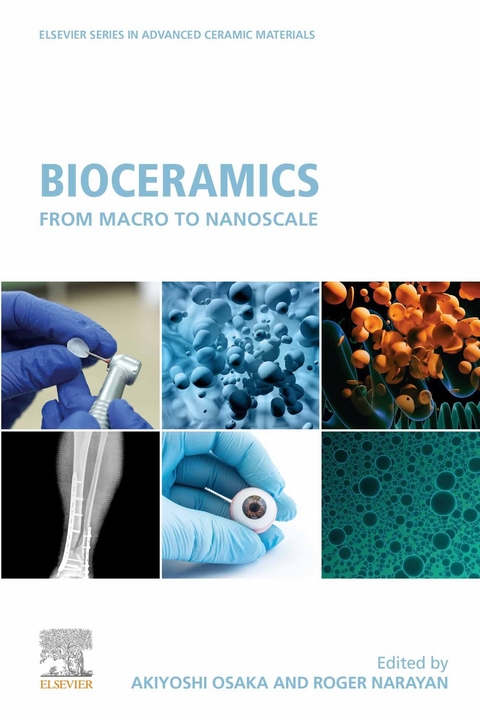
Biologically functional ceramic materials have been known about for several decades, like phosphate cements and gypsum, and they are within the zeroth generation. Modern and artificially synthesized bioceramics include amorphous materials in the Bioglass(R) family that were developed in the early 1970's and derivative glass ceramics such as Bioverit(R) and Cerabone A-W(R) that came in 1980's. They are from the 2nd generation of materials, and mostly applicable to bone replacement or bone defect fillers. Since the late 1990's, newer technologies have been introduced to the biologically functional material fields; they are the syntheses of organic-inorganic hybrids of micro- and macroscopic scales as well as nano-scales, organic fragment-covered ceramic particles of varied sizes, with light-controlling abilities to modify the frequency of light, in addition synthesis of high strength and high-tribological durability that had not been available before. With the advent of additive manufacturing technology employing lasers, electron beams, and printers, clinical materials of complicated porous structures are now easily prepared. These materials are of the 3rd generation. This book will cover almost all kinds of such 3rd generation ceramic and ceramic-related biomaterials. This book conveys the current state-of-the-art on the science and technology of bioceramics, from nano-size dots or particles to macro-scale architectures, of a wide range of constitutions including quantum dots with peptide fragments, meso-scale therapeutic particles designed to involve drugs or genes, mesoporous organic-inorganic hybrids, nano-structured oxide layers on metals and alloys. - Comprehensively covers all aspects (research/experimental and commercial products) related to the latest progresses in bioceramic science, technology and applications, with emphasis on nanobioceramics- Pulls together a broad range of materials, concepts, and technologies based on nanomaterials- Features novel preparation procedures like additive manufacturing (3-D printing and related techniques) that have also been introduced and practiced for forming complicated architectures- Features innovative 3rd generation ceramic and ceramic-related biomaterials
| Erscheint lt. Verlag | 13.9.2020 |
|---|---|
| Sprache | englisch |
| Themenwelt | Technik ► Maschinenbau |
| ISBN-10 | 0-08-103000-2 / 0081030002 |
| ISBN-13 | 978-0-08-103000-4 / 9780081030004 |
| Informationen gemäß Produktsicherheitsverordnung (GPSR) | |
| Haben Sie eine Frage zum Produkt? |
 EPUB (Adobe DRM)
Kopierschutz: Adobe-DRM
Adobe-DRM ist ein Kopierschutz, der das eBook vor Mißbrauch schützen soll. Dabei wird das eBook bereits beim Download auf Ihre persönliche Adobe-ID autorisiert. Lesen können Sie das eBook dann nur auf den Geräten, welche ebenfalls auf Ihre Adobe-ID registriert sind.
Details zum Adobe-DRM
Dateiformat: EPUB (Electronic Publication)
EPUB ist ein offener Standard für eBooks und eignet sich besonders zur Darstellung von Belletristik und Sachbüchern. Der Fließtext wird dynamisch an die Display- und Schriftgröße angepasst. Auch für mobile Lesegeräte ist EPUB daher gut geeignet.
Systemvoraussetzungen:
PC/Mac: Mit einem PC oder Mac können Sie dieses eBook lesen. Sie benötigen eine
eReader: Dieses eBook kann mit (fast) allen eBook-Readern gelesen werden. Mit dem amazon-Kindle ist es aber nicht kompatibel.
Smartphone/Tablet: Egal ob Apple oder Android, dieses eBook können Sie lesen. Sie benötigen eine
Geräteliste und zusätzliche Hinweise
Buying eBooks from abroad
For tax law reasons we can sell eBooks just within Germany and Switzerland. Regrettably we cannot fulfill eBook-orders from other countries.
aus dem Bereich