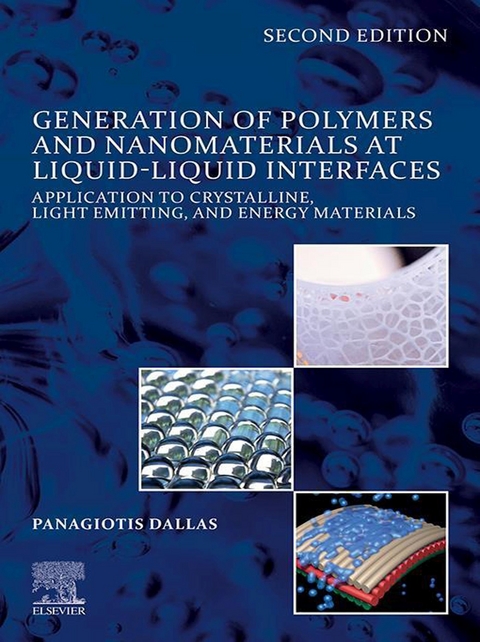
Generation of Polymers and Nanomaterials at Liquid-Liquid Interfaces (eBook)
224 Seiten
Elsevier Science (Verlag)
978-0-12-819505-5 (ISBN)
Dr. Panagiotis Dallas is a Principal Investigator and Hellenic Foundation for Research and Innovation Fellow at the Institute of Nanoscience and Nanotechnology, National Centre of Scientific Research 'Demokritos, Greece. He has previously held roles as Lecturer and Postdoctoral Research Assistant at the Department of Materials, Oxford University, United Kingdom, as well as Postdoctoral Research Assistant at Cornell University, USA. Dr. Dallas's main research interests are in the chemical synthesis of polymers, inorganic and carbon nanomaterials, photophysical and photosensitization properties of materials, and carbon dioxide sequestration and reduction. He has been involved in major collaborations with industrial partners and has published 37 articles and book chapters to date."
Generation of Polymers and Nanomaterials at Liquid-Liquid Interfaces: Application to Crystalline, Light Emitting, and Energy Materials, Second Edition is an innovative guide to the synthesis and processing of materials through liquid-liquid interfaces. This second edition has been revised and expanded, with a new chapter on light emitting materials and increased emphasis towards applications. The book aims to highlight the versatility of the interface between two liquids, providing a unique environment for synthesizing materials with highly tuned, desirable properties. In this revised and expanded second edition, the advanced applications of the synthesized materials and the two-phase systems are highlighted, with real potential within flexible electronics, energy storage, enhanced oil recovery, and sensors. This is supported by detailed coverage of interfacial processes and the fundamental physical chemistry behind them. The first two chapters provide an overview of interfaces in natural and biological systems, and outline the fundamental properties of the interface. Chapters 3 and 4 are devoted to the synthesis and self-organization of nanoparticles and polymers through interfacial systems. The synthesis of conductive, fluorescent and conventional polymers and their properties are extensively covered. Chapters 5 and 6 focus on novel applications. This book is of interest to researchers, scientists, and advanced students, in polymer synthesis, polymer chemistry, polymer science, nanomaterials and nanotechnology, polymer composites, materials science, energy, flexible electronics, and chemical engineering. In industry, this supports scientists, R&D, and other professionals, working with polymeric materials for applications in energy, electronics, sensors, and oil & gas. - Provides new ideas for the design of fluorescent polymers, conductive polymers, nanoparticle arrays, thin films, and novel 2D materials- Includes detailed coverage of synthesis and processing of polymers and nanomaterials at liquid-liquid interfaces- Explores state-of-the-art applications across flexible electronics, energy storage, enhanced oil recovery, and sensors
| Erscheint lt. Verlag | 28.7.2020 |
|---|---|
| Sprache | englisch |
| Themenwelt | Naturwissenschaften ► Chemie ► Physikalische Chemie |
| Naturwissenschaften ► Physik / Astronomie ► Festkörperphysik | |
| Technik ► Maschinenbau | |
| Wirtschaft | |
| ISBN-10 | 0-12-819505-3 / 0128195053 |
| ISBN-13 | 978-0-12-819505-5 / 9780128195055 |
| Informationen gemäß Produktsicherheitsverordnung (GPSR) | |
| Haben Sie eine Frage zum Produkt? |
 EPUB (Adobe DRM)
Kopierschutz: Adobe-DRM
Adobe-DRM ist ein Kopierschutz, der das eBook vor Mißbrauch schützen soll. Dabei wird das eBook bereits beim Download auf Ihre persönliche Adobe-ID autorisiert. Lesen können Sie das eBook dann nur auf den Geräten, welche ebenfalls auf Ihre Adobe-ID registriert sind.
Details zum Adobe-DRM
Dateiformat: EPUB (Electronic Publication)
EPUB ist ein offener Standard für eBooks und eignet sich besonders zur Darstellung von Belletristik und Sachbüchern. Der Fließtext wird dynamisch an die Display- und Schriftgröße angepasst. Auch für mobile Lesegeräte ist EPUB daher gut geeignet.
Systemvoraussetzungen:
PC/Mac: Mit einem PC oder Mac können Sie dieses eBook lesen. Sie benötigen eine
eReader: Dieses eBook kann mit (fast) allen eBook-Readern gelesen werden. Mit dem amazon-Kindle ist es aber nicht kompatibel.
Smartphone/Tablet: Egal ob Apple oder Android, dieses eBook können Sie lesen. Sie benötigen eine
Geräteliste und zusätzliche Hinweise
Buying eBooks from abroad
For tax law reasons we can sell eBooks just within Germany and Switzerland. Regrettably we cannot fulfill eBook-orders from other countries.
aus dem Bereich